What Are Rare Earth Metals and Why Are They in Everything?
Your phone's vibration motor, the magnet in your electric car's engine, the phosphors that make your screen glow — all of them depend on a group of 17 elements most people couldn't name if their lives depended on it. Rare earth metals are quietly embedded in nearly every piece of modern technology, yet they remain almost completely invisible to the people using them. That invisibility is part of what makes them so strategically important — and so politically explosive.

What Are Rare Earth Metals, Actually?
The 17 Elements Nobody Talks About
Rare earth metals — formally called rare earth elements, or REEs — are a set of 17 metallic elements. Fifteen of them belong to the lanthanide series on the periodic table, plus scandium and yttrium, which behave similarly and get lumped in by convention. Names like neodymium, dysprosium, lanthanum, and cerium show up constantly in materials science, but almost never in everyday conversation.
Here's the counterintuitive part: most of them aren't actually rare. Cerium, for example, is more abundant in the Earth's crust than copper. The 'rare' label comes from 18th-century mineralogy, when these elements were first isolated from uncommon mineral samples and the name stuck. What's genuinely rare is finding them in concentrations high enough to mine economically — they tend to be scattered thinly and mixed together, which makes extraction complicated and expensive.
Why They're Chemically Unusual
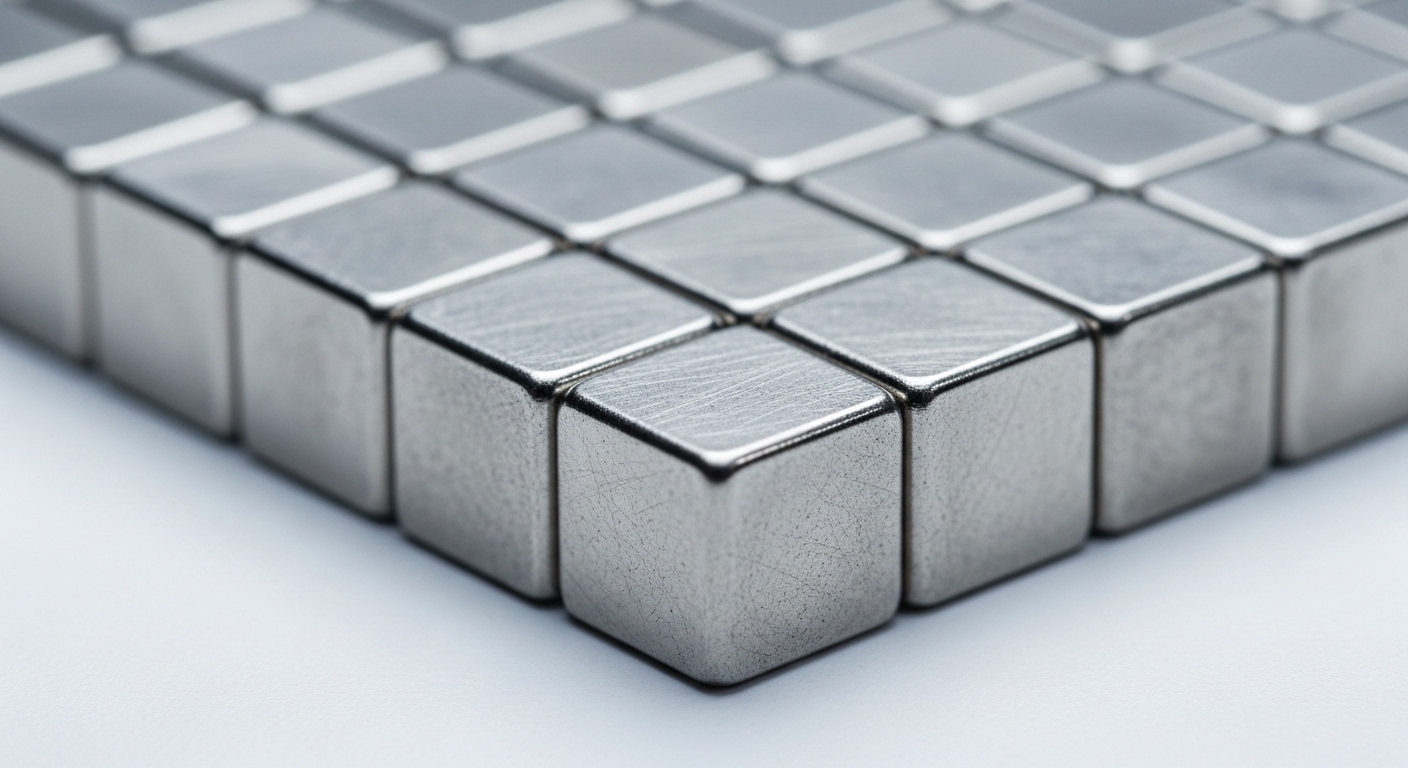
What makes rare earths special isn't abundance — it's behavior. Their electron configurations give them magnetic, luminescent, and catalytic properties that other elements simply don't replicate. Neodymium, for instance, produces the strongest permanent magnets known to science when alloyed with iron and boron. No substitute comes close in terms of the strength-to-size ratio those magnets achieve.
That specificity is the whole problem. You can't just swap in a different material when supplies get tight. The physics won't cooperate.
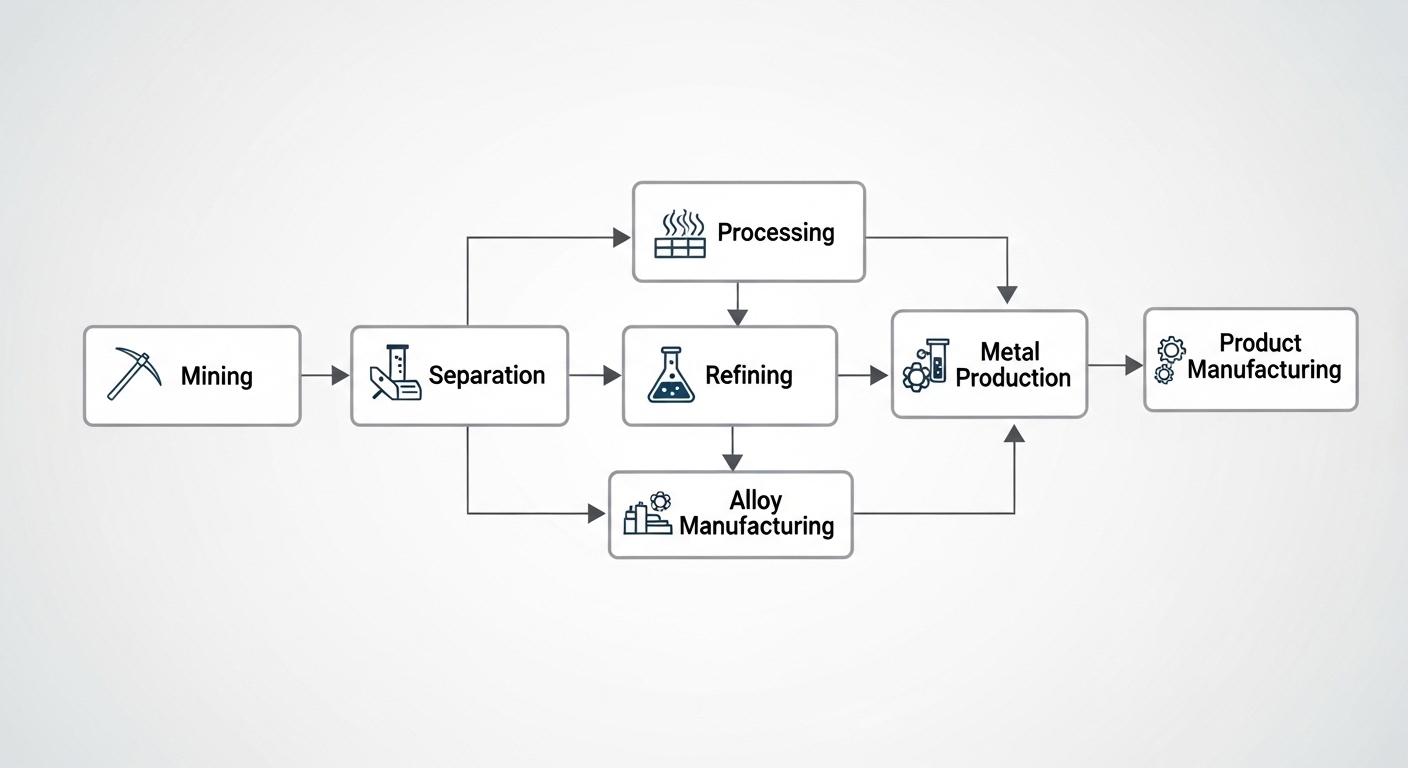
How Rare Earth Metals Actually Get From the Ground Into Your Devices
Mining and Separation — the Hard Part
The extraction process is genuinely messy. Rare earth ores typically contain multiple elements mixed together, and separating them requires a technique called solvent extraction — essentially washing the ore through a long series of chemical baths, each one pulling out slightly different elements. A single separation facility might run ore through hundreds of sequential stages. It's slow, chemically intensive, and generates significant waste, including low-level radioactive material because rare earth deposits often contain thorium and uranium as byproducts.
This is one reason why environmental regulations in many countries made domestic rare earth production economically unviable for decades. The chemistry works, but cleaning up after it is costly.
China's Grip on the Supply Chain
China currently produces the vast majority of the world's refined rare earth materials — estimates consistently place it above 85% of global processing capacity, even if raw ore comes from other countries. This isn't an accident. Starting in the 1980s, China made a deliberate strategic decision to develop rare earth processing infrastructure at scale, accepting the environmental costs that other nations weren't willing to absorb. Deng Xiaoping reportedly said that the Middle East had oil, but China had rare earths — and that framing turned out to be prescient.
China didn't just mine rare earths — it built the processing infrastructure the rest of the world quietly outsourced, and that decision took decades to notice.
The Mountain Pass mine in California was once the world's largest rare earth operation. It shut down in the early 2000s, largely because it couldn't compete with Chinese pricing, and its wastewater pipeline had leaked radioactive slurry into the Mojave Desert. It reopened years later under new ownership, but still ships much of its ore to China for processing — because the separation infrastructure simply doesn't exist domestically at scale.
Where Rare Earth Metals Actually Show Up in Modern Technology
Electric Vehicles and Wind Turbines
The green energy transition runs on rare earths in ways that rarely get acknowledged in climate conversations. A single electric vehicle motor can contain several kilograms of neodymium-iron-boron magnets. Offshore wind turbines — particularly the direct-drive designs that don't require a gearbox — use even larger quantities of these permanent magnets per unit. The irony is sharp: decarbonizing the economy requires dramatically scaling up mining of materials whose extraction carries real environmental costs.
This doesn't mean EVs or wind power are net negatives — lifecycle analyses consistently show they're not. But the supply chain assumptions embedded in most green energy forecasts deserve more scrutiny than they usually get.
Consumer Electronics and Defense Systems
Europium and terbium produce the red and green phosphors in display screens. Lanthanum goes into camera lenses and night-vision optics. Erbium is doped into fiber optic amplifiers to boost signal over long distances. Your phone's speaker uses a rare earth magnet. So does the hard drive in your laptop, the autofocus motor in your camera, and the guidance system in a precision-guided munition.
That last application is why the U.S. Department of Defense has flagged rare earth supply chains as a national security concern. Military hardware depends on these materials at every level, from jet engine alloys to sonar transducers.
A single F-35 fighter jet contains roughly 900 pounds of rare earth materials — which means every advanced weapons program runs on the same supply chain as your noise-canceling headphones.

Why the Rare Earth Supply Problem Is Harder to Solve Than It Looks
The Substitution Problem
The obvious question is: why not just find substitutes? Researchers have been working on this for years. Some progress exists — certain motor designs can use ferrite magnets instead of neodymium magnets, at the cost of size and efficiency. But for high-performance applications like EV traction motors or miniaturized consumer electronics, no substitute currently matches the performance of rare earth-based materials. The physics keeps winning.
Recycling is another avenue. Rare earth recovery from end-of-life electronics is technically possible but remains economically marginal. The concentrations in individual devices are small, collection infrastructure is fragmented, and the separation chemistry is just as complex on the recycling end as on the mining end. Progress is happening, but slowly.
Geopolitics and the Race to Diversify
Several countries have moved aggressively to develop alternative supply chains. Australia's Lynas Rare Earths operates one of the few significant rare earth processing facilities outside China. Canada, Greenland, and parts of Africa hold substantial deposits that are attracting investment. The U.S. has funded domestic processing capacity through legislation passed in the early 2020s, with some facilities now coming online.
But building a rare earth processing plant from scratch takes years and substantial capital. The chemical expertise, the environmental permitting, the workforce — none of it materializes quickly. Anyone who assumed supply chain diversification was a short-term fix underestimated the depth of the dependency that built up over three decades.
(Opinion: The rare earth situation is a case study in how democracies tend to optimize for short-term cost efficiency and then discover, too late, that they've traded away strategic resilience. The warning signs were visible for years before anyone treated them as urgent.)
Frequently Asked Questions
Are rare earth metals actually rare?
Most of them aren't rare in terms of crustal abundance — cerium is more common than copper, and even the least abundant rare earths are more plentiful than gold. What's rare is finding them in economically mineable concentrations. They tend to be dispersed thinly through rock and mixed with each other, making extraction and separation technically demanding and expensive.
Could we run out of rare earth metals?
Depletion isn't the near-term concern — known deposits are substantial, and new ones are being identified regularly, including on the ocean floor. The real constraint is processing capacity and geopolitical concentration, not geological scarcity. If supply chains diversify and recycling scales up, physical shortage becomes less likely over time. The bottleneck is infrastructure and politics, not the ground itself.
Why can't manufacturers just design products that don't use rare earths?
For some applications, they can — and engineers do try. But rare earth magnets and phosphors often provide performance characteristics that no alternative currently matches at the same size and weight. In applications where compactness and efficiency are critical, like EV motors or miniaturized electronics, substitutes typically require larger, heavier, or less efficient designs. The engineering tradeoffs are real, not just a matter of industry inertia.
The deepest oddity about rare earth metals is that their strategic importance grew almost entirely in the dark. Decades of consumer electronics, defense procurement, and energy policy were built on a supply chain that most decision-makers never examined closely — because the materials were cheap, the products worked, and nobody asked where the neodymium came from. The asking is happening now, loudly, but the infrastructure gap that opened over thirty years doesn't close in a budget cycle or two. Every EV rolling off an assembly line today is still, in all likelihood, running on magnets processed in the same country that supplied them a decade ago.



Comments
Post a Comment