How Do Private Search Engines Work? A Simple Explainer
Every time you search on a mainstream engine, that query gets logged, timestamped, and tied to a profile that knows your location, device, browsing history, and sometimes your real name. Private search engines exist specifically to break that chain — but the way they actually do it is more technically interesting than most people realize.

What Is a Private Search Engine, Really?
More Than Just 'No Cookies'
A private search engine is a search tool that deliberately avoids collecting personally identifiable information about the people using it. That means no persistent user profiles, no search history stored against your account, and no behavioral data sold to advertisers. The goal is simple: you ask a question, you get an answer, and the engine forgets you ever existed.
The phrase 'private search' gets used loosely, though. Some engines are genuinely privacy-first by architecture. Others are just mainstream engines with a thin privacy wrapper bolted on — which is a meaningful difference, not a marketing one. Knowing which is which requires understanding what happens under the hood.
Here's the counterintuitive part: most private search engines don't actually crawl the web themselves. They rely on the same underlying index data that the big players use — they just strip out the identifying layer before your query ever reaches that index.

How Do Private Search Engines Actually Work? The Proxy Model Explained
The Middleman Architecture
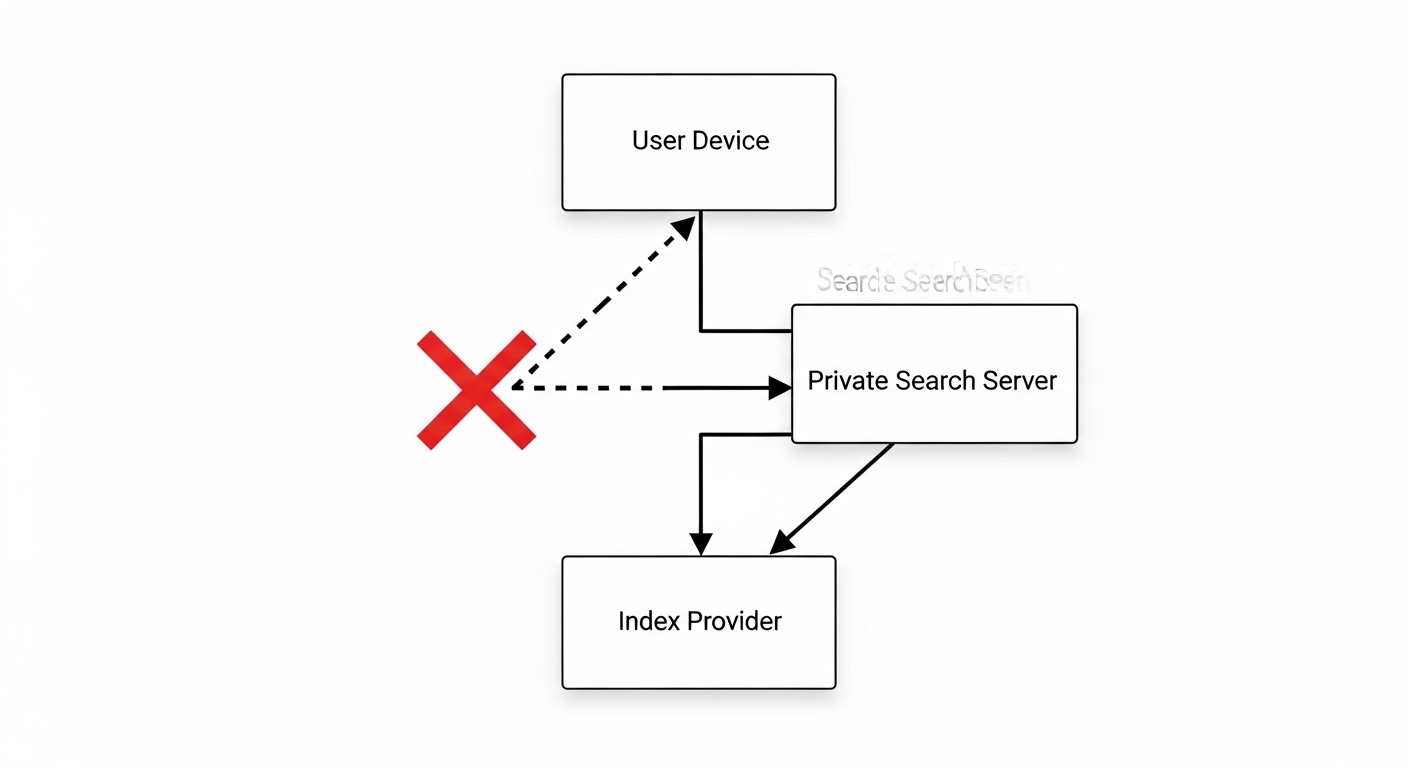
The dominant technical approach is called the proxy model. When you type a query into a private search engine, that engine strips your IP address, removes any identifying headers from the HTTP request, and then forwards a 'clean' version of your query to a larger index provider — often Bing, Google, or a combination of sources. The results come back to the private engine's servers, get reformatted, and are then delivered to you.
From the index provider's perspective, the request came from the private search engine's servers, not from you personally. Your IP address never touches Bing's or Google's infrastructure directly. That's the core privacy guarantee — and it's a real one, as long as the private engine itself isn't logging what it proxies.
The proxy model doesn't make your search invisible — it shifts who can see it. You're trusting the private engine instead of the index giant.
What Gets Stripped, and When
Before forwarding your query, a well-designed private engine removes your IP address, user-agent string (which can identify your browser and OS), and any cookies or session tokens. Some engines also add a small amount of noise — slightly rephrasing queries or batching them with other users' requests — to make individual queries harder to isolate even at the infrastructure level.
DuckDuckGo, one of the most widely used private search engines, uses this proxy approach and has published relatively detailed documentation about what it does and doesn't collect. It does store aggregate, non-personal search data for improving results, but not individual query logs tied to identifiers. That distinction matters enormously in practice.
How Private Search Engines Make Money Without Selling Your Data
Contextual Ads vs. Behavioral Ads
This is the question most people forget to ask. If a private search engine isn't selling your profile to advertisers, how does it pay its server bills? The answer is contextual advertising — ads matched to the words in your current query, not to a profile built from months of your behavior.
If you search for 'best hiking boots,' you'll see ads for hiking boots. Not because the engine knows you've been researching outdoor gear for three weeks, but simply because the words in your query right now suggest you might want hiking boots. It's a much older model of advertising — closer to a newspaper ad than a surveillance system.
Some private engines also offer paid subscription tiers, browser extensions with additional features, or licensing deals with device manufacturers. Brave Search, for instance, has built its own independent web index — a genuinely expensive undertaking — and funds it partly through its broader browser ecosystem.
Contextual advertising is essentially the pre-surveillance internet model. It turns out it still works well enough to run a search engine on.
The Independent Index Problem
Building a full web index from scratch is staggeringly expensive. You need to crawl billions of pages continuously, store petabytes of data, and maintain infrastructure that can answer millions of queries per second. Google has spent decades and hundreds of billions of dollars on this. Most private search engines simply cannot replicate it.
This is why the proxy model dominates. Brave Search is a notable exception — it has invested heavily in building its own independent index, which means it doesn't have to route your query through Bing at all. That's a stronger privacy guarantee architecturally, but it also means the results can sometimes feel less comprehensive for niche queries.

Where Private Search Engines Still Fall Short
The Browser and Network Layer Problem
Switching to a private search engine is a meaningful step, but it doesn't make your entire browsing session private. Your internet service provider can still see which websites you visit after clicking a search result. Your browser may still be sending telemetry data to its developer. And if you're logged into any Google or Meta service in another tab, those companies have other ways to track your activity that have nothing to do with which search engine you used.
Anyone who has ever switched to a private search engine and then noticed eerily relevant ads on social media a few minutes later has experienced this firsthand. The search was private; the rest of the session wasn't.
Metadata Leaks and Timing Attacks
Here's an operational detail that most casual explainers skip: even with a proxy model, the timing and volume of queries can theoretically be used to make inferences about user behavior. If a private search engine receives a burst of queries from the same IP address in a short window, a sophisticated observer watching network traffic could potentially correlate that pattern with a specific user — even without seeing the query content. This is called a timing attack, and it's a known limitation of the proxy architecture.
In practice, this threat is mostly relevant to high-risk users — journalists, activists, people in adversarial environments. For everyday privacy from ad networks and data brokers, the proxy model is more than adequate.
(Opinion: The gap between 'private search' and 'truly anonymous search' is wider than most marketing copy admits. Private search engines are a genuine improvement over the default, but treating them as a complete privacy solution is a mistake. They're one layer of a stack, not the whole stack.)
Frequently Asked Questions
Is using a private search engine the same as using incognito mode?
No — and this is one of the most common points of confusion. Incognito mode prevents your browser from saving your search history locally on your device. It does nothing to stop the search engine's servers, your ISP, or anyone watching your network traffic from seeing your queries. A private search engine addresses what happens on the server side; incognito addresses what's stored on your device. They solve different problems.
Can private search engines be forced to hand over user data to governments?
If a private search engine genuinely doesn't log queries tied to identifiers, there's nothing to hand over — which is the strongest legal protection possible. Some engines are also incorporated in jurisdictions with stronger data protection laws, which adds another layer. That said, if an engine does retain any logs, those can be subject to legal requests. The architecture matters more than the privacy policy.
Do private search engines give worse results than Google?
For common queries, the gap has narrowed considerably. Since many private engines pull from the same underlying index data as mainstream engines, the results for everyday searches are often nearly identical. Where you'll notice a difference is in highly localized searches, very recent news, or niche technical queries where Google's proprietary ranking signals and freshness algorithms still have a real edge.
The deeper implication of private search engines isn't really about search at all — it's about what the default internet would look like if surveillance weren't baked into the business model. Private search engines are a small but concrete proof that it's technically possible to answer a billion questions a day without building a dossier on every person asking them. Whether that model can scale to compete with the incumbents is a different question, and one that's still very much open.



Comments
Post a Comment