Front vs. Mid-Engine Cars: A Simple Explainer on Why Engine Placement Matters
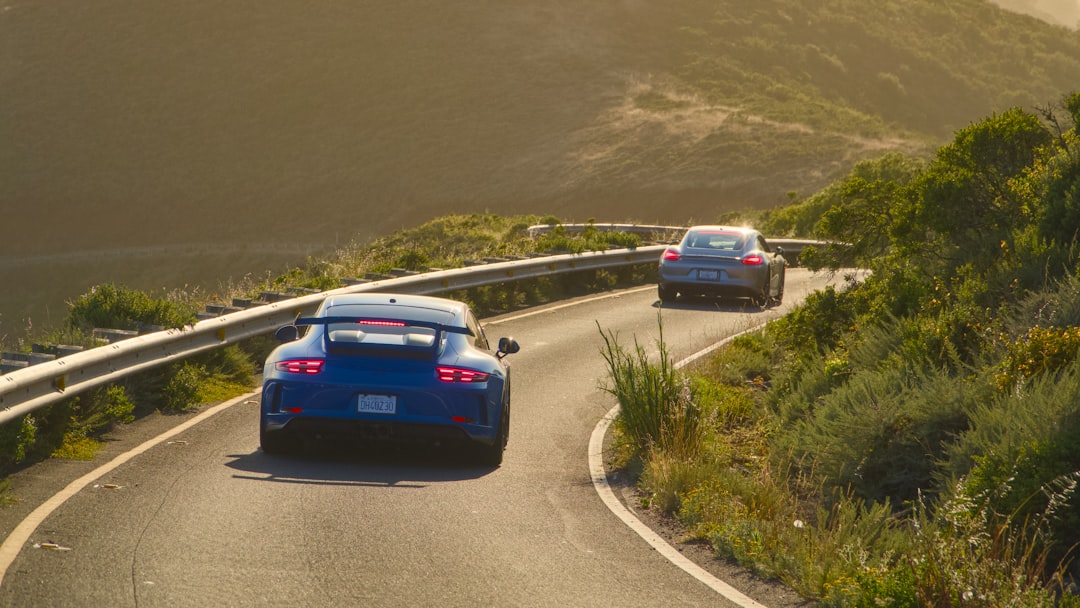
A Porsche 911 and a Ferrari 488 can both hit 60 mph in under four seconds, but they feel completely different to drive — and the biggest reason is where the engine sits. Engine placement is one of the most consequential engineering decisions in any car's design. It shapes how the car corners, how it crashes, how it feels at the limit, and even how much luggage you can carry. Most people never think about it until they drive something unusual and wonder why it feels so different.
| Option | Best For | Our Pick For Most Drivers |
|---|---|---|
| Front-Engine | Daily driving, practicality, predictable handling | Yes — for 90% of people |
| Mid-Engine | Track performance, balanced dynamics, driving purity | Only if driving feel is the priority |
What 'Engine Placement' Actually Means — and Why Engineers Care So Much
The Basic Definitions
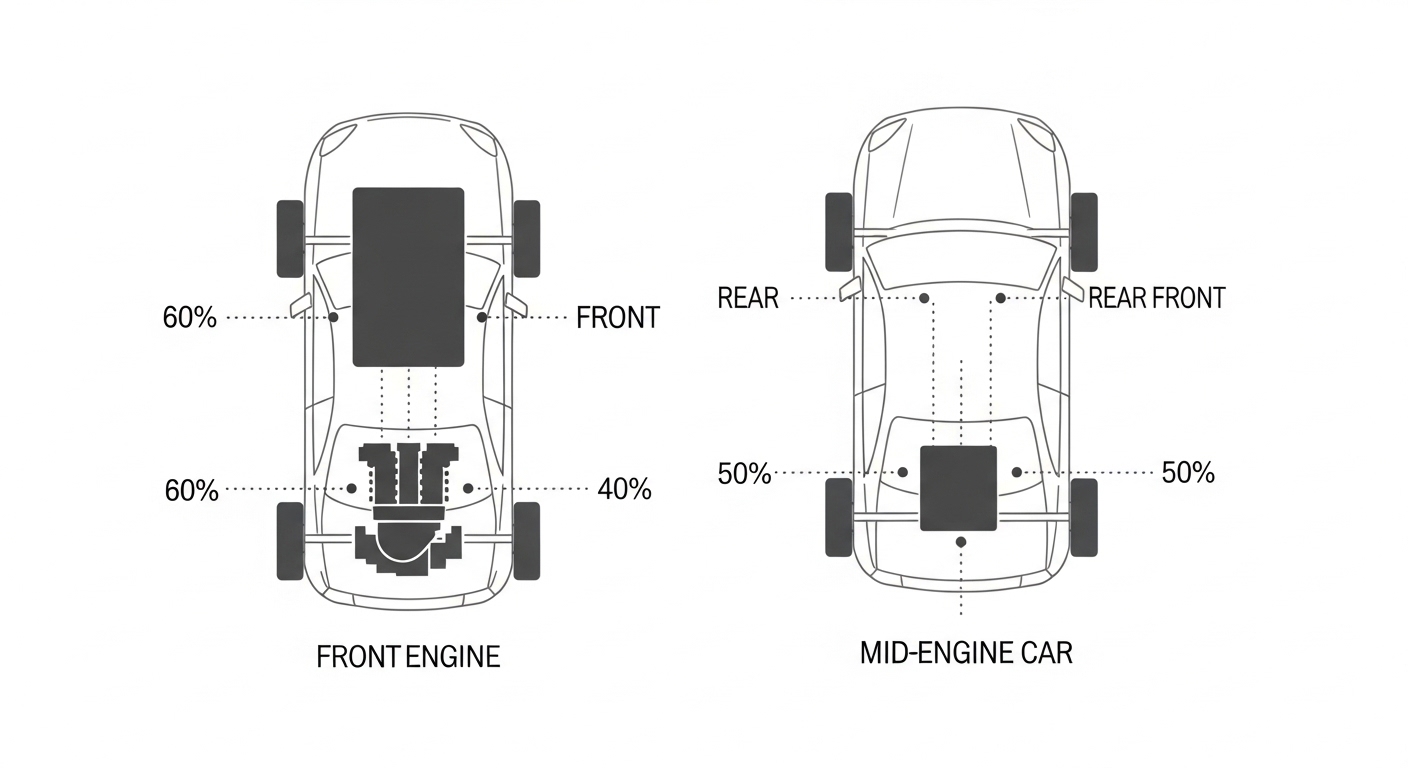
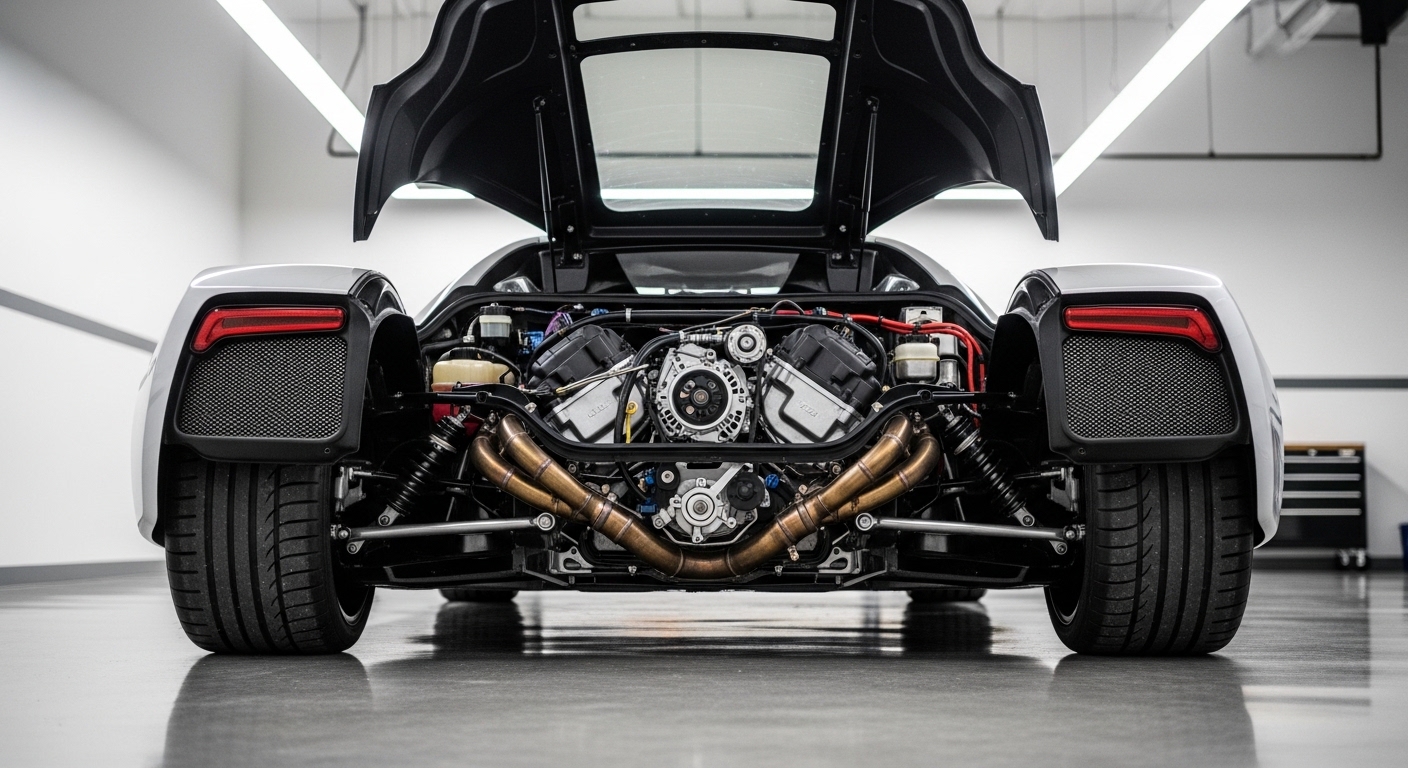
A front-engine car has its engine mounted ahead of the front axle or just behind it, over the front wheels. This is the layout you find in virtually every family sedan, SUV, and pickup truck on the road. A mid-engine car places the engine behind the driver but in front of the rear axle — tucked into the middle of the car's wheelbase, hence the name.
There is also a rear-engine layout, where the engine sits behind the rear axle entirely. The original Volkswagen Beetle and the Porsche 911 use this arrangement. It is worth distinguishing because rear-engine handling is its own strange beast — the 911's reputation for 'oversteer snap' at the limit comes directly from that heavy mass hanging behind the rear wheels.
Why Mass Location Changes Everything
The core physics concept here is polar moment of inertia — a measure of how hard it is to rotate an object around its center. A car with heavy components at its extremities (like a front engine and a rear gearbox) has a high polar moment. It resists changing direction but feels stable at highway speeds. A car with mass concentrated near its center has a low polar moment. It changes direction quickly and eagerly, which is great on a racetrack and occasionally terrifying on a wet road.
Polar moment of inertia is why a figure skater spins faster when they pull their arms in. The same principle decides whether your car feels like a scalpel or a barge in a corner.
Front-Engine Cars — The Deep Dive
Why Almost Every Car You Have Ever Owned Is Front-Engined
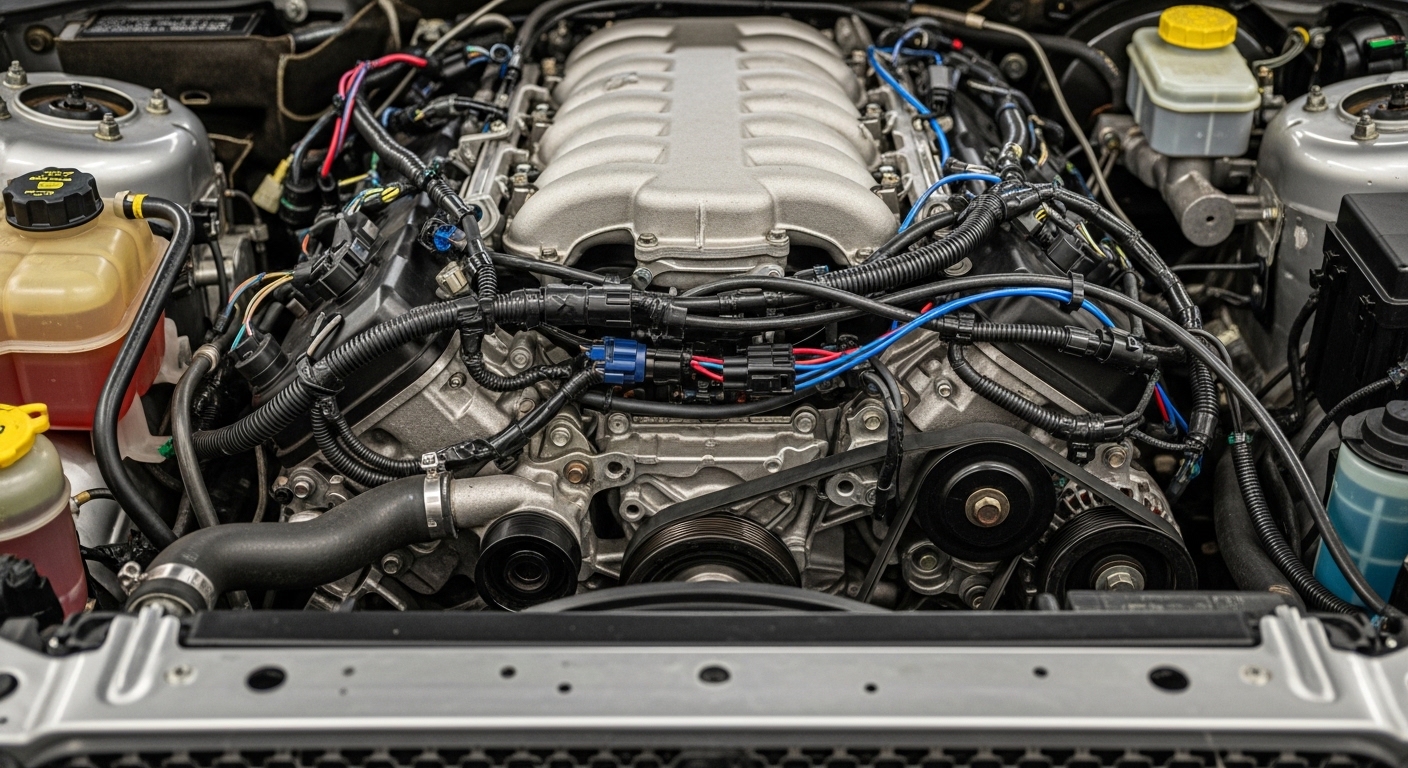
Front-engine layouts dominate the market for practical reasons that have nothing to do with performance. Packaging is simpler: the engine, transmission, and driven wheels can all be grouped together at the front, which is why front-wheel-drive cars are so cheap to manufacture and maintain. There is also more usable cabin space and a proper trunk in the rear. If you have ever tried to fit a stroller into a mid-engine sports car, you understand the trade-off immediately.
Crash safety is another underappreciated advantage. A long engine bay ahead of the occupants provides a substantial crumple zone. Modern front-engine cars are engineered so the powertrain deflects downward in a severe frontal impact rather than intruding into the cabin. This geometry is harder to achieve when the engine is directly behind the seats.
The Handling Compromise
The classic front-engine, rear-wheel-drive layout — think BMW 3 Series or a Ford Mustang — achieves a roughly 50/50 weight split and is widely considered the ideal balance for a performance road car. But most front-engine cars are front-wheel-drive, which means the front tires have to steer, drive, and brake simultaneously. Under hard acceleration, weight transfers rearward, reducing front grip exactly when you need it most. Anyone who has felt a front-wheel-drive car 'torque steer' under hard acceleration knows this sensation firsthand.
Understeer — where the front of the car pushes wide in a corner — is the characteristic handling trait of front-heavy cars. Engineers tune suspension and electronic stability systems to manage it, and most drivers never notice. But it is a real physical limitation that no amount of software can fully eliminate.
Mid-Engine Cars — The Deep Dive
Why Racers Figured This Out Decades Ago
Formula 1 cars moved to mid-engine layouts in the late 1950s and early 1960s, and the performance advantage was so obvious that front-engine racing cars essentially disappeared from top-level motorsport within a few years. The concentrated mass allowed faster direction changes, better traction under acceleration, and more predictable handling at the limit. Road car manufacturers noticed.
The Ferrari 308, the Lamborghini Countach, the original Acura NSX — all mid-engine. The NSX is a particularly interesting case because Honda engineers reportedly drove Ferrari and Porsche products extensively to understand what made them feel special, then set out to build something with that same mid-engine balance but without the temperamental reliability. The result was a car that genuinely surprised the supercar establishment when it launched.
The Real-World Catch
Mid-engine cars are genuinely harder to drive at the limit. With mass concentrated centrally, once the rear steps out, it can rotate quickly — more quickly than an inexperienced driver can catch. This is sometimes called 'snap oversteer,' and it has caught out more than a few confident drivers who assumed a supercar would be forgiving. Modern electronic stability systems have largely tamed this, but the underlying physics remain.
The packaging constraints are severe. There is no trunk in the traditional sense — most mid-engine cars offer a small front storage compartment (a 'frunk') and perhaps a shallow shelf behind the engine. Visibility rearward is often poor because the engine sits directly behind the driver's head. And servicing the engine typically requires removing bodywork, which makes routine maintenance more expensive.
A mid-engine car is not a front-engine car with better handling. It is a fundamentally different machine that happens to use the same roads.
Head-to-Head Feature Comparison
Where Each Layout Wins and Loses
| Feature | Front-Engine | Mid-Engine |
|---|---|---|
| Weight distribution | Often front-heavy (55–65% front) | Near 50/50 or slightly rear-biased |
| Handling character | Understeer tendency, predictable | Neutral to oversteer, agile |
| Cargo space | Full rear trunk, practical | Frunk only, very limited |
| Crash safety packaging | Long front crumple zone | Shorter front structure |
| Maintenance access | Easy, standard tooling | Complex, often requires bodywork removal |
| Manufacturing cost | Lower | Higher |
| Driver skill required | Low to moderate | Moderate to high (at the limit) |
| Rear visibility | Good to excellent | Often poor |
One detail that comparison tables rarely capture: mid-engine cars tend to have a very specific throttle-on-corner-exit feel that experienced drivers describe as uniquely satisfying. The rear tires are directly over the driven axle, so power translates to forward motion with almost no delay or body movement. It is a sensation that is genuinely hard to replicate in a front-engine car, regardless of how well-tuned the chassis is.
Which Layout Should You Actually Choose?
The Honest Decision Guide
If you are buying a car for any purpose that involves passengers, cargo, daily commuting, or a budget under roughly $60,000, a front-engine car is almost certainly the right answer. The layout has been refined over a century and modern examples are remarkably capable. A well-sorted front-engine sports car like a BMW M2 or a Porsche Cayman GT4 — wait, the Cayman is mid-engine — can be deeply satisfying without the packaging penalties.
The mid-engine layout makes sense if you are specifically buying a car for the driving experience and you are willing to accept the compromises. If you track your car, if you care about how a vehicle communicates through the steering wheel and seat, and if you have another car for grocery runs, a mid-engine machine rewards the investment in a way that is difficult to quantify but immediately obvious the first time you push it through a set of fast corners.
The Surprising Middle Ground
The Porsche 718 Cayman deserves a mention here because it sits in a genuinely unusual position: it is a mid-engine car priced within reach of serious enthusiasts, practical enough for occasional road trips, and widely considered by driving journalists to have better handling than the more famous 911 it shares a showroom with. The 911's rear-engine layout gives it more luggage space and a more comfortable ride, but the Cayman's mid-engine balance is technically superior for dynamic driving. Porsche has acknowledged this tension internally for decades.
(Opinion: The mid-engine layout is the more intellectually honest engineering choice for a sports car — it does not compromise the dynamics to accommodate luggage or a back seat. The fact that most manufacturers avoid it comes down to cost and market reality, not physics. If you are serious about driving, the layout matters more than the horsepower number.)FAQ
Is a mid-engine car always faster than a front-engine car?
Not automatically. Straight-line speed depends mostly on power-to-weight ratio, not engine placement. Where mid-engine cars have a measurable advantage is in cornering speed and lap times on a circuit, because the balanced weight distribution allows higher cornering forces and more predictable behavior at the limit. A powerful front-engine car can absolutely be quicker in a straight line than a mid-engine car with a smaller engine.
Why do most everyday cars use a front-engine layout?
Cost, packaging efficiency, and safety. Grouping the engine, transmission, and driven wheels at the front simplifies manufacturing and reduces the number of components needed. It also creates a natural crumple zone ahead of the occupants. The front-engine layout is not the best for pure driving dynamics, but it is the most practical solution for a car that needs to carry four people, their luggage, and survive a parking lot.
Can a front-engine car handle as well as a mid-engine car?
With enough engineering effort, a front-engine car can get very close — but there are physical limits. The front-engine, rear-wheel-drive layout with a 50/50 weight split (like a BMW M3 or a Corvette) comes closest. However, the higher polar moment of inertia means the car will always feel slightly less agile in direction changes compared to a well-sorted mid-engine design. Electronics can mask the difference in everyday driving, but at the limit on a track, the gap becomes apparent.
Engine placement is one of those engineering decisions that ripples through every other aspect of a car's design — the way the hood slopes, where the fuel tank goes, how the suspension geometry is set up, even how the car sounds from inside the cabin. Most drivers will spend their entire lives in front-engine cars and never feel like they are missing anything. But the mid-engine layout exists as a reminder that the 'normal' way of doing something is often just the convenient way, not the best way — and that distinction has a way of mattering more than expected once you have felt it for yourself.



Comments
Post a Comment