Living on Mars Time: How NASA Scientists Adapt to a 24.6-Hour Day
During the first weeks of the Mars Pathfinder mission in 1997, scientists at NASA's Jet Propulsion Laboratory started showing up to work in the middle of the night, eating breakfast at 3 a.m., and wearing blackout curtains over their office windows. They weren't pulling all-nighters. They were living on Mars time — and it was quietly dismantling their bodies' sense of when day and night were supposed to happen.
Background and Context: Why Mars Time Exists at All
The 39-Minute Problem
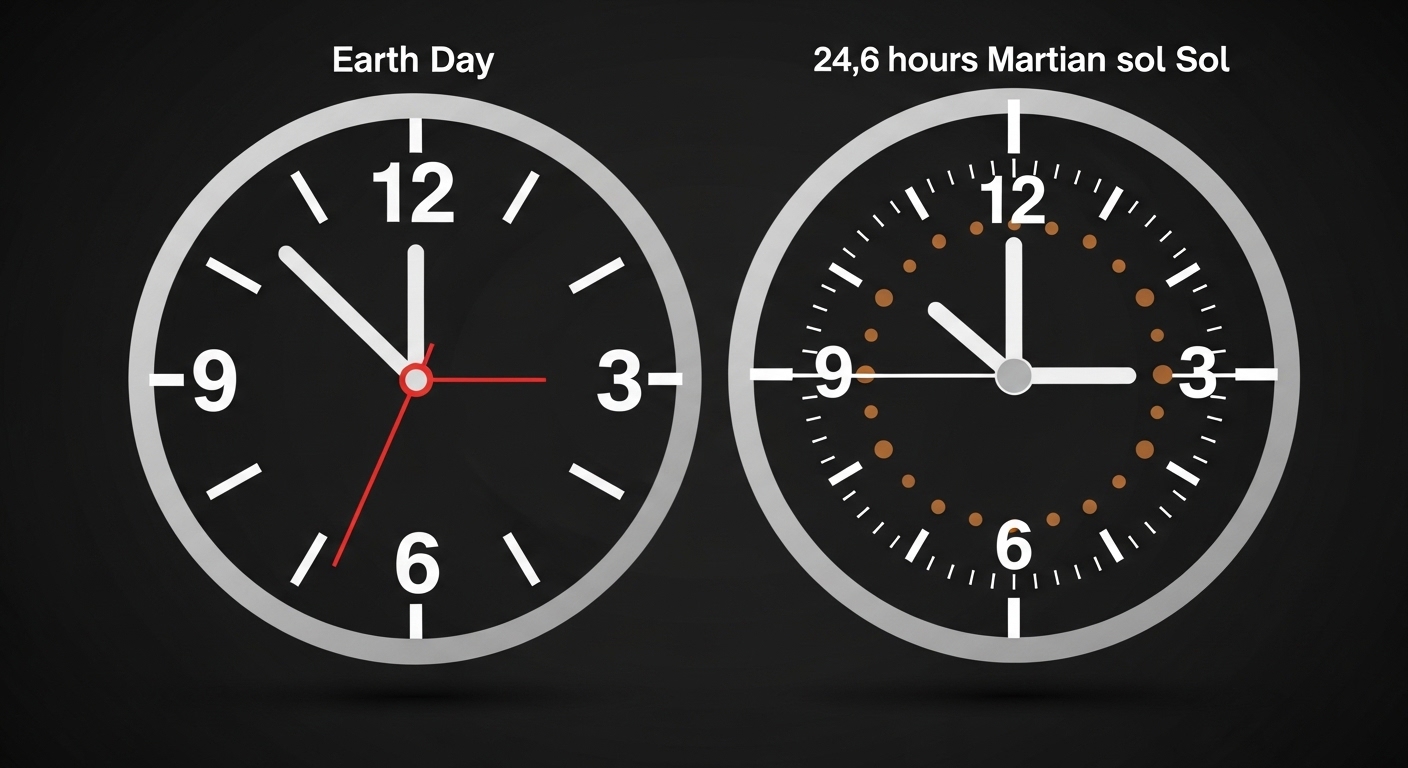
A Martian day — called a sol — lasts 24 hours and 37 minutes, roughly. That extra 37 to 40 minutes (estimates vary slightly depending on how you measure it) doesn't sound like much. But it compounds. After just one week of living on Mars time, a mission controller's schedule has drifted nearly five hours relative to Earth time. After a month, they're completely inverted — working through Earth's night and sleeping through its day.
The reason scientists must sync to Mars time at all comes down to solar power and data windows. Mars rovers are largely solar-powered, which means they operate during Martian daylight. Commands sent from Earth need to arrive before the rover wakes up, and data sent back needs to be received during Earth's operational hours. The most efficient way to manage this is for the mission team to simply live on the same clock as the rover.
A Tradition That Goes Back Decades
NASA's experience with Mars time stretches back to the Viking landers in the 1970s. Those teams dealt with the same drift problem, though with far less understanding of circadian biology than scientists have today. By the time the Mars Exploration Rovers Spirit and Opportunity landed in January 2004, JPL had developed informal protocols — blackout curtains, special meal schedules, designated "Mars time" cafeteria hours — but nothing close to a formal medical program.

The Challenge They Faced: What a Drifting Clock Does to the Human Body
Circadian Rhythm Is Not Flexible by Default
The human circadian clock runs on approximately a 24-hour cycle, anchored primarily by light exposure. Shift workers on Earth deal with misalignment, but their schedule at least stays fixed — a night shift worker always starts at 10 p.m. Mars time is different because the schedule never stabilizes. It keeps drifting, every single day, by that same 37-to-40-minute increment. There is no adjustment point, no new normal to settle into.
Research on circadian disruption suggests that chronic misalignment between the internal clock and the external environment is associated with sleep degradation, impaired cognitive performance, mood disturbances, and metabolic changes. For mission controllers making real-time decisions about a $2.5 billion rover, cognitive impairment is not an abstract concern. A misread command or a delayed response could send a rover wheel-first into a rock.
The schedule never stabilizes — it keeps drifting every single day, which means the body never gets the chance to adapt the way a standard night-shift worker eventually can.
Social and Domestic Fallout
The human cost extended well beyond the lab. Scientists living on Mars time during the Spirit and Opportunity missions described being essentially unreachable to their families for weeks at a time. A spouse trying to call at what felt like a reasonable evening hour might be interrupting the scientist's 3 a.m. sleep window. Children's school schedules, social events, even grocery store hours — none of it aligned. One researcher described the experience as feeling like a prolonged case of jet lag that never resolved.
What They Did: Adapting the Human Body to an Alien Clock
Custom Watches and Physical Anchors
One of the most practical solutions was also one of the simplest: custom wristwatches calibrated to run on a 24-hour-37-minute cycle. These weren't exotic pieces of engineering — they were essentially standard watch movements adjusted to run slightly slower. Scientists wore them constantly, and the watches served as a physical anchor, a constant reminder that the number on their wrist was the only clock that mattered for the next several weeks.
JPL also restructured the physical environment of the mission. Cafeteria hours were extended and shifted. A dedicated "Mars kitchen" stocked with food at odd hours meant scientists didn't have to choose between eating on schedule and eating at all. Blackout curtains became standard issue for anyone working extended Mars time shifts, both at the lab and, for those who wanted them, at home.
Light Therapy and Sleep Management
By the time the Curiosity rover mission launched in 2011, NASA had brought sleep researchers and chronobiologists into the planning process more formally. Light exposure is the primary tool for nudging the circadian clock, and mission planners used it deliberately. Bright, blue-spectrum light was used to signal "morning" to scientists' brains at whatever hour their Mars schedule demanded it. Conversely, scientists were advised to minimize bright light exposure before their scheduled sleep window, regardless of what the sun outside was doing.
Melatonin supplements were also used by some team members to help accelerate the daily drift. The timing of melatonin intake matters enormously — taken at the wrong point in the circadian cycle, it can actually worsen misalignment rather than help it. Having chronobiologists on call to advise individual team members on their specific schedules was a meaningful upgrade from the informal approaches of earlier missions.
Light is the master switch for the human circadian clock — and mission planners learned to use it as deliberately as any piece of mission hardware.
Rotation Schedules to Limit Exposure
A key structural decision was limiting how long any individual scientist spent on Mars time. Rather than keeping the same team on the drifting schedule for the full primary mission, JPL developed rotation systems that cycled people off Mars time after a defined period — often a few weeks — before rotating in a fresh team. This reduced the cumulative physiological burden and, practically speaking, kept people functional enough to make good decisions.
Results and Key Lessons: What Mars Time Taught Us About Human Limits
The Missions Succeeded — But the Cost Was Real
Spirit and Opportunity both operated far beyond their planned 90-sol primary missions. Opportunity kept going for nearly 15 years. The teams that managed them did their jobs under genuinely unusual physiological conditions, and the science they produced was extraordinary. By any operational measure, the Mars time adaptation strategies worked well enough.
But "well enough" is a careful phrase. Post-mission surveys and informal accounts from scientists who lived through extended Mars time periods consistently describe it as one of the harder aspects of the job — not the technical complexity, not the pressure, but the simple grinding disorientation of a clock that never stops moving. Some researchers reported that it took weeks after returning to Earth time to feel fully normal again.
The Counterintuitive Finding About Human Adaptability
Here's the part that surprises most people: the human body actually cannot adapt to a 24-hour-37-minute day, even with extended exposure. Studies on circadian flexibility suggest that the human clock can be entrained to cycles somewhere in the range of roughly 23.5 to 24.5 hours under controlled conditions — and a Martian sol sits just outside that window for most people. This means no amount of time living on Mars time will make it feel natural. The drift is permanent, not a phase.
That finding has direct implications for any future crewed Mars mission. Astronauts living on Mars for months or years won't simply "adjust" to the local day. They'll be managing a chronic, low-grade circadian mismatch for the entire duration of their stay — unless mission designers build in deliberate countermeasures from day one.
Lessons Carried Forward
The protocols developed across Pathfinder, Spirit, Opportunity, and Curiosity now inform how JPL plans staffing for every Mars surface mission. The Perseverance rover mission, which landed in 2021, benefited from years of accumulated knowledge about rotation schedules, light therapy timing, and the psychological support structures that help people function on a drifting clock. Remote work tools, accelerated by broader technology trends, also allowed more team members to work from home during Mars time periods — reducing commute burden and giving people more control over their light environment.
(Opinion: The Mars time problem is one of the more underappreciated challenges in planetary science. We spend enormous effort engineering rovers to survive Martian temperatures and radiation, and comparatively little public attention goes to the fact that the humans operating those rovers are running on a clock that their biology was never built for. That asymmetry seems worth correcting.)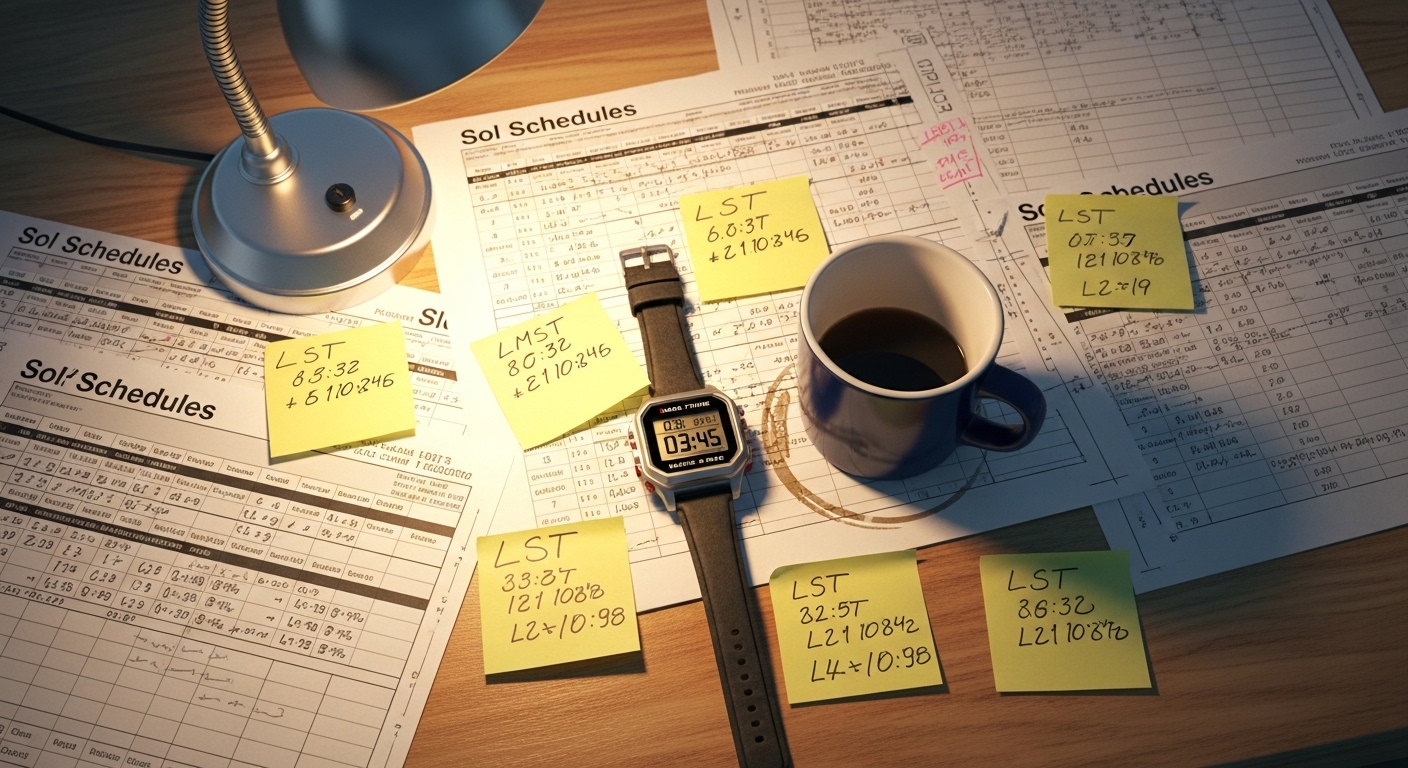
Frequently Asked Questions
Do all Mars mission scientists have to live on Mars time?
No — only the subset of the team directly responsible for planning rover activities and sending commands typically shifts to Mars time. Scientists analyzing data, writing papers, or working on longer-term planning generally stay on Earth time. The Mars time burden falls most heavily on the operations team during the primary mission phase, which is why rotation schedules matter so much.
Could future Mars astronauts just ignore local time and live on a 24-hour schedule?
In principle, yes — and some mission planners have proposed exactly that. Keeping a strict 24-hour schedule on Mars would mean that "daylight" and "work hours" gradually drift out of sync with the local environment, but for an indoor habitat with artificial lighting, that may be manageable. Whether it's psychologically sustainable for years at a time is a genuinely open question that researchers are still working through.
Is the 37-minute daily drift really that disruptive compared to ordinary jet lag?
Jet lag is disruptive but temporary — your body resynchronizes to the new time zone within days. Mars time drift is different because it never stops. You're not adjusting to a new fixed schedule; you're chasing a moving target indefinitely. Research on non-24-hour sleep-wake disorder, a condition some blind individuals experience due to the absence of light cues, gives some insight into what this feels like — and it's consistently described as more debilitating than standard jet lag.
The custom Mars-time watches worn by JPL scientists are a small, almost poignant detail — a mechanical object built to track a day that human biology was never designed to follow. If we do eventually send people to live on Mars for extended periods, that mismatch won't be solved by better watches or blacker curtains. It will be one of the quiet, persistent costs of being the wrong kind of animal in the wrong kind of place.


Comments
Post a Comment