What Are Gravitational Waves? A Simple Guide to Ripples in Spacetime
Two black holes, each roughly thirty times the mass of our sun, collided over a billion light-years away — and the ripple that event sent through the fabric of space arrived at Earth on September 14, 2015, stretching and squeezing the entire planet by less than the width of a proton. Scientists detected it anyway. That moment, the first confirmed detection of a gravitational wave, changed physics in a way that hadn't happened since the invention of the telescope.

What Are Gravitational Waves, Exactly?
Spacetime as a Physical Fabric
Einstein's general relativity, published in 1915, reframed gravity not as a force pulling objects together but as a curvature in spacetime — a four-dimensional fabric woven from three dimensions of space and one of time. Massive objects bend this fabric, and other objects follow those curves the way a marble rolls toward the center of a stretched rubber sheet. That analogy is imperfect, but it captures the basic idea.
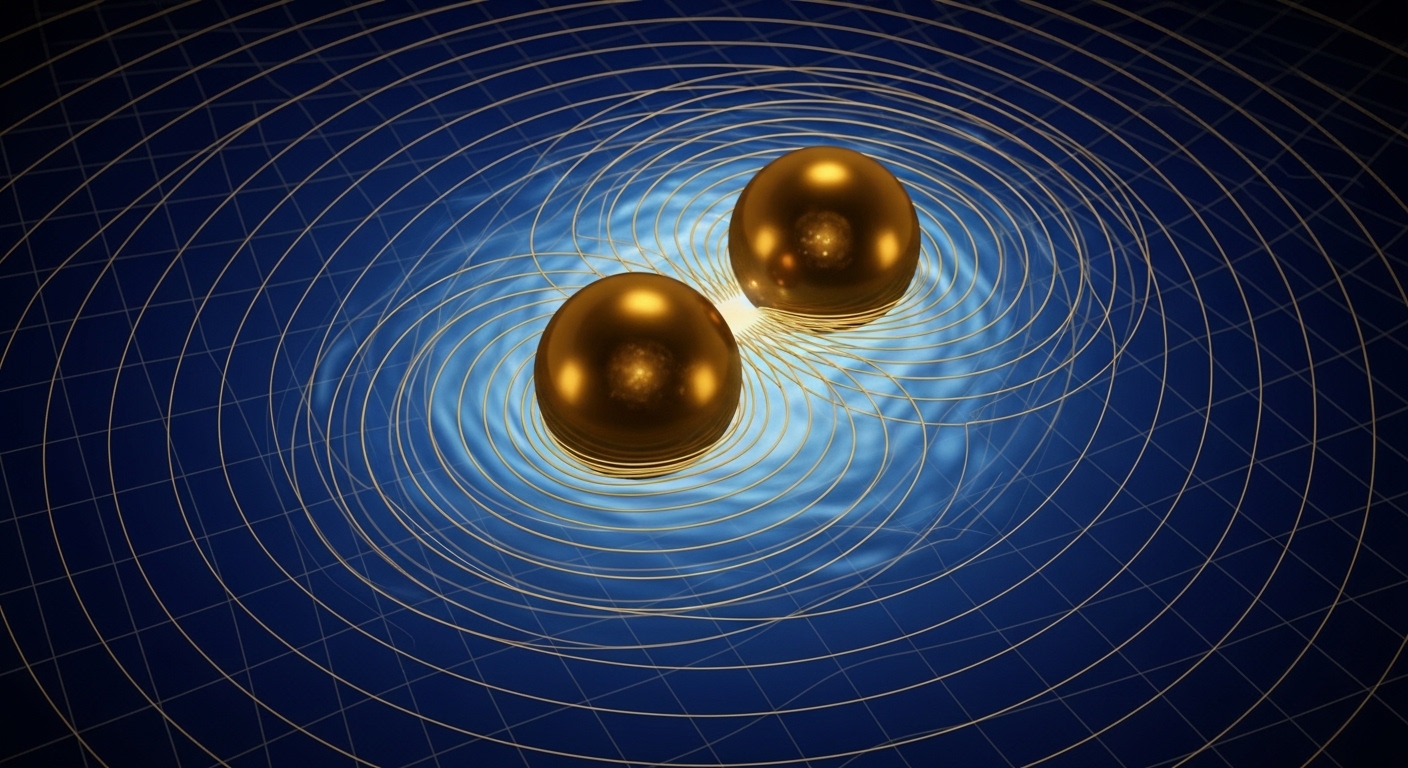
Gravitational waves are what happens when that fabric is disturbed violently. When massive objects accelerate — especially when they orbit each other, spiral inward, or collide — they generate ripples that propagate outward through spacetime at the speed of light. Think of dropping a stone into a still pond: the disturbance radiates outward in all directions. Gravitational waves do the same thing, except the 'pond' is the entire structure of space and time itself.
What Makes Them Different From Other Waves
Sound waves need air. Light waves are oscillations in electromagnetic fields. Gravitational waves are different in a fundamental way: they are oscillations in the geometry of space itself. They don't travel through spacetime — they are spacetime doing something. That distinction sounds philosophical, but it has real consequences for how we detect them and what they can tell us.
As a gravitational wave passes through you right now (and statistically, one probably is), it alternately stretches space in one direction and squeezes it in the perpendicular direction. The effect is called a 'quadrupole strain,' and it is almost incomprehensibly small for any wave we can realistically detect from Earth.
How Do Scientists Actually Detect Gravitational Waves?
The LIGO Instrument — A Ruler for Spacetime
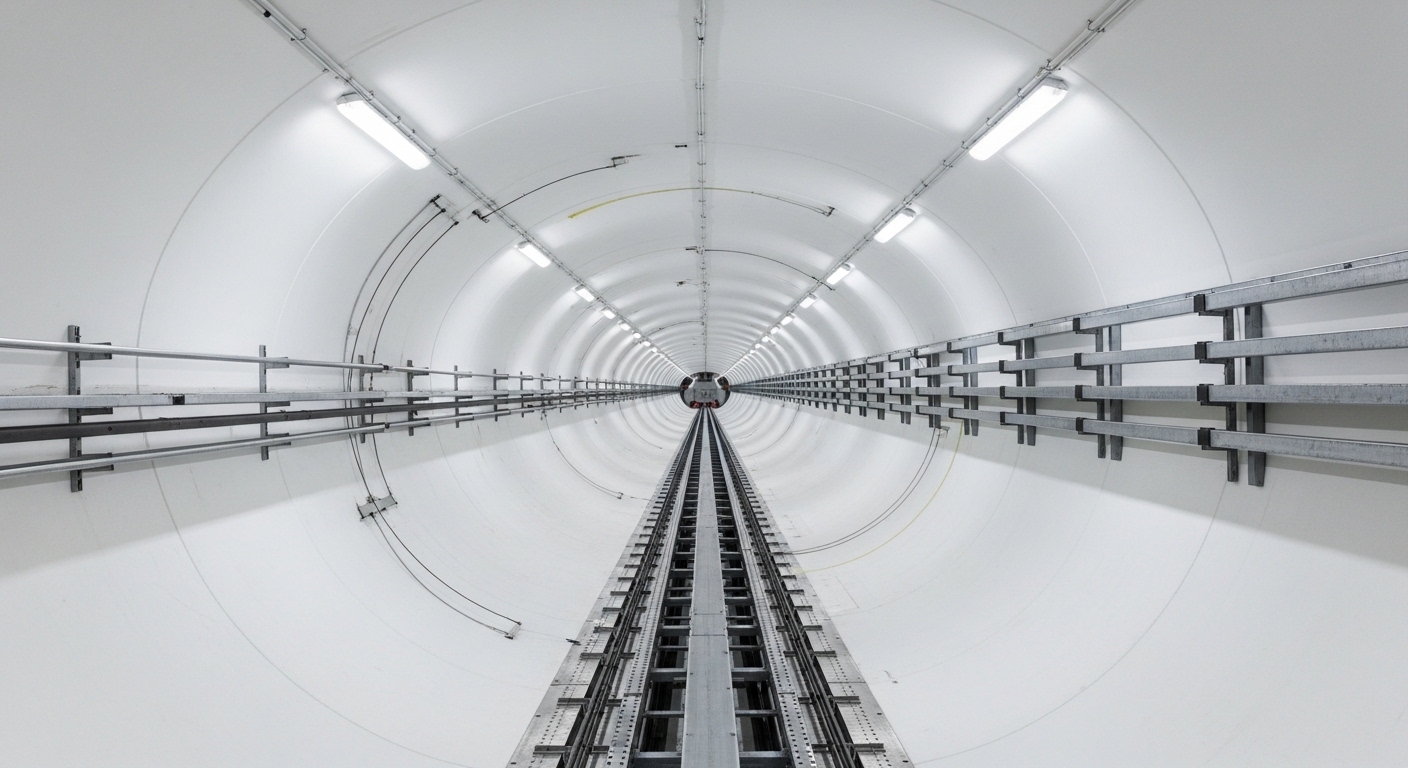
The Laser Interferometer Gravitational-Wave Observatory, known as LIGO, uses a deceptively simple concept: split a laser beam, send each half down a perpendicular tunnel four kilometers long, bounce them off mirrors, and recombine them. If space is perfectly undisturbed, the two beams cancel each other out when recombined. If a gravitational wave passes through and stretches one tunnel while squeezing the other — even by a fraction of a proton's width — the beams no longer cancel perfectly, and the instrument registers a signal.
The engineering required to make this work is staggering. The mirrors must be isolated from every conceivable vibration: passing trucks, ocean waves, seismic activity, even the thermal jitter of atoms in the mirror surface. The laser power circulating inside the arms is amplified to hundreds of kilowatts to improve sensitivity. LIGO operates two detectors — one in Hanford, Washington, and one in Livingston, Louisiana — so that a real gravitational wave signal appears in both, while local noise shows up in only one.
A gravitational wave that moves the entire Earth by less than a proton's width is not a weak signal — it is an almost unimaginable amount of energy arriving from unimaginable distances. The weakness is ours, not the wave's.
The Global Network Growing Around LIGO
LIGO is no longer alone. The Virgo detector in Italy and KAGRA in Japan have joined the network, and a planned detector called LIGO-India is in development. Multiple detectors matter enormously: triangulating a signal across several observatories allows scientists to pinpoint the direction of the source in the sky, which is how astronomers knew where to point telescopes when two neutron stars merged in 2017 — an event that produced both gravitational waves and visible light simultaneously.
That 2017 event, designated GW170817, was a landmark. For the first time, a gravitational wave source was observed across multiple 'messengers' — gravitational waves, gamma rays, visible light, X-rays, and radio waves all from the same event. Astronomers call this multi-messenger astronomy, and it opened an entirely new way of studying the universe.
What Sources Actually Produce Gravitational Waves?
The Objects Violent Enough to Warp Spacetime Detectably
Not everything produces gravitational waves we can measure. A person waving their arms technically generates them, but at a level so absurdly small it would take equipment the size of a galaxy to detect. The sources that matter are objects with enormous mass undergoing rapid acceleration — and the universe has a few categories of those.
Binary black hole mergers were the first detected source and remain the most common. Two black holes locked in a decaying orbit spiral toward each other over millions of years, accelerating as they go, then merge in a fraction of a second. The final 'chirp' — a rapid rise in frequency and amplitude — is the gravitational wave signal LIGO picks up. Binary neutron star mergers work the same way but involve denser, more exotic objects. Supernovae can also produce gravitational waves if the explosion is asymmetric enough, though none have been detected from a supernova yet.
The Surprising Source Nobody Talks About — Continuous Waves
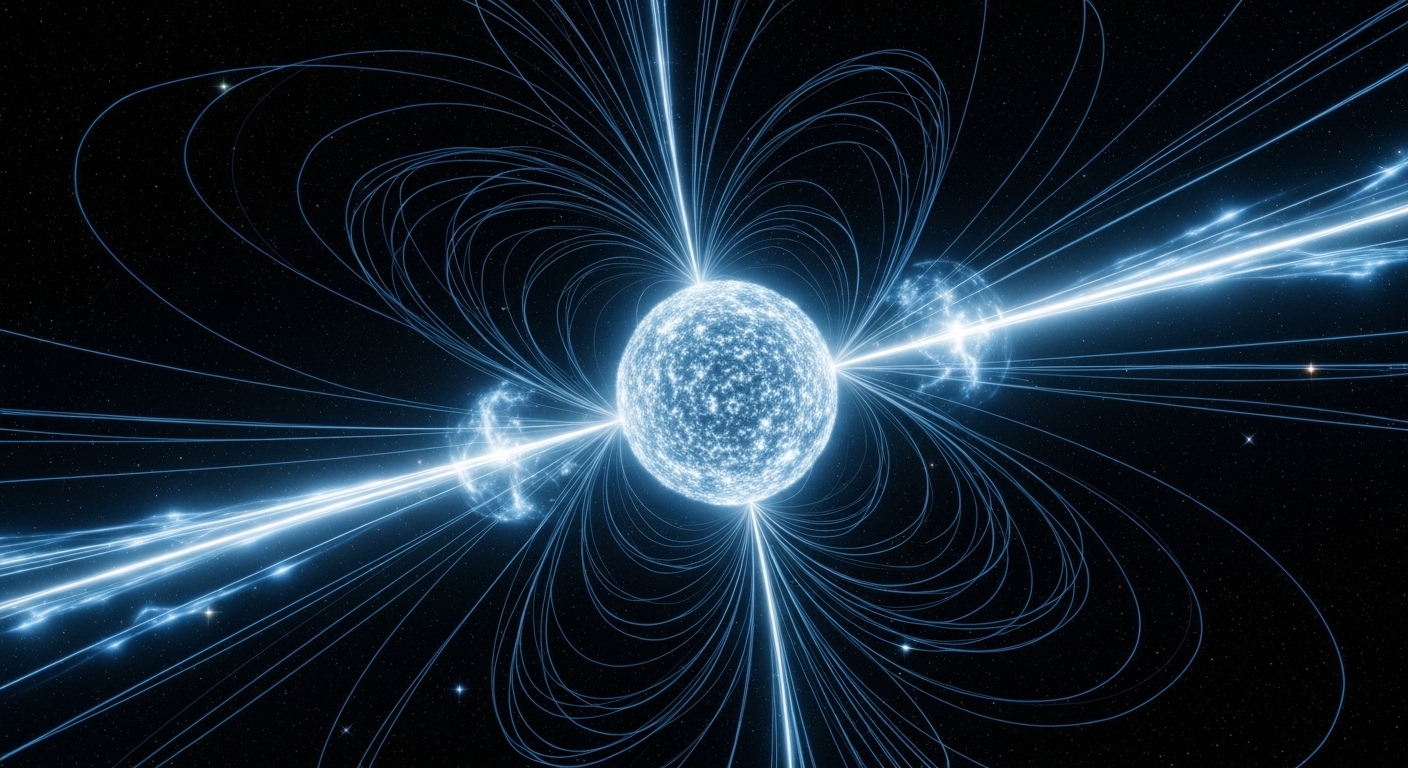
Most public attention goes to merger events, but researchers also search for 'continuous gravitational waves': steady, persistent signals from a single spinning neutron star with a slight asymmetry in its mass distribution. Imagine a perfectly smooth spinning top — it produces no gravitational waves. Give it a tiny bump on one side, and it radiates continuously as it rotates. No continuous wave source has been confirmed yet, but the search is ongoing and would reveal things about neutron star interiors that no other method can.
Every confirmed gravitational wave detection so far has come from a merger. The universe's most persistent signals — continuous waves from spinning neutron stars — remain just out of reach.
Why Gravitational Waves Matter Beyond the Physics Lab
A New Sense for Observing the Universe
Before gravitational wave astronomy, everything we knew about the universe came from electromagnetic radiation — light in its various forms, from radio waves to gamma rays. That is a bit like trying to understand a city by only looking at it, never listening to it. Gravitational waves let us 'hear' the universe for the first time. They pass through dust, gas, and entire galaxies without being absorbed or scattered, which means they carry information from places and events that are completely invisible to any telescope.
The center of our galaxy is obscured by dense clouds of gas and dust. Gravitational waves from events there would reach us completely unimpeded. The very early universe, in the first fractions of a second after the Big Bang, is opaque to light — but gravitational waves from that era, if they exist and can be detected, would be a direct window into conditions that no other observation can reach.
What Gravitational Waves Have Already Taught Us
The detections so far have already revised our understanding of black hole populations. Before LIGO, most astronomers expected black holes formed from stellar collapse to top out around twenty to thirty solar masses. Early detections included black holes significantly heavier than that, suggesting formation pathways nobody had fully accounted for. The neutron star merger in 2017 also provided a direct measurement of how fast the universe is expanding — the Hubble constant — using gravitational waves as a 'standard siren,' independent of other measurement methods.
That last point matters more than it might seem. There is currently a genuine, unresolved tension between different methods of measuring the Hubble constant. Gravitational waves offer a third, independent method that could eventually resolve which measurement is right — or reveal that something deeper is wrong with our cosmological models.
(Opinion: The Hubble tension is the most underreported crisis in modern physics. If gravitational wave measurements end up disagreeing with both existing methods, the implications for our understanding of dark energy and the expansion of the universe would be genuinely unsettling — and genuinely exciting.)
Frequently Asked Questions
Can gravitational waves harm humans?
No. Even the strongest gravitational waves detected so far stretched and squeezed Earth by an amount far smaller than an atomic nucleus. The energy is real but spread across an incomprehensibly large area by the time it reaches us. There is no known mechanism by which a gravitational wave from any realistic astrophysical source could cause biological harm.
How is a gravitational wave different from gravity itself?
Gravity is the static curvature of spacetime caused by mass sitting in one place. A gravitational wave is a dynamic disturbance — a change in that curvature propagating outward from an accelerating source. The analogy is the difference between a rock sitting on a rubber sheet (static gravity) and someone shaking the sheet (gravitational waves). Both are expressions of the same underlying physics, but they behave very differently.
Why did it take so long to detect gravitational waves if Einstein predicted them in 1916?
Einstein himself doubted they could ever be detected — the signals are so extraordinarily faint that even he considered detection practically impossible. It took decades of advances in laser technology, vibration isolation, quantum optics, and computational signal processing to build instruments sensitive enough. The gap between prediction and detection was not a failure of effort; it was a genuine engineering problem that took most of the twentieth century to solve.
The strangest part of gravitational wave astronomy is not the technology or the physics — it is the philosophical shift it represents. For all of human history, we have understood the cosmos through light. Every star chart, every galaxy map, every photograph of a nebula is a record of photons that traveled to us. Gravitational waves are something else entirely: a record of mass in motion, of spacetime itself flexing. We have not just built a new instrument. We have grown a new sense — and we have barely begun to use it.


Comments
Post a Comment