How Do Lunar Rovers Work? The Technology Behind Exploring the Moon
The Moon's surface is covered in a fine, razor-sharp dust that can destroy seals, clog filters, and short-circuit electronics — and every rover sent there has had to solve that problem before solving anything else. Lunar exploration sounds like pure adventure, but the engineering underneath it is a relentless negotiation with one of the most hostile environments reachable from Earth. From the Soviet Lunokhod program in the 1970s to the Chinese Yutu rovers and the new generation of commercial and government landers being developed now, the core challenge has barely changed: how do you build a machine that can drive, observe, and survive on a world with no air, wild temperature swings, and a surface that behaves like wet cement mixed with broken glass?
What Is a Lunar Rover, Really?
More Than a Remote-Control Car
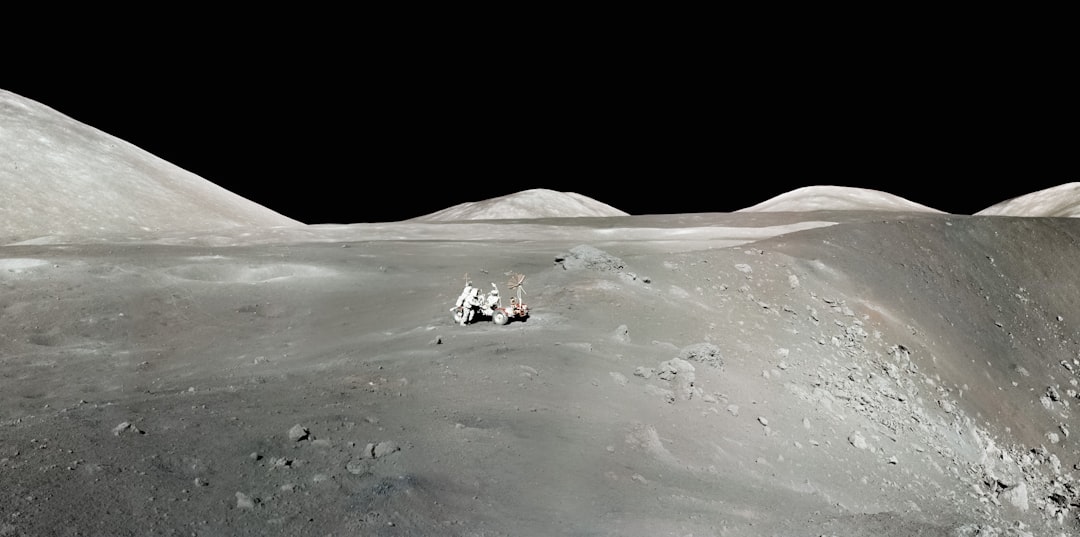
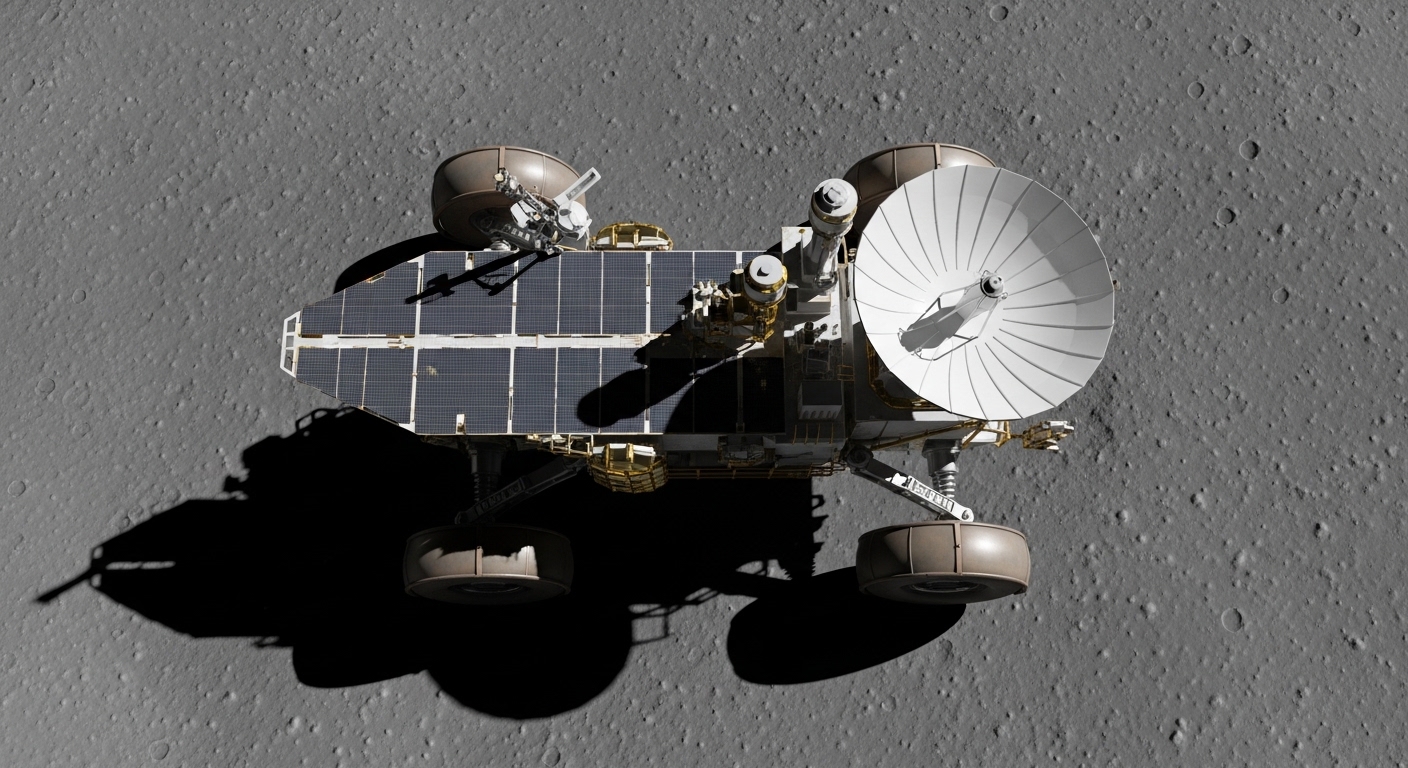
A lunar rover is a surface vehicle designed to travel across the Moon, carry scientific instruments, and transmit data back to Earth. That sounds simple. The execution is anything but. Unlike a Mars rover, which benefits from a thin atmosphere that slightly moderates temperatures and slows dust, a lunar rover operates in a near-perfect vacuum where temperatures swing from around 120°C (250°F) in direct sunlight to roughly -130°C (-200°F) in shadow — sometimes within meters of each other.
The first crewed lunar rovers were the Apollo Lunar Roving Vehicles, used on Apollo 15, 16, and 17 between 1971 and 1972. These were essentially electric dune buggies built by Boeing and driven by astronauts. Each weighed about 210 kilograms on Earth but only around 35 kilograms in lunar gravity. They covered tens of kilometers per mission — distances that would have been impossible on foot in a spacesuit.
Uncrewed rovers are a different category entirely. They have to make decisions, or at least follow pre-programmed logic, without a human in the seat. That changes almost every design choice.
How Does a Lunar Rover Actually Move?
The Wheel Problem Nobody Talks About
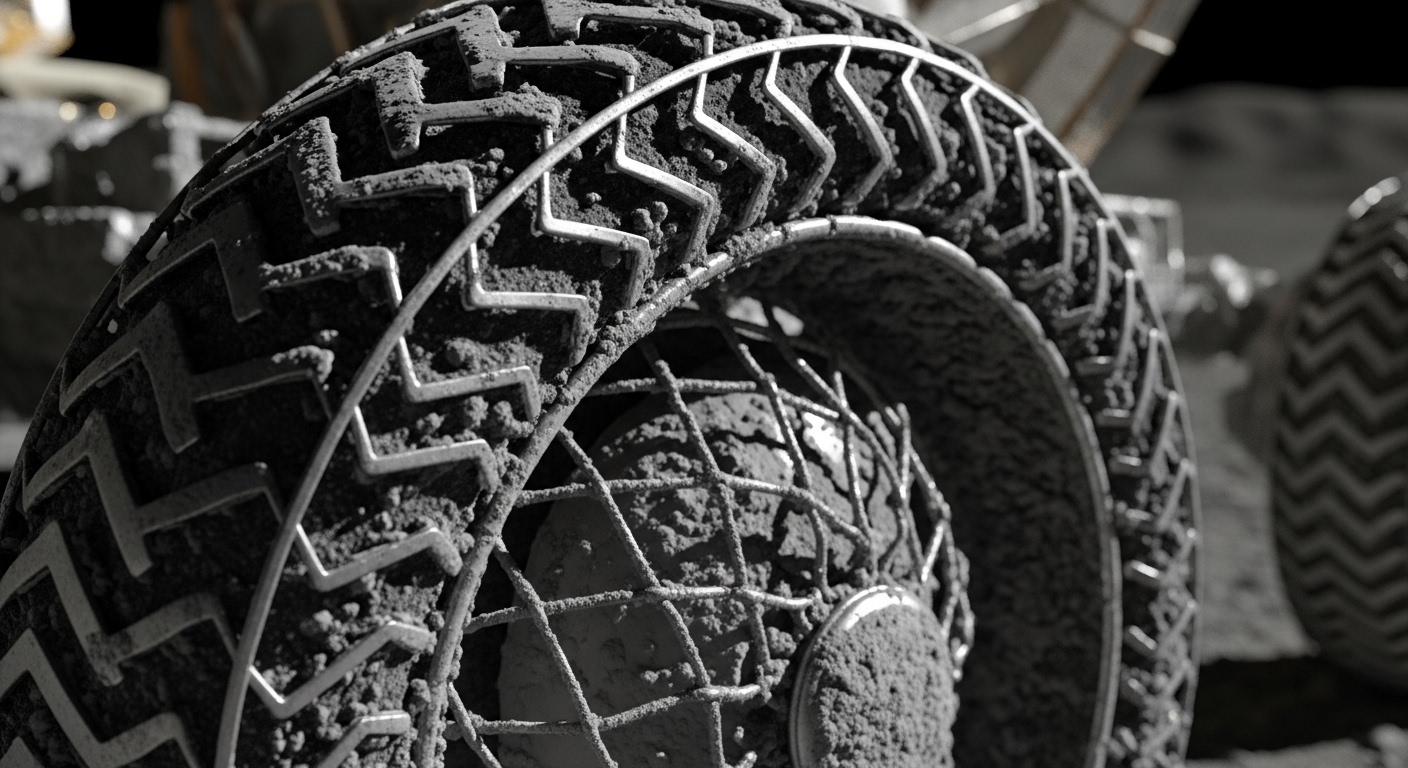
You cannot use rubber tires on the Moon. Rubber degrades rapidly in vacuum and extreme cold, and the thermal cycling would crack it within days. The Apollo rovers used wheels made from zinc-coated piano wire woven into an open mesh, with titanium chevron treads riveted on for grip. This design was flexible enough to absorb shock, light enough to meet mass budgets, and durable enough to last a mission.
Modern uncrewed rovers like China's Yutu-2 — which landed on the lunar far side in January 2019 aboard the Chang'e 4 mission — use rigid aluminum wheels with grousers (raised ridges) to bite into the regolith. The tradeoff is that rigid wheels can sink into soft patches of soil, and the regolith on the Moon behaves unpredictably. In some areas it's compacted; in others it's loose powder meters deep.
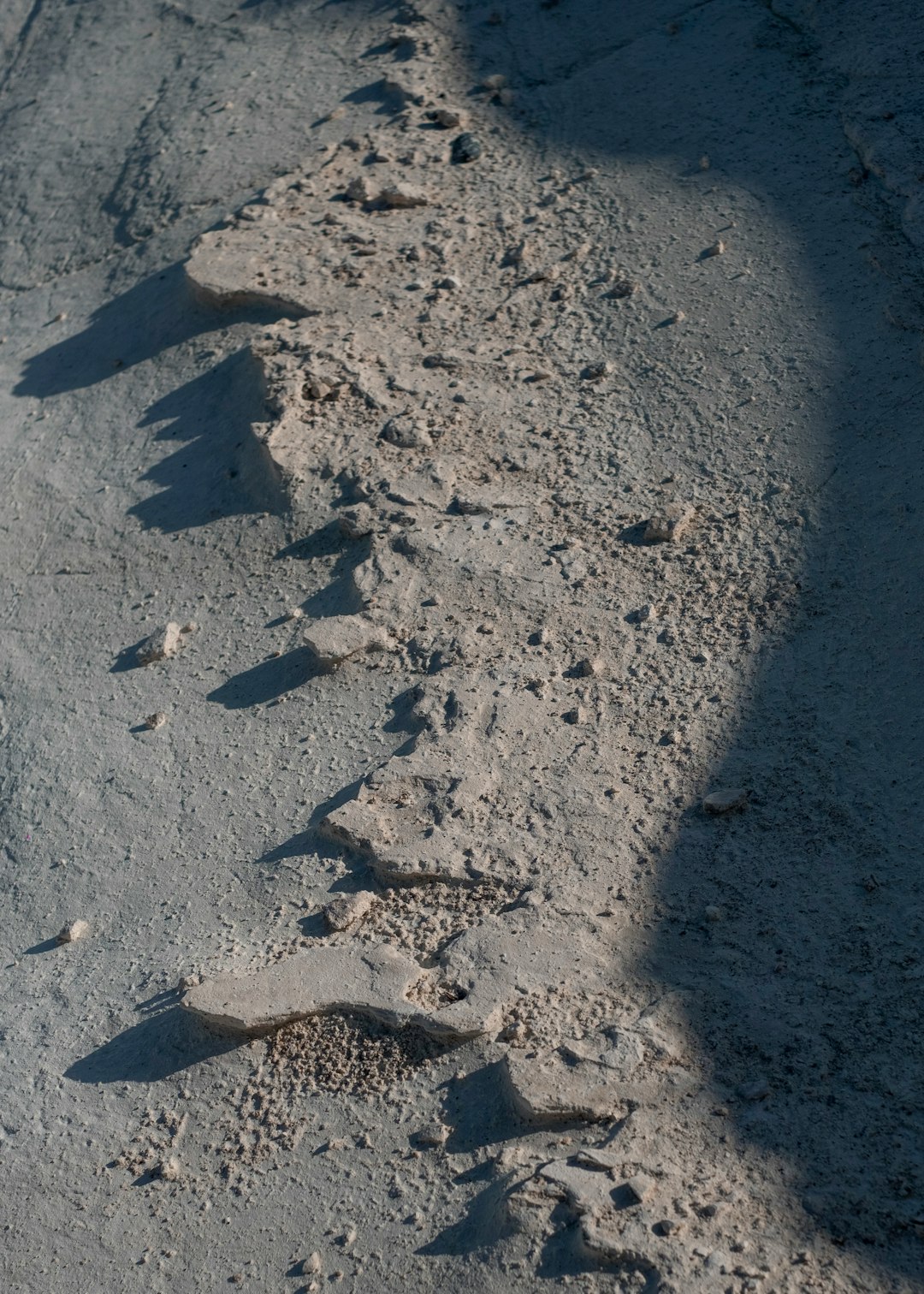
Lunar regolith isn't just dusty — its particles are angular and abrasive at the microscopic level, because there's no wind or water to round them off over time. That makes it uniquely destructive to moving parts.
Drive Systems and Steering
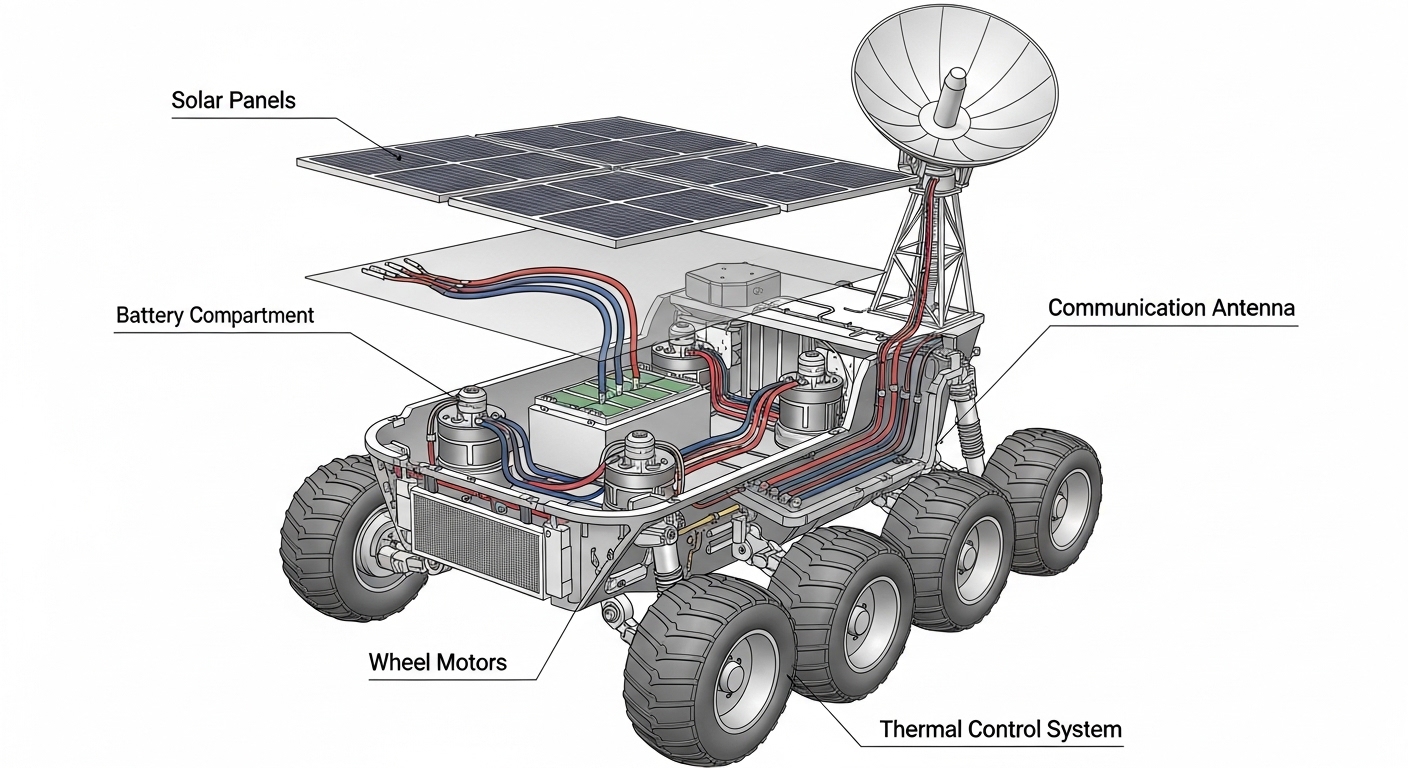
Most modern rovers use independent electric motors on each wheel, which eliminates the need for a central drivetrain and allows the rover to keep moving even if one motor fails. Steering is typically achieved by varying the speed or direction of individual wheels — a technique called differential steering — rather than using a traditional steering column. This gives the rover a very tight turning radius, which matters enormously when navigating around boulders.
Speed is deliberately kept low. Yutu-2 moves at roughly 200 meters per hour under autonomous control. That's not a limitation of the motors — it's a safety constraint. At that pace, the rover has time to detect hazards and stop before tumbling into a crater.
How Do Lunar Rovers Get Their Power?
Solar Panels and the Lunar Night Problem
Most uncrewed lunar rovers rely on solar panels for power during the lunar day. A single lunar day lasts about 14 Earth days, followed by 14 Earth days of darkness — and during that night, temperatures plunge so severely that most electronics would simply freeze and crack without active heating. This is the single biggest operational challenge for any rover not equipped with a nuclear power source.
The Yutu rovers handle this by entering a hibernation mode during lunar night, shutting down most systems and relying on radioisotope heater units (RHUs) — small pellets of radioactive material that generate heat passively — to keep critical components above their minimum survival temperature. The rover then wakes up when sunlight returns. Yutu-2 has survived multiple lunar nights this way, which was not a given: its predecessor, Yutu-1, suffered a mechanical failure during its first lunar night and never fully recovered.
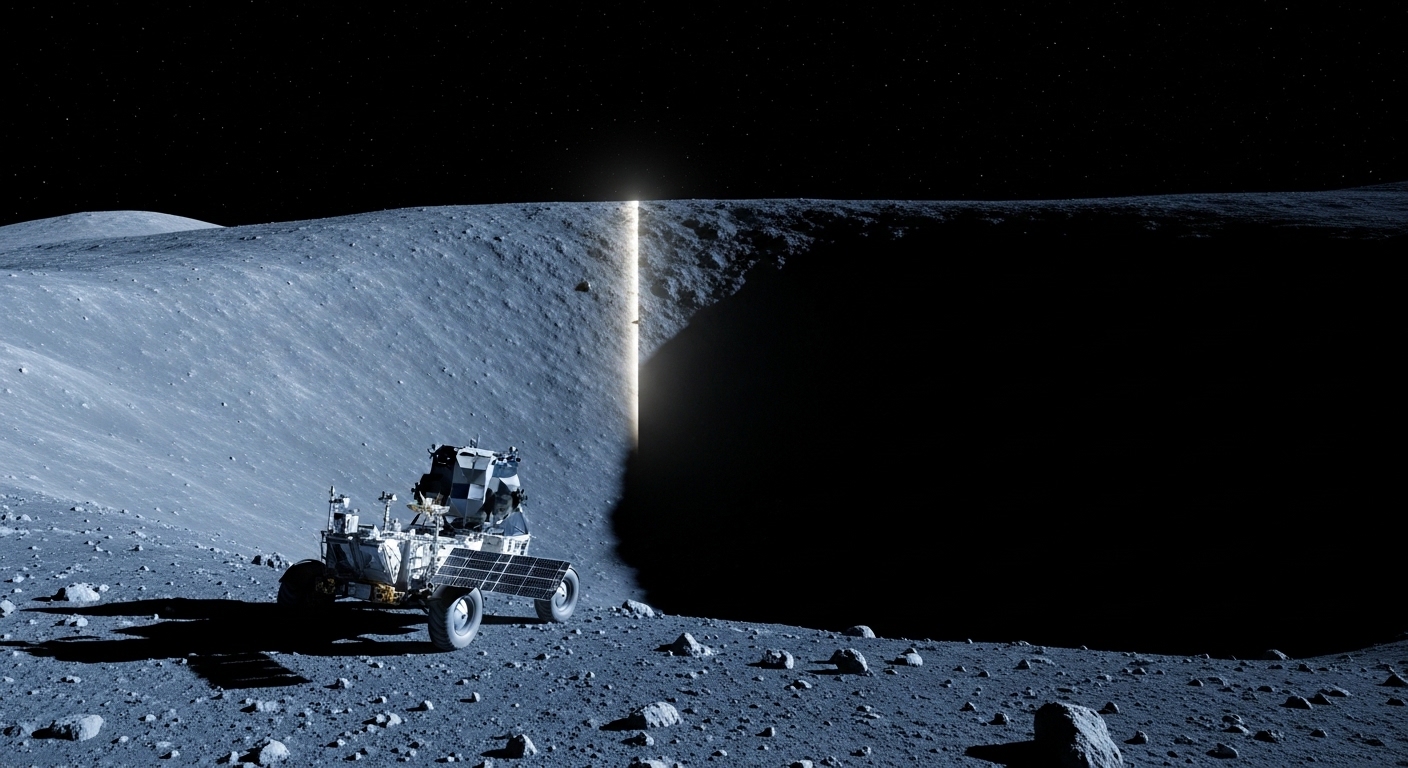
NASA's future Artemis-era rovers, including the VIPER mission designed to prospect for water ice near the lunar south pole, are designed to operate in the permanently shadowed regions where solar power is unreliable. VIPER's design incorporates a combination of solar charging during brief traverses into sunlit areas and battery reserves for operations in shadow.
Why Nuclear Power Changes Everything
The Apollo rovers had it easy in one sense: astronauts brought their own life support and didn't need the rover to survive the night. A nuclear-powered rover — using a radioisotope thermoelectric generator (RTG) like those on NASA's Mars rovers Curiosity and Perseverance — could operate continuously through the lunar night. No hibernation, no power gaps, no waiting two weeks to resume science. The tradeoff is mass, cost, and the regulatory complexity of launching radioactive material.
How Do Lunar Rovers Communicate and Navigate?
The Speed-of-Light Delay
Radio signals travel at the speed of light, but the Moon is far enough away that there's a round-trip communication delay of roughly 2.5 seconds. That doesn't sound like much until you're trying to drive a rover in real time. If the rover is heading toward a crater edge, a human operator on Earth can't react fast enough to stop it — by the time the command arrives, the rover has already moved another meter or two.
This is why autonomous hazard detection is non-negotiable. Rovers use stereo cameras to build a 3D map of the terrain ahead, then run that map through onboard software that flags obstacles and steep slopes before the rover reaches them. The level of autonomy varies: some rovers require ground controllers to approve each movement segment, while others can execute longer traverses independently.
The far side of the Moon adds a layer of complexity that the near side doesn't have: there's no direct line of sight to Earth, so China's Chang'e 4 mission required a dedicated relay satellite — Queqiao — parked at a gravitationally stable point beyond the Moon to maintain contact with Yutu-2.
Knowing Where You Are Without GPS
There is no GPS on the Moon. Rovers navigate using a combination of wheel odometry (counting wheel rotations to estimate distance traveled), inertial measurement units (IMUs) that track orientation and acceleration, and visual landmark matching using cameras. Ground controllers also use orbital imagery from satellites like NASA's Lunar Reconnaissance Orbiter to cross-check the rover's estimated position against known surface features.
Wheel slip is a persistent problem. If a wheel spins without gripping — which happens in loose regolith — the odometry calculation drifts, and the rover's self-reported position becomes increasingly inaccurate. Engineers account for this with slip-detection algorithms that flag suspicious discrepancies between expected and actual movement.
What Science Do Lunar Rovers Actually Do?
The Instruments That Matter
Driving is just the delivery mechanism. The science payload is the point. Rovers typically carry spectrometers to analyze the chemical composition of rocks and soil, ground-penetrating radar to probe beneath the surface, cameras for geological context, and sometimes drill or scoop mechanisms to collect samples. Yutu-2 carries a ground-penetrating radar that has revealed layered subsurface structures beneath the far side — data that's genuinely reshaping understanding of how that region formed.
VIPER, if it launches as planned, will carry a drill capable of reaching about a meter below the surface to directly sample water ice deposits. Finding accessible water ice is not just scientifically interesting — it's practically critical, because water can be split into hydrogen and oxygen for rocket propellant, making it the fuel depot for any sustained human presence on the Moon.
The Dust Problem, Revisited
Apollo astronauts reported that lunar dust stuck to everything — suits, visors, equipment — and was nearly impossible to brush off because of its electrostatic charge. For rovers, dust accumulation on solar panels is a slow death sentence: it reduces power generation over time, and there's no rain or wind to clean it off. Engineers have experimented with electrostatic dust shields and specialized surface coatings, but this remains an unsolved engineering problem for long-duration missions.
(Opinion: The dust problem deserves more public attention than it gets. It's not glamorous, but it may ultimately determine whether any rover — crewed or uncrewed — can operate on the Moon for months rather than weeks. Solving it would be as consequential as any propulsion breakthrough.)Frequently Asked Questions
Can a lunar rover drive at night?
Most current lunar rovers cannot operate during the lunar night because they rely on solar power and lack sufficient heating to survive the roughly -130°C temperatures. They enter a hibernation state and resume operations when sunlight returns. A rover powered by a radioisotope thermoelectric generator (RTG) could theoretically operate continuously, but no lunar rover has used this approach yet — though it's been used successfully on Mars.
Why don't lunar rovers just use the same technology as Mars rovers?
Some technology overlaps, but the environments differ enough to require distinct designs. Mars has a thin atmosphere that provides slight thermal buffering and allows parachutes for landing. The Moon has none of that. Mars also has a longer day-night cycle that's more manageable for solar power. The Moon's 14-day night is uniquely brutal, and the lunar regolith's electrostatic, abrasive properties are more severe than Martian dust in several ways.
How far has any lunar rover actually traveled?
The record for total distance traveled on the Moon belongs to the Soviet Lunokhod 2 rover, which covered roughly 42 kilometers during its 1973 mission — a figure that stood unchallenged for decades. Among uncrewed rovers, Yutu-2 has surpassed earlier records for the far side but has covered a much shorter total distance due to its cautious pace and terrain. The Apollo crewed rovers covered up to about 35 kilometers in a single mission.
The most striking thing about lunar rover technology isn't any single system — it's how much of it is a direct response to failure. The wire-mesh wheel exists because rubber failed in testing. The hibernation protocol exists because Yutu-1 didn't survive its first night. The relay satellite at the Moon's far side exists because nobody had solved the line-of-sight problem before Chang'e 4 tried. Every design choice carries the ghost of something that broke. And as the next generation of rovers heads toward the lunar south pole — a region no rover has ever visited — engineers are about to find out what they haven't thought of yet.


Comments
Post a Comment