How Do Mars Rovers Get Power? Solar Panels vs. Nuclear Explained
The Mars rovers we celebrate as engineering triumphs are, at their core, machines with a very mundane problem: they need electricity, and there's no outlet on Mars. How engineers solved that problem — and why the answer changed dramatically over the decades — is one of the more interesting design stories in space exploration. The choice between solar panels and nuclear power isn't just a technical preference. It determines where a rover can go, how long it can survive, and what science it can actually do.

What Powers a Mars Rover? The Two Options Engineers Have
Solar Panels: Familiar but Fragile
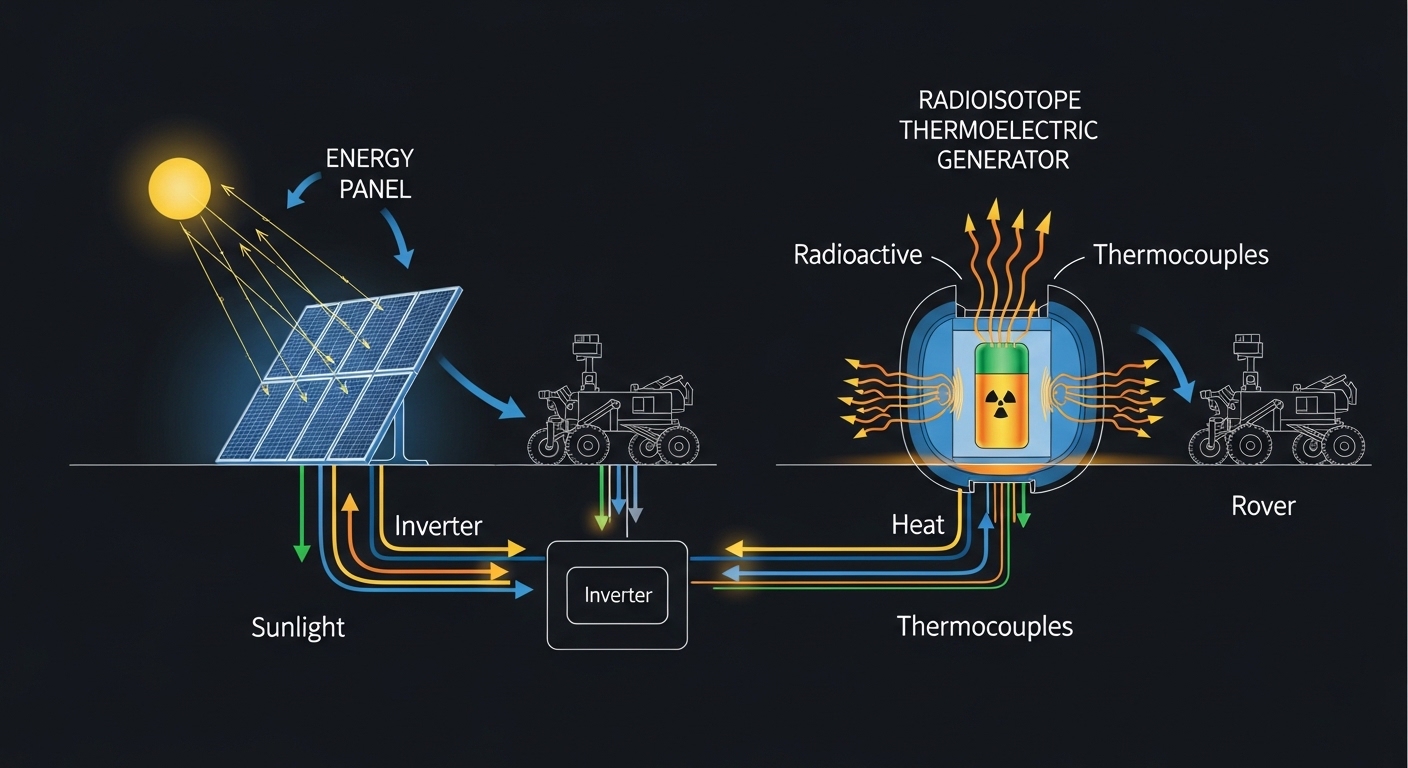
Solar panels work on Mars for the same reason they work on a rooftop in Arizona — sunlight hits photovoltaic cells and generates current. The catch is that Mars sits roughly 1.5 times farther from the Sun than Earth does, which means solar intensity at the Martian surface is already less than half of what we get here. Add a thin, dusty atmosphere that scatters and absorbs light, and you're working with a significantly reduced energy budget before you've even landed.
The Spirit and Opportunity rovers, which landed in 2004, used solar arrays as their primary power source. Each generated around 140 watts under ideal conditions — roughly enough to power two or three incandescent light bulbs. That number dropped over time as dust accumulated on the panels, and both rovers relied on wind gusts to occasionally clean them off. Opportunity famously outlasted its 90-day design life by more than 14 years, but its eventual demise in 2018 came from a planet-wide dust storm that blocked sunlight for weeks.
Nuclear Power: The RTG Approach
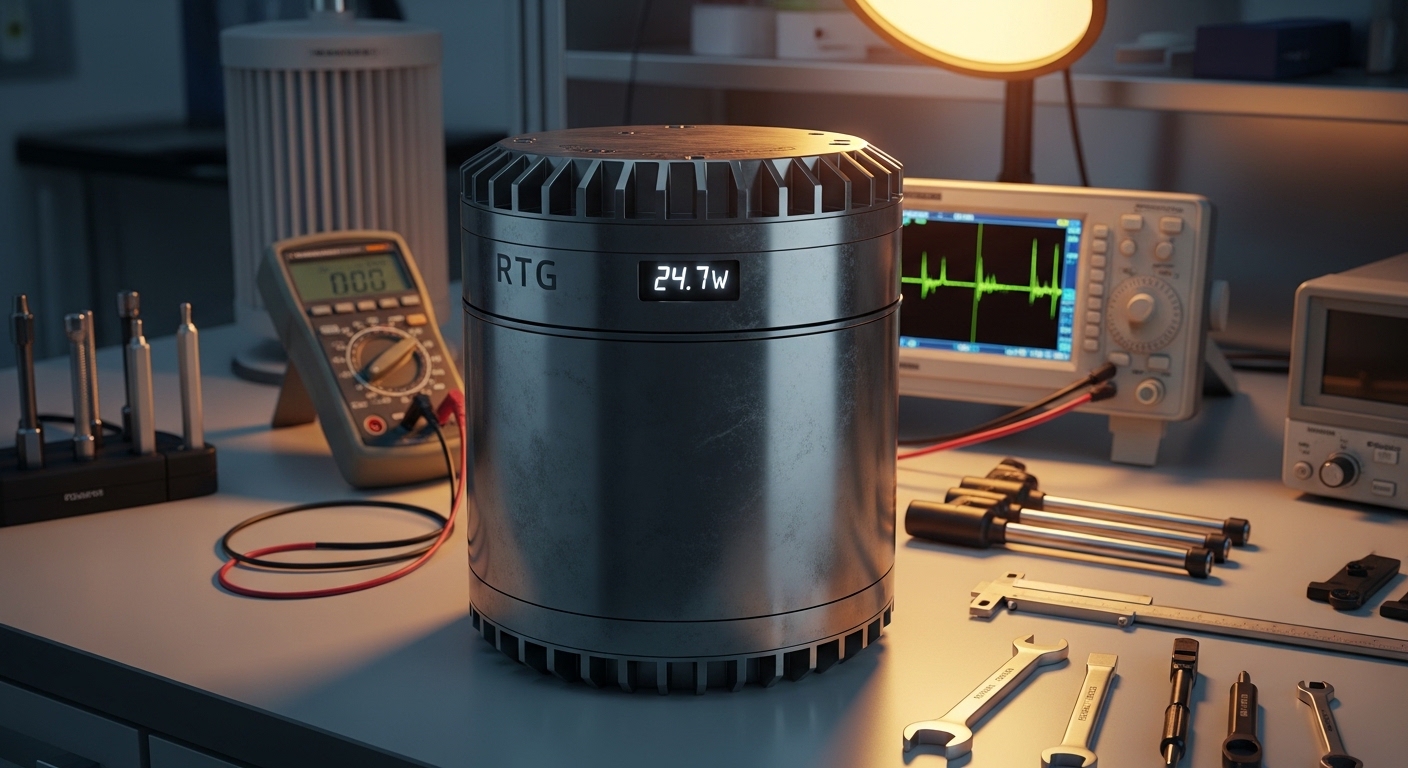
The alternative is a Radioisotope Thermoelectric Generator, or RTG. This device contains a radioactive material — typically plutonium-238 — that generates heat as it decays. That heat is converted directly into electricity using thermocouples, which are simple solid-state devices with no moving parts. The Curiosity rover, which landed in 2012, and the Perseverance rover, which arrived in 2021, both use RTGs.
Curiosity's Multi-Mission Radioisotope Thermoelectric Generator (MMRTG) launched with roughly 110 watts of electrical output. That sounds less than the solar arrays on Opportunity, but the critical difference is consistency: an RTG produces power at night, during dust storms, and in polar winter. It doesn't care about the weather. The tradeoff is that output declines slowly over time as the plutonium decays — by about a few percent per year — but that's a predictable, manageable curve rather than a sudden cliff.
How Solar Power Actually Works on Mars — The Engineering Constraints
The Dust Problem Is Worse Than It Sounds
Martian dust is electrostatically charged, which means it clings to surfaces with unusual stubbornness. The InSight lander, which used solar panels, saw its power output drop from roughly 4,000 watt-hours per day at landing to under 500 watt-hours by early 2022 — a decline driven almost entirely by dust accumulation. Engineers even attempted a creative workaround: using the lander's robotic arm to trickle sand near the panels, hoping the falling grains would knock dust loose. It worked, a little. Which sounds ridiculous, but it extended the mission by weeks.
The Ingenuity helicopter, which hitched a ride with Perseverance, used solar panels to charge its battery. It operated successfully for far longer than planned, but its design accounted for the dust problem by keeping the panel area small and the energy requirements minimal. That's a reasonable approach for a 1.8-kilogram helicopter. It's not a viable strategy for a 900-kilogram science laboratory.
Dust on Mars doesn't just dim the panels — it can cut power output by more than 90% during a major storm, turning a functioning rover into an inert box waiting for sunlight that may not come for months.
Latitude and Season Matter Enormously
Where a solar-powered rover lands is partly determined by sunlight availability. Spirit and Opportunity landed near the equator, where solar angles are more favorable year-round. A solar-powered rover sent to high latitudes or the polar regions would face months of near-darkness in winter — a mission-ending scenario without a nuclear backup. This geographic constraint is a real scientific limitation: some of the most scientifically interesting regions on Mars, including areas with potential subsurface ice, are at higher latitudes where solar power becomes unreliable.
How RTGs Work — and Why Plutonium-238 Specifically
The Physics of Radioactive Decay as a Power Source
Plutonium-238 has a half-life of about 87.7 years. That's long enough to provide decades of useful power output, but short enough that the decay rate — and therefore the heat production — is substantial. Compare that to uranium-238, which has a half-life of 4.5 billion years: it barely generates any heat at all because it decays so slowly. The choice of isotope is a precise engineering decision, not an arbitrary one.
The thermocouples that convert heat to electricity aren't especially efficient — typical conversion rates are in the range of 6 to 8 percent. Most of the thermal energy is actually radiated away as waste heat, which on Mars is sometimes deliberately used to keep sensitive electronics warm during the brutal Martian nights, where temperatures can drop to around minus 80 degrees Celsius. The RTG is doing double duty: power source and space heater.
The Supply Problem Nobody Talks About
Here's the detail that rarely makes the headlines: plutonium-238 suitable for RTGs is genuinely difficult to produce. It's a byproduct of specific nuclear reactor operations, and for a period after the Cold War, the United States was almost entirely dependent on Russian stockpiles. The U.S. Department of Energy restarted domestic production, but output has been limited. This supply constraint is a real bottleneck for future missions — not every rover that could benefit from an RTG will necessarily get one.
The U.S. came close to running out of mission-ready plutonium-238 in the 2000s — a supply problem that had nothing to do with physics and everything to do with post-Cold War budget decisions.

Why the Power Choice Shapes the Entire Mission
Operational Hours, Science Output, and Survival
A solar-powered rover on Mars typically needs to spend part of each day recharging, which means science operations are scheduled around battery state and sunlight availability. Curiosity and Perseverance, by contrast, can operate at any hour and don't need to hibernate through dust storms. Perseverance has been able to run its MOXIE oxygen-production experiment, charge the Ingenuity helicopter, and drive — sometimes simultaneously — because the RTG provides a steady baseline of power that solar arrays simply can't guarantee.
The longevity difference is also striking. Spirit lasted about 6 years before getting stuck and losing power. Opportunity lasted over 14 years before a dust storm ended it. Curiosity, launched in 2011, is still operating. The RTG's slow, predictable decline is a more forgiving failure mode than the sudden blackout of a dust-covered solar panel.
What Future Missions Might Use
There's genuine interest in next-generation nuclear options beyond RTGs, including small fission reactors that could power not just rovers but future crewed habitats. NASA's Kilopower project demonstrated a small fission reactor concept in ground tests, producing kilowatts rather than the hundreds of watts an RTG provides. That's a different order of magnitude — enough to run life support, lighting, and equipment for a human crew.
(Opinion: The solar-versus-nuclear debate for Mars rovers is largely settled in practice, even if it doesn't feel that way publicly. RTGs win for serious long-duration science missions. The remaining argument is mostly about cost and plutonium supply, not engineering preference.)
Frequently Asked Questions
Can a Mars rover use both solar panels and an RTG at the same time?
In principle, yes — a rover could combine both systems. In practice, current missions have used one or the other as the primary source. The added mass, complexity, and cost of combining both systems hasn't been justified for any mission so far, though hybrid approaches have been discussed for future concepts.
Is the plutonium in a Mars rover dangerous to people on Earth?
The plutonium-238 in an RTG is encased in multiple layers of protective material specifically designed to survive launch accidents and atmospheric reentry. The risk to the public from a launch failure is considered very low by mission planners, though it has been a point of public debate. Plutonium-238 primarily emits alpha radiation, which is stopped by a sheet of paper and poses minimal external exposure risk.
Why didn't early rovers like Sojourner use nuclear power?
Sojourner, which landed in 1997, was a tiny rover — about the size of a microwave oven and weighing under 12 kilograms. RTGs are relatively heavy and expensive, and the mission was designed as a short technology demonstration rather than a long-duration science mission. Solar panels were sufficient for its limited operational scope. RTGs make the most sense when a mission needs to last years and operate in conditions where sunlight is unreliable.
The deeper implication here is easy to miss: the power source a rover carries isn't just a technical footnote — it's the decision that defines the mission's ambition. Every place on Mars that a solar-powered rover couldn't reach, every dust storm that ended a mission early, every night-time science opportunity that had to be skipped — those are the invisible costs of the energy choice made years before launch. The rovers we remember as successes are partly defined by the ones that ran out of light.


Comments
Post a Comment