The Prisoner's Dilemma Explained: A Simple Guide to This Famous Puzzle
Two people who would both be better off staying quiet will, under the right conditions, reliably betray each other — every single time. That's the Prisoner's Dilemma in a nutshell, and it's one of the most powerful ideas in all of science. It shows up in nuclear arms races, business competition, climate negotiations, and even the behavior of bacteria. Understanding it doesn't just make you better at games — it changes how you see the world.

What Is the Prisoner's Dilemma? A Plain-Language Definition
The Classic Setup
The original scenario goes like this: two suspects are arrested and held in separate rooms. They can't communicate. Each is offered the same deal — betray your partner or stay silent. If both stay silent, they each get a light sentence. If one betrays and the other stays silent, the betrayer walks free while the silent one gets a heavy sentence. If both betray each other, they both get a moderate sentence.
The cruel twist is that no matter what your partner does, you personally come out better by betraying. If they stay silent, betraying gets you freedom instead of a light sentence. If they betray, betraying gets you a moderate sentence instead of a heavy one. Betrayal is what game theorists call a "dominant strategy" — it beats silence in every scenario, even though mutual silence would have been better for both.
The Payoff Matrix
| Partner Stays Silent | Partner Betrays | |
|---|---|---|
| You Stay Silent | Both get light sentence | You get heavy sentence; partner goes free |
| You Betray | You go free; partner gets heavy sentence | Both get moderate sentence |
The bottom-right cell — mutual betrayal — is called the Nash Equilibrium, named after mathematician John Nash. It's the outcome where neither player can improve their result by changing their choice alone. It's stable, but it's also worse for everyone than the top-left cell.
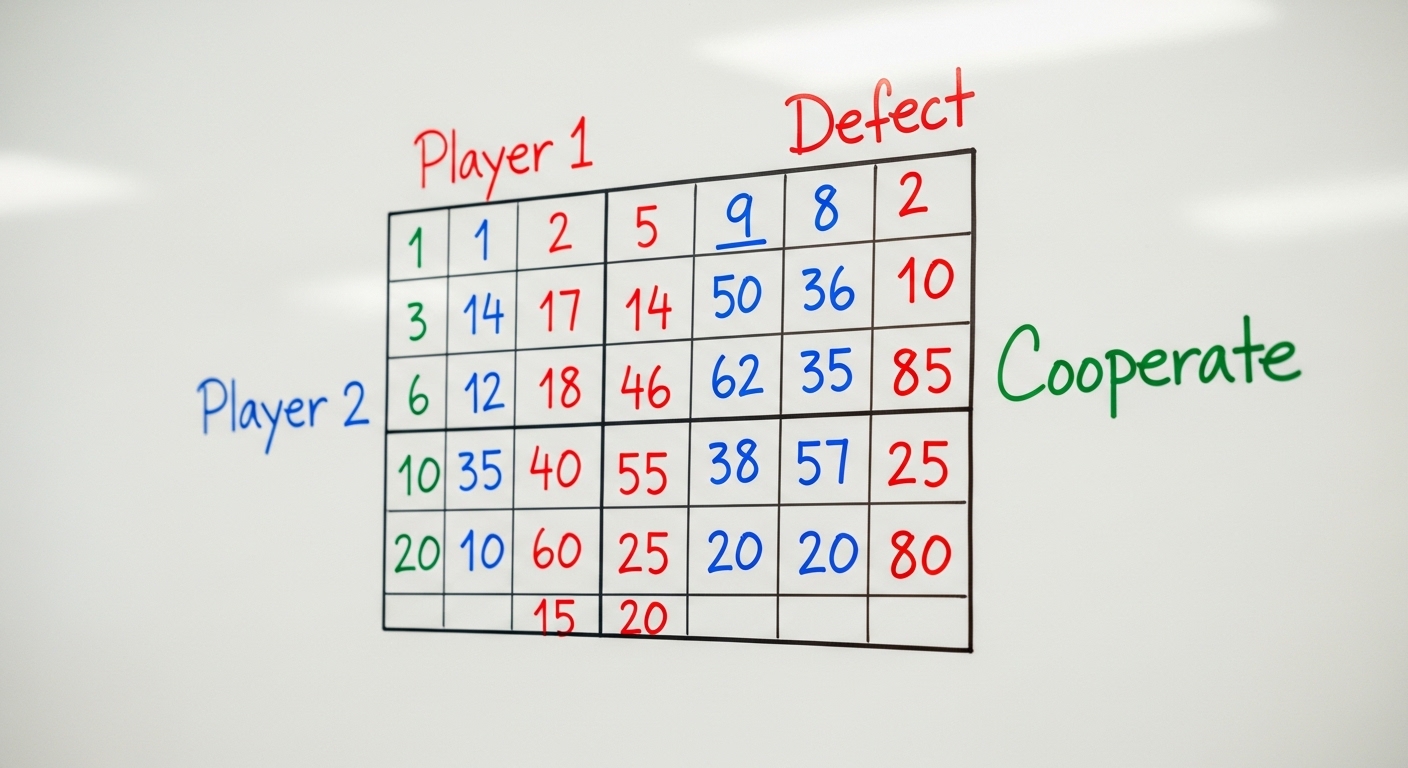
How the Prisoner's Dilemma Actually Works — The Game Theory Behind It
Why Rational People Choose the Worse Outcome
The dilemma is genuinely paradoxical because both players are acting rationally — and yet they end up worse off than if they had both acted "irrationally." Each player's logic is airtight from their own perspective. The problem is that individual rationality and collective rationality point in opposite directions.
This is what makes the Prisoner's Dilemma so much more than a thought experiment. It's a formal proof that self-interest can produce outcomes that harm everyone involved. Economists call this a "social dilemma," and it's the engine behind many of the most stubborn problems in human society.
Individual rationality and collective rationality can point in opposite directions — and when they do, everyone loses.
What Changes When the Game Repeats
The single-round version almost always ends in mutual betrayal. But something fascinating happens when the same two players face the dilemma repeatedly — this is called the Iterated Prisoner's Dilemma. Now reputation matters, and future consequences can influence present choices.
In a landmark series of computer tournaments organized by political scientist Robert Axelrod in the early 1980s, the winning strategy was disarmingly simple: cooperate on the first move, then do whatever your opponent did last round. This strategy — called Tit for Tat — beat far more complex strategies by being nice, retaliatory, forgiving, and clear. The key insight was that cooperation can evolve even among purely self-interested players, as long as the relationship continues long enough.

Where the Prisoner's Dilemma Shows Up in Real Life
Arms Races Between Nations
The Cold War arms race between the United States and the Soviet Union is one of the most documented real-world examples of the Prisoner's Dilemma at scale. Both sides would have been safer — and spent far less — if neither had built massive nuclear arsenals. But each side's dominant strategy was to arm up regardless of what the other did. The result was mutual betrayal on a civilizational scale: both nations spent enormous resources reaching a standoff that left everyone less secure.
The same logic applies to any two competing nations considering whether to subsidize their own industries, impose tariffs, or develop biological weapons. The structure of the incentives is identical to the interrogation room.
Business Competition and Price Wars
Two airlines operating the same route could both keep prices high and profit comfortably. But each airline has an incentive to undercut the other to grab more passengers. If both cut prices, both earn less — the classic mutual-betrayal outcome. Price wars in the airline industry, the smartphone market, and retail have all followed this pattern, sometimes driving companies to near-bankruptcy even when the industry as a whole would have been healthier with stable pricing.
Climate Change Negotiations
Every country benefits if all countries reduce carbon emissions. But each individual country bears real economic costs to cut emissions, while the benefits are shared globally. The temptation to "defect" — keep polluting while others cut back — is structurally identical to betraying your partner in the interrogation room. International climate agreements are essentially attempts to engineer a cooperative equilibrium in a massive, multi-player Prisoner's Dilemma.

Why the Prisoner's Dilemma Matters Beyond Game Theory
What It Reveals About Human Cooperation
Here's the counterintuitive part: research suggests that real humans cooperate far more often than the pure logic of the dilemma predicts. Laboratory experiments consistently show that a significant portion of participants choose to stay silent — to cooperate — even in one-shot games where betrayal is the "rational" choice. Emotions like guilt, empathy, and a sense of fairness appear to override cold calculation.
Humans cooperate more than the math says they should — and that gap between theory and behavior is where culture, trust, and civilization actually live.
Applications in Biology and Evolution
The Prisoner's Dilemma isn't just a human story. Biologists have found its structure in the behavior of bacteria, immune cells, and even plants competing for root space. Organisms that "cooperate" — by sharing resources or warning others of predators — often outcompete purely selfish ones over time, especially in stable communities. This has become a key framework for understanding how altruism could evolve through natural selection without requiring any conscious intent.
How Institutions Solve the Dilemma
Laws, contracts, and social norms are, in a deep sense, technologies for escaping Prisoner's Dilemmas. A contract between two businesses transforms a one-shot game into a repeated one with enforceable consequences. Environmental regulations change the payoff matrix so that defecting (polluting) becomes costly. Understanding this reframes what governments and institutions actually do: they're dilemma-solving machines.
(Opinion: The most underappreciated lesson of the Prisoner's Dilemma isn't about betrayal — it's about institutional design. Societies that have built strong, trusted institutions have essentially solved hundreds of simultaneous Prisoner's Dilemmas without anyone needing to think about game theory. That's a remarkable achievement, and it's worth protecting.)
Frequently Asked Questions
Is the Prisoner's Dilemma a real scenario that happens in actual criminal cases?
The classic setup — two suspects, separate rooms, simultaneous choices — is a stylized thought experiment, not a description of standard police procedure. However, the underlying structure does appear in real plea bargaining situations, where defendants must decide whether to cooperate with prosecutors without knowing what their co-defendants will do. The dilemma captures the incentive structure accurately, even if the exact scenario is simplified.
What is the best strategy for winning the Prisoner's Dilemma?
In a single-round game, betrayal is the dominant strategy if you're purely self-interested. In repeated games, research from Robert Axelrod's tournaments suggests that simple cooperative strategies — particularly Tit for Tat and its variants — tend to outperform aggressive ones over time. The "best" strategy depends heavily on whether the game is played once or many times, and whether you care about the other player's outcome.
How is the Prisoner's Dilemma different from the Nash Equilibrium?
The Nash Equilibrium is a concept that applies to many games: it's any outcome where no player can improve their result by changing their strategy alone. The Prisoner's Dilemma is a specific type of game where the Nash Equilibrium (mutual betrayal) is worse for everyone than another available outcome (mutual cooperation). The dilemma is famous precisely because it shows that Nash Equilibria are not always good outcomes — they're just stable ones.
The Prisoner's Dilemma has been around as a formal concept since the early 1950s, and it keeps proving its relevance. Every time you see two competitors stuck in a race to the bottom, two nations locked in an arms buildup, or two neighbors refusing to cooperate on something that would benefit both, you're watching the same ancient logic play out. Recognizing the structure is the first step toward escaping it — and that's a skill worth having.



Comments
Post a Comment