What Is a Satellite Constellation? The Tech Behind Global Internet Explained
A single satellite orbiting 35,000 kilometers above Earth can see roughly one-third of the planet's surface — which sounds impressive until you realize it also introduces a half-second delay into every data packet you send. That latency problem is exactly why engineers stopped thinking about lone satellites and started thinking about swarms. A satellite constellation isn't just a collection of spacecraft; it's a coordinated network designed so that at least one satellite is always overhead, always close enough to cut that delay down to something a video call can actually survive.
What Is a Satellite Constellation, Really?
The Basic Definition — and Why It's Different From a Single Satellite
A satellite constellation is a group of artificial satellites working together as a unified system, coordinated in their orbits so they provide continuous, overlapping coverage of a target area — or the entire globe. The key word is coordinated. These aren't satellites launched independently and hoping for the best. Their orbital planes, altitudes, and inclinations are calculated together so the geometry of the network holds together over time.
Traditional communications satellites sit in geostationary orbit (GEO), roughly 35,786 kilometers up, where they appear stationary relative to the ground. That fixed position is useful for broadcasting, but the distance creates unavoidable latency — physics sets a hard floor around 240 milliseconds round-trip just for the signal to travel up and back. For streaming video, that's tolerable. For real-time gaming or financial trading, it's a dealbreaker.
Constellations solve this by operating in low Earth orbit (LEO), typically between 300 and 2,000 kilometers altitude. The satellites move fast — completing a full orbit in roughly 90 to 120 minutes — but because there are hundreds or thousands of them, a ground terminal always has one nearby. The latency drops to somewhere between 20 and 40 milliseconds for the best current systems, which is genuinely competitive with terrestrial broadband.
The latency advantage of LEO isn't marginal — it's a 6x to 10x improvement over geostationary systems, and that gap is what makes satellite internet usable for the first time in most real-world applications.
How Does a Satellite Constellation Actually Work?
Orbital Shells, Planes, and the Math of Coverage
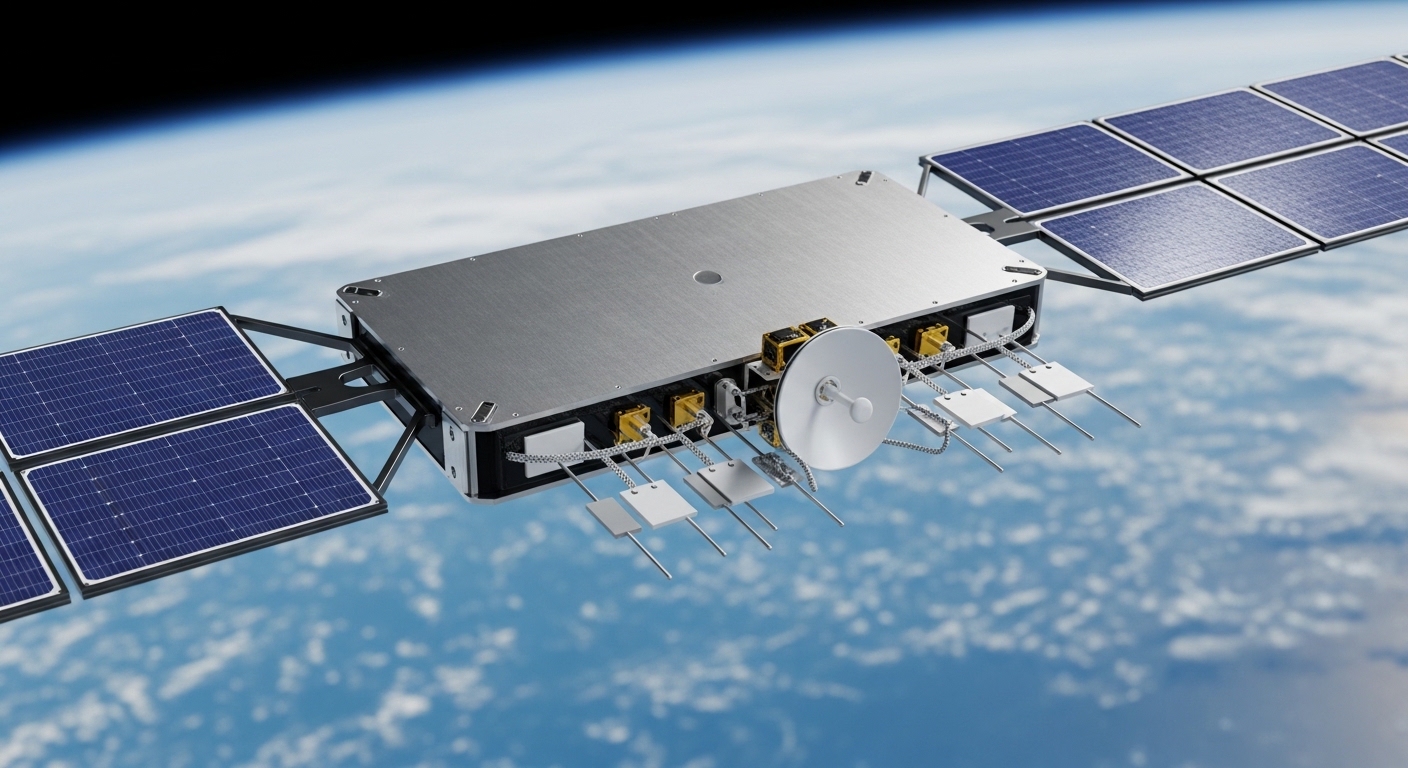
Building a constellation starts with choosing an orbital shell — a specific altitude band — and then distributing satellites across multiple orbital planes within that shell. Think of it like slicing an orange: each slice is an orbital plane, tilted at a specific angle relative to the equator (called inclination). Satellites within each plane are spaced evenly, and the planes themselves are spread around the globe.
The number of planes and satellites per plane determines coverage density. A constellation designed for global coverage needs enough satellites that as one passes out of view, another is already rising. At very low altitudes, each satellite has a smaller footprint on the ground, so you need more of them. This is why some planned constellations involve thousands of spacecraft — not ambition for its own sake, but geometry.
How Data Moves Through the Network
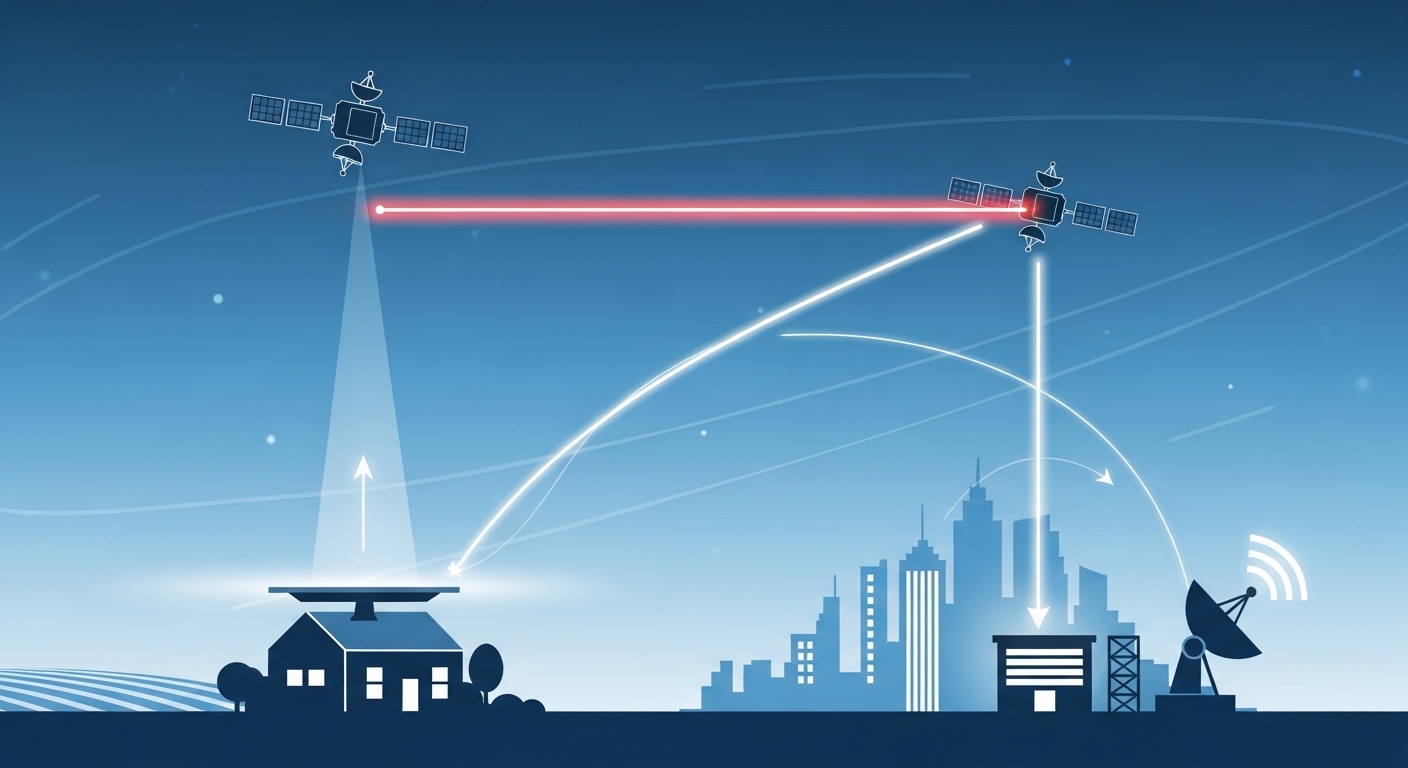
When you send a request through a LEO constellation, your ground terminal (a flat-panel dish, typically) locks onto the nearest satellite. That satellite either beams the signal down to a ground station connected to the internet backbone, or — in more advanced systems — passes it laterally to a neighboring satellite using inter-satellite links (ISLs). ISLs are laser or radio links between spacecraft, letting data hop across the constellation without touching the ground until it reaches a gateway near its destination.
ISLs are the engineering detail most overviews skip. They matter enormously because they allow the constellation to route traffic over the shortest geometric path, which in some cases is actually faster than fiber — light travels faster through the vacuum of space than through glass. For routes between distant cities, a constellation with ISLs can theoretically beat terrestrial fiber on raw latency.
Ground terminals have gotten dramatically simpler. Early satellite dishes required precise mechanical pointing. Modern phased-array terminals use electronically steered beams — no moving parts — and can track a fast-moving LEO satellite while simultaneously acquiring the next one before the handoff. That seamless handoff happens many times per hour without the user noticing.
Real-World Examples — Who's Actually Running These Networks?
Starlink: The Constellation That Changed the Conversation
SpaceX's Starlink is the most publicly visible example of a modern LEO constellation. By the mid-2020s, it had deployed thousands of satellites across multiple orbital shells, making it by far the largest active constellation in history. It operates primarily in the 550-kilometer shell, with additional satellites at higher altitudes for polar coverage. Users in rural areas — farms, remote research stations, ships at sea — have reported download speeds that would have been unimaginable from a satellite dish a decade ago.
The Ukraine conflict brought Starlink unexpected geopolitical prominence when terminals were deployed to maintain communications infrastructure under conditions where ground-based networks had been damaged. That real-world stress test demonstrated both the resilience and the strategic implications of privately operated global communications infrastructure.
Other Players Worth Knowing
Amazon's Project Kuiper received regulatory approval to deploy thousands of satellites and began launching in the mid-2020s, positioning itself as a direct Starlink competitor. OneWeb, now operating under different ownership, focuses on enterprise and government customers with a smaller constellation at higher LEO altitudes. Telesat's Lightspeed targets a similar enterprise market with a design philosophy that prioritizes ISLs from the start.
China has announced plans for its own large-scale LEO constellations, with state-backed projects targeting tens of thousands of satellites. The orbital spectrum is becoming genuinely crowded — which is not a metaphor. Orbital slots and radio frequency allocations are finite resources, and the race to file for them with the International Telecommunication Union has become its own competitive arena.

Why Satellite Constellations Matter — and What's Still Broken
The Connectivity Gap They're Trying to Close
Estimates vary, but a significant portion of the global population still lacks reliable broadband access — not because the technology doesn't exist, but because laying fiber or building cell towers in remote or low-income areas doesn't pencil out economically. Satellite constellations sidestep that infrastructure problem entirely. A fishing village on an island, a school in a mountainous region, an oil platform — all become reachable with the same service.
(Opinion: The connectivity argument is genuinely compelling, but it's worth being skeptical about whether current pricing structures actually reach the people who need it most. A terminal that costs several hundred dollars upfront and requires a monthly subscription is still out of reach for many of the world's unconnected communities. The technology is ahead of the business model.)
The Problems That Don't Get Enough Attention
Orbital debris is the issue that keeps satellite engineers up at night. At LEO altitudes, even a paint fleck traveling at orbital velocity carries enough kinetic energy to damage a spacecraft. Thousands of new satellites dramatically increase collision probability, and a cascade of collisions — the Kessler syndrome scenario — could render certain orbital bands unusable for generations. Most constellation operators plan for deorbiting their satellites within a few years of end-of-life, but enforcement is inconsistent.
Astronomers have raised sustained objections about light pollution. Satellites in low orbits are bright enough to streak through long-exposure images, interfering with ground-based telescope observations. Operators have experimented with darkening coatings and modified orientations to reduce reflectivity, with mixed results. The tension between commercial space ambitions and scientific infrastructure is unlikely to resolve cleanly.
Kessler syndrome isn't science fiction — it's a mathematically predictable threshold, and the more satellites we launch without robust deorbit guarantees, the closer we get to making certain orbits permanently unusable.

Frequently Asked Questions
How many satellites does a constellation need to cover the whole Earth?
It depends heavily on altitude. At very low orbits (around 300–400 km), each satellite's ground footprint is small, so you might need several thousand to achieve continuous global coverage. At higher LEO altitudes (around 1,200 km), fewer satellites can cover the same area because each one sees a larger swath of ground. Most current global broadband constellations plan for somewhere between 600 and several thousand satellites for full coverage, with denser deployments improving capacity rather than just coverage.
Is satellite internet from a constellation the same as old satellite internet?
Not really. Traditional satellite internet used geostationary satellites roughly 36,000 km up, which introduced latency of 500–700 milliseconds round-trip — enough to make video calls choppy and online gaming nearly impossible. LEO constellations operate at a fraction of that altitude, cutting latency to 20–60 milliseconds in most cases. The user experience is genuinely different, closer to a slow terrestrial broadband connection than the old satellite experience most people remember.
Can satellites in a constellation crash into each other?
It's a real concern, not a theoretical one. Operators use conjunction analysis — continuous monitoring of predicted close approaches — and maneuver satellites when a collision probability exceeds a threshold (typically around 1 in 10,000). The challenge scales with the number of objects in orbit. With thousands of active satellites plus existing debris, the number of conjunction events that need evaluation each week has grown substantially, and the coordination between operators is still largely informal rather than governed by binding international rules.
The strangest thing about satellite constellations is that the hardest engineering problem turned out not to be the rockets or the satellites themselves — it was the ground terminal. Getting a phased-array antenna cheap enough for a household to buy was the bottleneck that held back LEO internet for years. The satellites were almost the easy part. That inversion — where the thing in space is simpler than the thing on your roof — says something about how much the economics of space access have shifted, and how much further they still have to go before the connectivity promise actually reaches everyone it's supposed to reach.


Comments
Post a Comment