The Four Fundamental Forces of Nature: Explained for Beginners
Everything that has ever happened in the universe — every explosion, every heartbeat, every atom holding together — comes down to just four forces. Not dozens, not hundreds. Four. And the strangest part is that physicists still have no idea how to make two of them fit into the same mathematical framework as the other two.

What Are the Four Fundamental Forces?
A Quick Map of the Forces
The four fundamental forces are gravity, electromagnetism, the strong nuclear force, and the weak nuclear force. Every physical interaction you have ever witnessed — a magnet snapping to a fridge, a nuclear reactor generating heat, the sun fusing hydrogen — is one of these four forces at work. Nothing else.
What makes them 'fundamental' is that they cannot be broken down into something simpler. Friction, for instance, is not a fundamental force — it is electromagnetism in disguise, playing out between the electrons on two surfaces. Air resistance, tension in a rope, the pressure of a chair against your back: all electromagnetism.
Each force also has a characteristic range and strength. Gravity is the weakest of the four by an almost incomprehensible margin, yet it shapes galaxies. The strong nuclear force is the most powerful, yet it operates only across distances smaller than a proton. Understanding why requires looking at each one individually.
How Gravity and Electromagnetism Shape Everything You Can See
Gravity: The Weakest Force That Runs the Universe
Gravity is the force between any two objects that have mass. The more mass, the stronger the pull. The greater the distance, the weaker it becomes — following what physicists call an inverse-square law, meaning double the distance and the force drops to a quarter of its original strength.
Here is the counterintuitive part: gravity is roughly 10 to the power of 36 times weaker than electromagnetism. A small fridge magnet can hold a piece of paper against the entire gravitational pull of the Earth. And yet gravity is the dominant force at cosmic scales because it only attracts — it never repels — and it works across infinite distances without canceling out.
Albert Einstein's general relativity reframed gravity not as a pulling force but as a curvature in spacetime caused by mass. A planet does not pull the moon toward it; the planet bends the fabric of space, and the moon follows that curve. This description is more accurate than Newton's version, especially near very massive objects like black holes.
Electromagnetism: The Force Behind Almost Everything Else
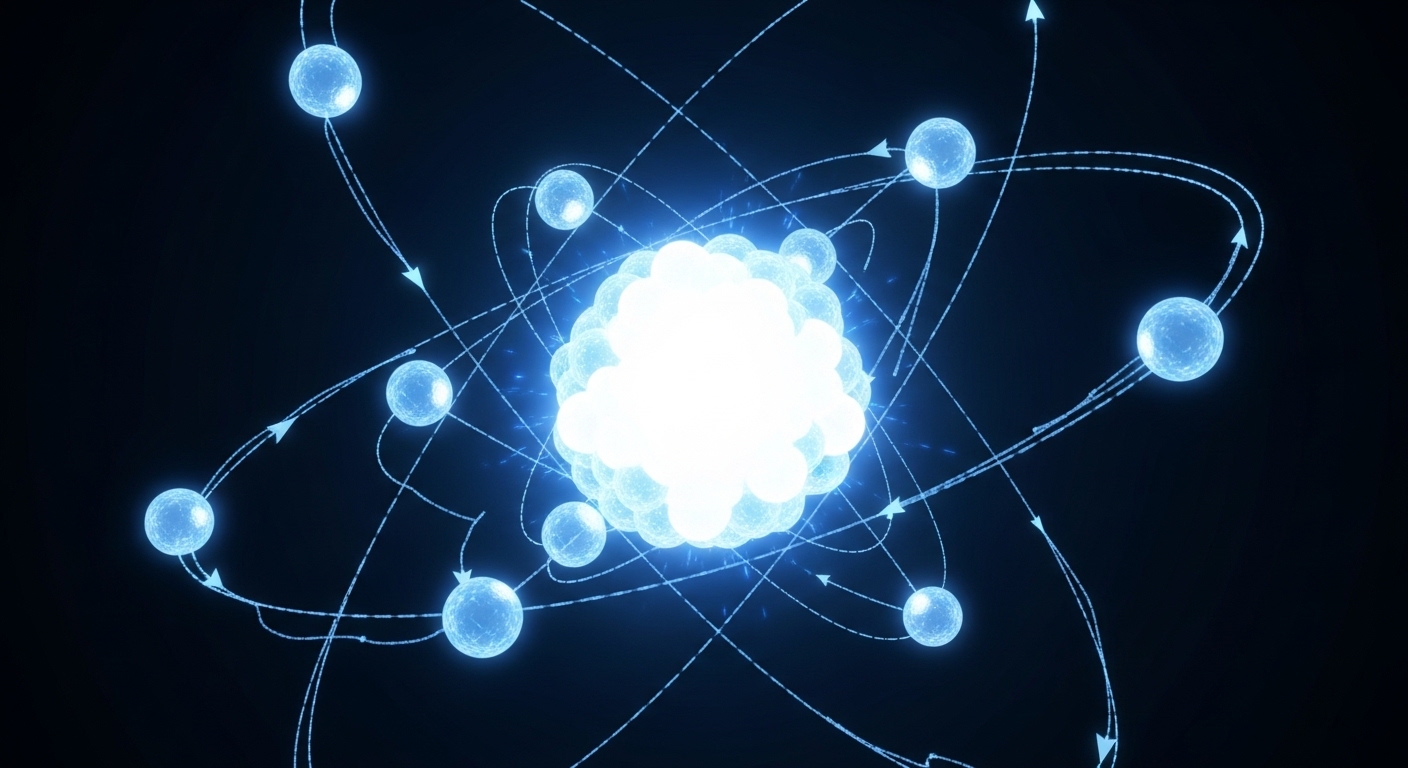
Electromagnetism governs the behavior of electrically charged particles. It is responsible for light, radio waves, X-rays, chemical bonds, and the fact that you do not fall through your chair. The force is carried by photons — the same particles that make up visible light — even when no light is visibly present.
James Clerk Maxwell unified electricity and magnetism into a single theory in the 1860s, which was one of the great intellectual achievements of the 19th century. His equations predicted that electromagnetic waves travel at a fixed speed — and that speed turned out to be the speed of light. Which sounds like a coincidence, but is not.
Electromagnetism is so dominant in everyday life that almost every force you physically feel — pushing, pulling, touching — is just electrons repelling each other at very short range.

How the Strong and Weak Nuclear Forces Work Inside Atoms
The Strong Force: What Holds Atomic Nuclei Together
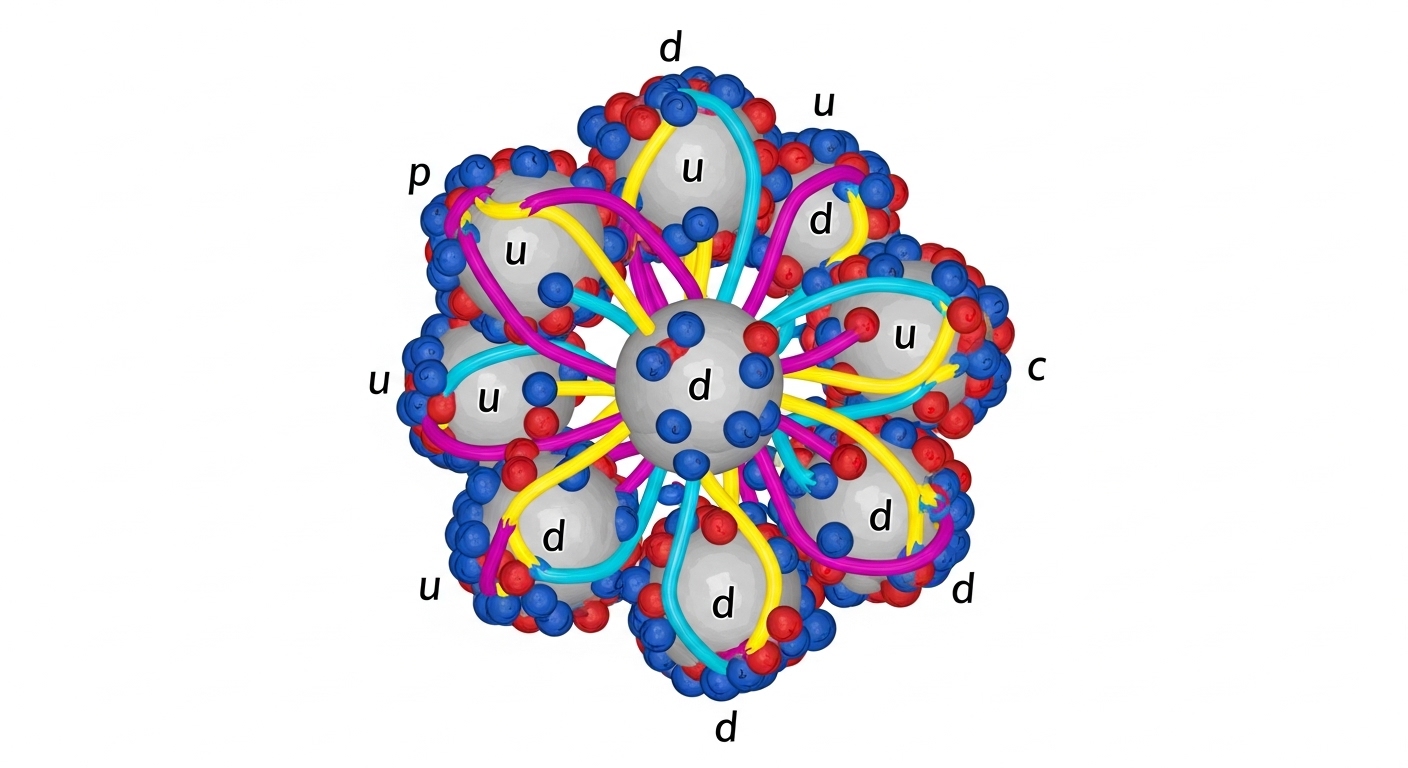
Atomic nuclei are packed with positively charged protons. Positive charges repel each other electromagnetically, so by all rights, every nucleus should instantly fly apart. The reason it does not is the strong nuclear force, which overpowers electromagnetic repulsion at extremely short distances — roughly the diameter of a proton.
The strong force is mediated by particles called gluons, and it acts on quarks — the building blocks of protons and neutrons. A proton is made of three quarks held together by gluons. A residual version of this force, sometimes called the nuclear force, also binds protons and neutrons together inside the nucleus.
The practical consequence of the strong force is enormous. Nuclear fission — the process used in nuclear power plants and atomic bombs — releases energy by breaking apart heavy nuclei, allowing the strong force's stored energy to convert into heat and radiation. The energy density is staggering compared to any chemical process.
The Weak Force: The One That Changes Particles
The weak nuclear force is the odd one out. It does not hold things together or pull them apart in the conventional sense. Instead, it changes the identity of particles — specifically, it converts one type of quark into another, which transforms neutrons into protons (or vice versa) in a process called beta decay.
Beta decay is how radioactive elements like carbon-14 slowly transform into other elements over time. This is the mechanism behind radiocarbon dating, which archaeologists use to date organic material up to roughly 50,000 years old. The weak force, operating inside individual atoms, is what makes that clock tick.
The weak force is also responsible for the nuclear reactions that power the sun. Without it, hydrogen could not fuse into helium, and the sun would not shine. It is called 'weak' not because it is feeble, but because its effective range is even shorter than the strong force — about one thousandth the diameter of a proton.
Without the weak force, the sun stops working. It is the force that almost nobody has heard of, quietly keeping every star in the universe burning.
Why Unifying All Four Forces Is Physics' Biggest Unsolved Problem
The Standard Model and Its Blind Spot
Physicists have successfully unified three of the four forces — electromagnetism, the strong force, and the weak force — into a framework called the Standard Model. It is one of the most precisely tested theories in science. Some of its predictions have been confirmed to more than ten decimal places of accuracy.
Gravity refuses to cooperate. General relativity, which describes gravity beautifully at large scales, is mathematically incompatible with quantum mechanics, which governs the other three forces at small scales. When you try to combine them, the equations produce infinities — meaningless results that signal a breakdown in the theory.
String theory, loop quantum gravity, and several other frameworks have been proposed to bridge this gap. None has been experimentally confirmed. This is not a minor technical footnote — it means our best description of the universe is fundamentally split in two, and nobody knows how to fix it.
The Electroweak Unification — and What It Suggests
In the 1960s and 70s, physicists Sheldon Glashow, Abdus Salam, and Steven Weinberg showed that electromagnetism and the weak force are actually two aspects of a single 'electroweak' force. At extremely high energies — the kind present just after the Big Bang — they behave as one. This earned them the Nobel Prize in Physics in 1979.
The fact that two forces can merge under the right conditions has led many physicists to suspect that all four forces were once unified in the first moments after the Big Bang, and then 'froze out' into separate forces as the universe cooled. This idea, called Grand Unification, remains unproven but is a major driver of theoretical physics research.
(Opinion: The unification problem is one of the most genuinely humbling things in science. We have sent probes beyond the solar system and sequenced the human genome, yet we cannot write a single equation that covers all four forces. That gap feels less like a puzzle waiting to be solved and more like a sign that we are missing something conceptually fundamental — not just mathematically.)
Frequently Asked Questions
Which of the four fundamental forces is the strongest?
The strong nuclear force is the most powerful of the four. It is roughly 100 times stronger than electromagnetism at the distances inside an atomic nucleus, and vastly stronger than gravity. Its extreme strength is why nuclear reactions release so much more energy than chemical ones.
Why can't we feel the strong or weak nuclear forces in daily life?
Both forces operate only at subatomic distances — far smaller than anything we can directly perceive. The strong force's range is roughly the size of a proton. The weak force's range is even shorter. At any scale larger than an atomic nucleus, both forces effectively vanish, which is why gravity and electromagnetism are the only forces we experience directly.
Is there a fifth fundamental force?
Possibly. Some physicists have proposed that dark energy — the mysterious force accelerating the expansion of the universe — could represent a fifth fundamental interaction. There have also been occasional experimental hints of anomalies that do not fit the Standard Model, though none has been definitively confirmed as of now. The search is ongoing and genuinely open.
The four forces have been known in their current form for roughly half a century, yet the deeper question — why these four, why these strengths, why these ranges — has no answer. The universe did not come with an explanation for its own architecture. We just live inside it, running experiments, and hoping the math eventually tells us something the math was not designed to say.



Comments
Post a Comment