Nature's Math Trick: Why Cicadas Emerge in Prime Number Cycles
Every 13 or 17 years, billions of cicadas burst from the ground simultaneously, fill the air with a deafening chorus, mate, lay eggs, and die — all within a few weeks. The timing is not random. These insects have, through evolution, locked themselves to prime numbers, and the reason why is one of the most elegant examples of natural selection doing something that looks suspiciously like mathematics.

What Are Periodical Cicadas — and How Are They Different?
Not All Cicadas Are the Same
Most people have heard cicadas in summer and assumed they show up every year. That is true for 'annual' cicadas, which actually have multi-year life cycles but emerge in overlapping cohorts so some are always present. Periodical cicadas are a completely different story. Found only in eastern North America, they belong to the genus Magicicada and spend almost their entire lives underground as nymphs, feeding on tree root fluids.
There are multiple distinct broods — geographically separated populations — each synchronized to either a 13-year or 17-year cycle. When their time comes, they all emerge together in a single massive event. The sheer scale of it is staggering: population densities can reach over a million individuals per acre in some forested areas.
The Underground Clock
How does a cicada nymph count years underground? Research suggests they track the annual cycle of a specific sugar — xylem fluid — that flows through tree roots in a pattern tied to the seasons. Each spring flush of that fluid appears to register as one year in the cicada's internal counter. When the counter hits 13 or 17, something triggers a mass synchronized emergence. The mechanism is still not fully understood, which is part of what makes it fascinating.

Why Prime Numbers? The Evolutionary Logic Behind the Cycle
The Predator Satiation Strategy
The most widely accepted explanation starts with a concept called predator satiation. When cicadas emerge in massive numbers, predators — birds, raccoons, foxes, squirrels — eat their fill and still cannot make a dent in the population. There are simply too many cicadas for any predator to meaningfully reduce the breeding population. This is a numbers game, and cicadas win it by going all-in at once rather than trickling out year after year.
But satiation alone does not explain why the cycle has to be prime-numbered. Any long cycle would reduce predator pressure. The prime number part is a separate, more subtle advantage.
The Prime Number Defense Against Synchronization
Here is where the math becomes genuinely surprising. Suppose a predator species — or a competing cicada brood — has a population cycle of its own, say a boom-and-bust pattern every 2, 3, 4, or 6 years. If a cicada brood emerges on a non-prime cycle, say every 12 years, it will periodically coincide with predator population peaks. A 12-year cicada would overlap with a 4-year predator cycle every 12 years, with a 3-year cycle every 12 years, and with a 6-year cycle every 12 years. Those overlaps happen frequently.
A prime-numbered cycle minimizes how often it coincides with any shorter repeating cycle — that is not a coincidence, it is the mathematical definition of what a prime number does.
A 17-year cicada, by contrast, shares a common multiple only with cycles that are themselves multiples of 17. A predator on a 2-year cycle would only synchronize with a 17-year emergence every 34 years. A predator on a 3-year cycle would only sync up every 51 years. The cicada effectively becomes a moving target that almost nothing can reliably time its own boom to intercept.
The Hybridization Problem
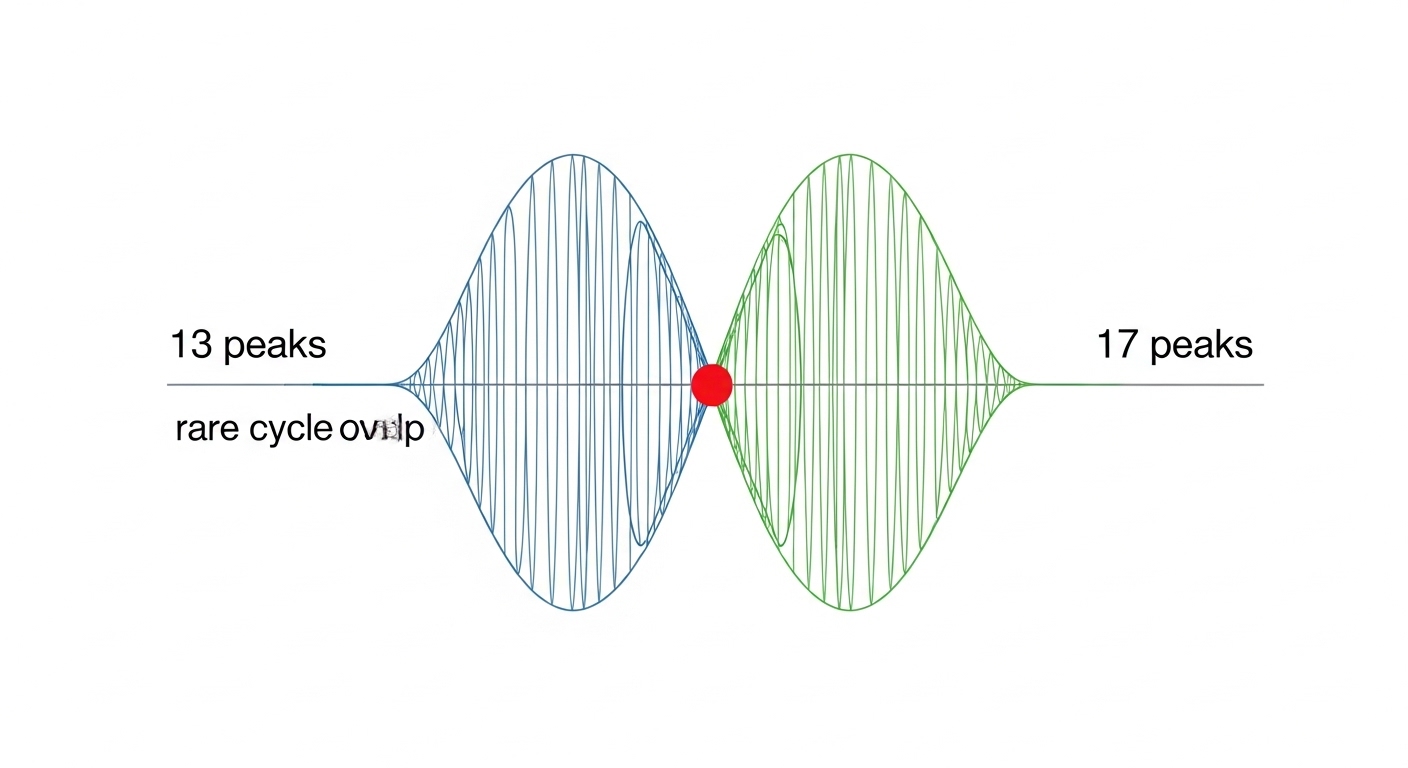
There is a second, less obvious advantage. If two broods with different cycles were to emerge in the same location simultaneously, they might interbreed and produce offspring with intermediate cycle lengths — say, 15 years. A 15-year cycle is not prime. It factors into 3 and 5, meaning it would sync up with shorter cycles far more often. Those hybrid offspring would face heavier predation and die out. Prime cycles are self-reinforcing: they resist being diluted by hybridization because the math keeps the broods apart. A 13-year and 17-year brood only co-emerge in the same location every 221 years.
Where You Can Actually See This Happen
Brood XIII and Brood XIX — A Rare Double Emergence
In 2024, something remarkable happened in parts of the American Midwest: Brood XIII (a 17-year brood) and Brood XIX (a 13-year brood) emerged simultaneously for the first time since 1803. Parts of Illinois sat at the geographic overlap zone, and observers reported densities that made walking through some forests feel genuinely surreal — the ground crunching underfoot, the noise reaching levels comparable to a lawnmower. This kind of dual emergence will not happen again until 2245.
That event was a living demonstration of the math. Two prime cycles, running independently for over two centuries, briefly intersected — exactly as the arithmetic predicts they would, rarely and on a schedule no predator could reliably exploit.
What Happens to Animals During an Emergence
Local bird populations visibly gorge during emergences and have been documented to temporarily abandon their usual territories to congregate where cicadas are densest. Some research suggests that the nutrient pulse from billions of decaying cicada bodies after the emergence measurably boosts tree growth in affected forests that same year. The cicadas are not just surviving the ecosystem — they are briefly restructuring it.
The cicada's death matters as much as its emergence: the nitrogen from billions of decomposing bodies acts like a slow-release fertilizer, and the forest responds.

Why This Discovery Matters Beyond Cicadas
Evolution Does Not 'Know' Math — But It Finds It Anyway
The cicada case is a striking example of how natural selection can stumble onto abstract mathematical principles without any planning or foresight. No cicada 'chose' a prime cycle. Over millions of years, variants with non-prime cycles were more likely to be wiped out during predator peaks or diluted by hybridization. Prime-cycle variants survived. The math was always there; evolution just kept eliminating everything that did not fit it.
This pattern — where biology independently arrives at solutions that mathematicians would recognize — shows up elsewhere. Sunflower seed arrangements follow Fibonacci sequences. Nautilus shells approximate logarithmic spirals. Honeycomb cells are hexagons because hexagons pack the most area with the least wax. Nature does not do math on purpose, but math describes the shapes that survive.
What Researchers Are Still Trying to Figure Out
The molecular mechanism of the cicada's internal clock remains genuinely open. Scientists have proposed that gene expression tied to seasonal xylem changes acts as the counter, but pinning down the exact genetic pathway has proven difficult. There is also an unresolved question about how the very first prime cycles got established — the transition from a non-prime ancestor cycle to a prime one would have required specific conditions that researchers are still modeling.
(Opinion: The cicada story is one of those rare cases where a biological fact is more elegant than any analogy you could invent for it. The idea that a blind evolutionary process independently derived a number-theoretic solution to a predator problem is, frankly, more impressive than most things humans have deliberately engineered.)
Frequently Asked Questions
Do cicadas only emerge in prime-numbered years?
Periodical cicadas in North America emerge on either 13-year or 17-year cycles — both prime numbers. Annual cicada species, which are found worldwide, do not follow this pattern and appear every summer. The prime-cycle behavior is specific to the Magicicada genus and is thought to be an evolved defense against predator synchronization.
Could a cicada brood ever shift to a different cycle length?
It has almost certainly happened in evolutionary history, and researchers have documented rare 'stragglers' — individual cicadas that emerge a year early or late. If enough stragglers survive and breed successfully, a new brood with a shifted cycle could theoretically establish itself. In practice, a shift to a non-prime cycle would likely be selected against over time because of increased predator overlap. Some researchers believe this is exactly how the current prime cycles were originally established — through gradual shifts that happened to land on primes and then stuck.
Why are periodical cicadas only found in eastern North America?
The honest answer is that scientists are not entirely certain. The leading hypothesis involves the glacial history of North America: repeated ice age cycles may have fragmented and isolated cicada populations in eastern refugia, creating the conditions for extreme synchronization to evolve as a survival strategy. Similar extreme periodicity has not been documented in cicada species elsewhere, though some other insects show shorter synchronized cycles.
What makes the cicada story linger is not just the cleverness of the solution — it is the timescale. These insects have been running this same prime-number program for millions of years, outlasting predators, ice ages, and the entire history of human civilization several times over. The next time Brood XIII and Brood XIX meet again in 2245, whatever is standing in those Illinois forests will have no idea it is witnessing the product of an evolutionary equation that was already ancient when the first humans crossed into North America.



Comments
Post a Comment