What Are Planetary Conjunctions? Explaining Celestial Alignments
On the evening of December 21, 2020, millions of people stepped outside and saw something that hadn't been visible to the naked eye since the Middle Ages: Jupiter and Saturn so close together they looked like a single brilliant star. Astronomers called it the 'Great Conjunction,' and it generated more public interest in the night sky than almost any event in recent memory. But what actually causes two planets to appear that close — and does it mean anything beyond the visual spectacle?
What Is a Planetary Conjunction, Exactly?
The Plain-Language Definition
A planetary conjunction happens when two or more planets appear to occupy nearly the same position in the sky as seen from Earth. The key word is 'appear.' The planets aren't actually close to each other in space — they're often hundreds of millions of kilometers apart. What you're seeing is a line-of-sight effect, like holding up two fingers at arm's length and making them overlap.
Astronomers define a conjunction more precisely: it occurs when two objects share the same right ascension — essentially the same 'column' of sky measured along the celestial equator. The angular separation at that moment can range from a fraction of a degree to several degrees, and that gap determines whether the event looks dramatic or underwhelming.
There's also a related term worth knowing: 'appulse.' That's when two objects reach their closest apparent approach, which doesn't always coincide exactly with the conjunction by right ascension. For casual observers, the distinction rarely matters. For someone trying to predict whether the two planets will fit inside a single telescope eyepiece, it matters quite a bit.
Inferior vs. Superior Conjunctions
When the inner planets — Mercury and Venus — are involved, astronomers add another layer. An 'inferior conjunction' is when Mercury or Venus passes between Earth and the Sun. A 'superior conjunction' is when the Sun sits between Earth and the inner planet. During inferior conjunctions, the planet is technically closest to us but usually lost in solar glare. During superior conjunctions, it's on the far side of the Sun and equally invisible. Neither is what most people mean when they talk about a conjunction worth watching.
How Do Planetary Conjunctions Actually Form?
The Mechanics of Orbital Speed
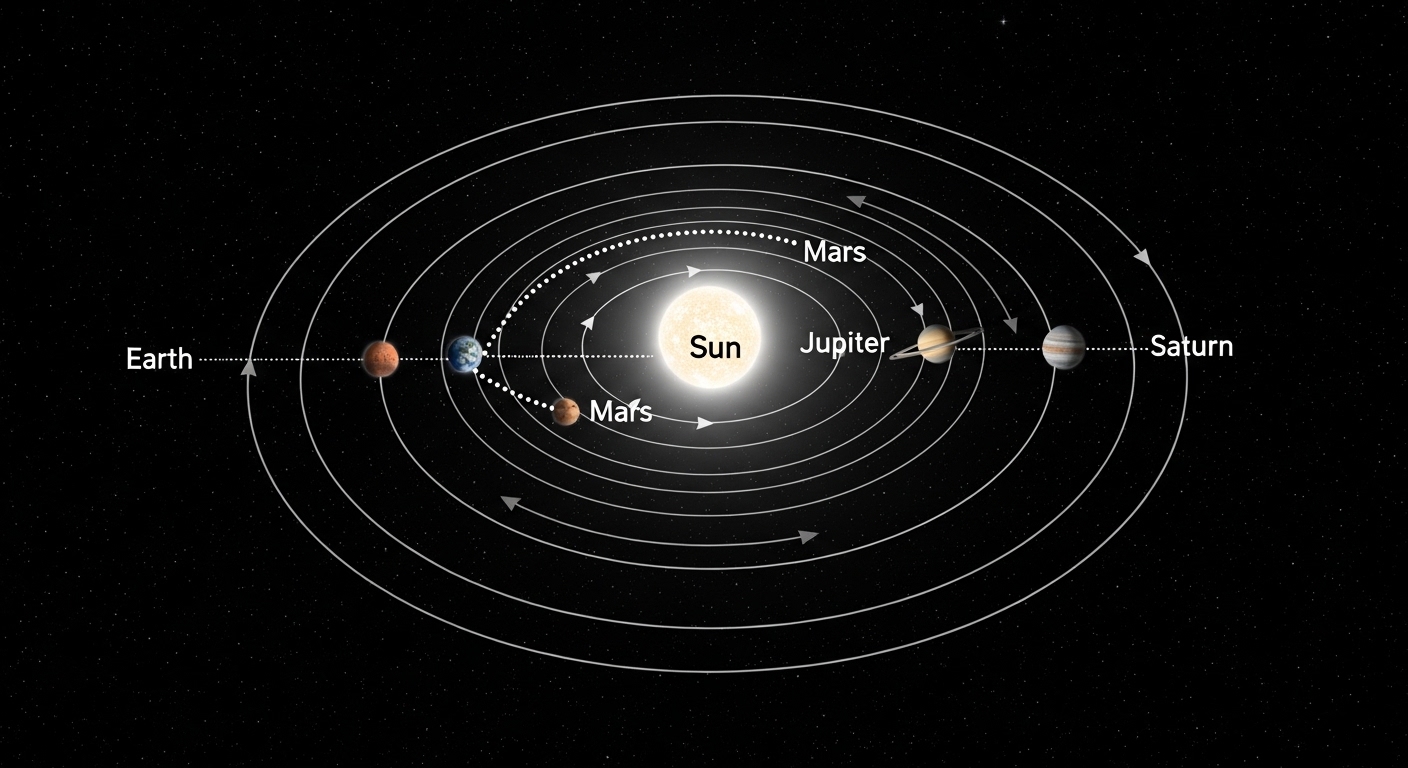
Every planet orbits the Sun at a different speed. Mercury completes a full orbit in about 88 days. Saturn takes roughly 29 years. Because inner planets move faster, they periodically 'lap' the outer ones — and from Earth's moving vantage point, the geometry occasionally stacks planets into the same narrow slice of sky.
Think of it like watching two cars on a circular track from a fixed seat in the stands. Sometimes they're on opposite sides of the track. Sometimes they line up in front of you. The 'lapping' isn't random — it follows predictable cycles based on each planet's orbital period. Jupiter and Saturn, for instance, align in conjunction roughly every 20 years, which is why the 2020 event was so rare in its extreme closeness but not in its basic occurrence.
The planets aren't moving toward each other — Earth's own orbit is doing most of the work, shifting our viewing angle until two distant worlds appear to nearly touch.
Why Some Conjunctions Are Tighter Than Others
The planets don't all orbit in a perfectly flat plane. Each orbit is tilted slightly relative to the others — a property called orbital inclination. When two planets reach the same right ascension but their inclinations put them at different heights in the sky, the conjunction looks loose and unimpressive. When the inclinations happen to align favorably, the planets can get within a fraction of a degree of each other. The 2020 Jupiter-Saturn conjunction reached a separation of about 0.1 degrees — roughly one-fifth the apparent width of the full Moon.
That combination of timing and geometry is what makes truly close conjunctions rare. You need the orbital 'lapping' to happen at a point where both planets are also near the same ecliptic latitude. It's two independent cycles converging, which doesn't happen often.
Famous Conjunctions Throughout History — and What People Made of Them
The Star of Bethlehem Theory
Some astronomers and historians have proposed that the 'Star of Bethlehem' described in ancient texts may have been a planetary conjunction. One frequently discussed candidate is a Jupiter-Venus conjunction around 2 BCE, which would have produced an exceptionally bright object in the western sky. Another theory points to a Jupiter-Saturn conjunction in 7 BCE. Neither theory is proven, and serious scholars remain divided — but the fact that ancient observers recorded conjunctions as significant omens shows how long humans have been paying attention to these events.
For most of human history, conjunctions weren't just astronomical curiosities. They were interpreted as portents — of war, of the death of kings, of great change. Astrology built entire predictive systems around planetary alignments. The scientific revolution didn't erase that cultural weight overnight; even today, major conjunctions generate enormous public interest that has nothing to do with orbital mechanics.
The 2020 Great Conjunction
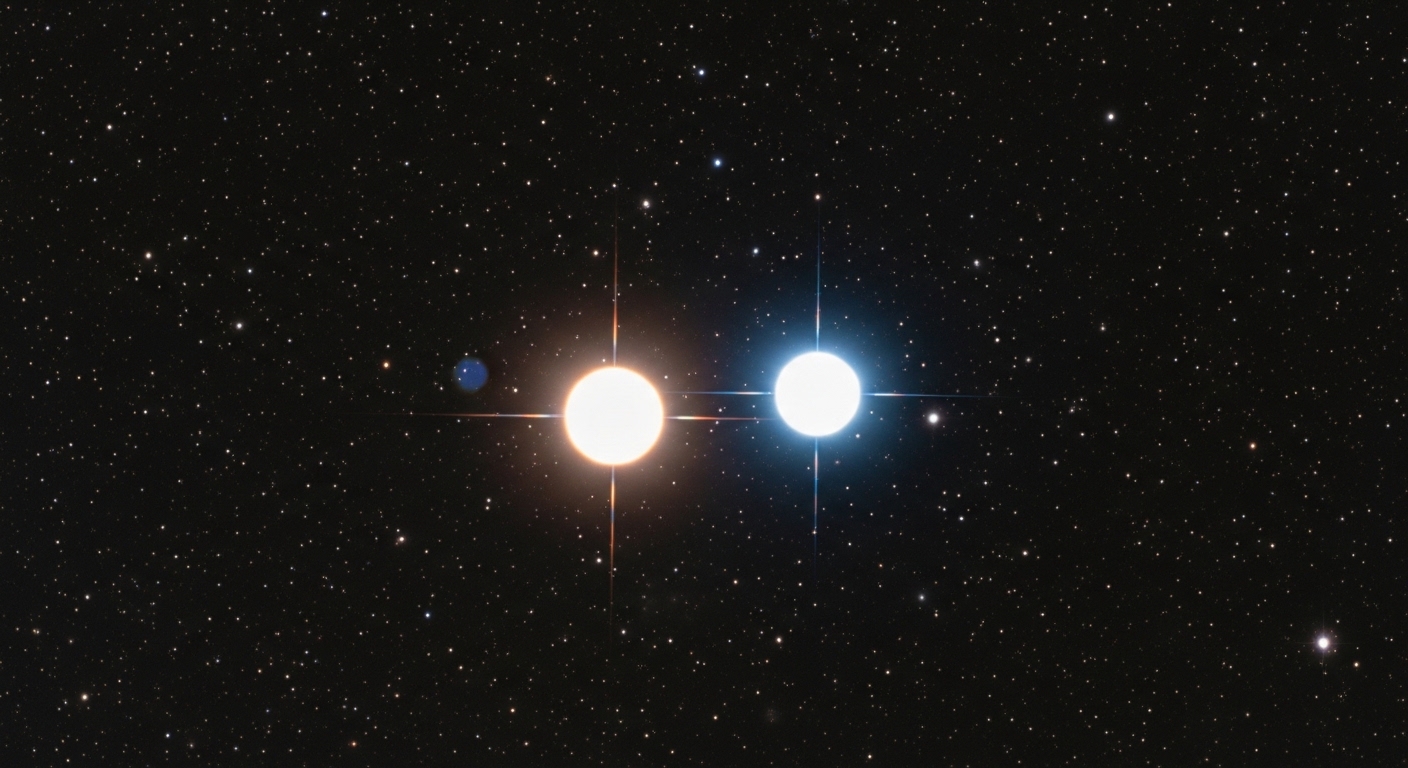
The December 2020 Jupiter-Saturn conjunction was the closest the two planets had appeared since 1623 — and the closest easily observable one since 1226. Telescope owners reported being able to see both planets and several of their moons in a single field of view, which is genuinely unusual. Jupiter's four Galilean moons and Saturn's rings in the same eyepiece is the kind of thing that makes people forget they were just going outside to check the mail.
The 2020 Great Conjunction was close enough that both planets fit inside a single low-power telescope eyepiece — something most living astronomers had never seen before.
Why Planetary Conjunctions Matter Beyond the View
What They Tell Us About Orbital Mechanics
Conjunctions are predictable to extraordinary precision. Modern ephemeris software can calculate the exact angular separation of any two planets at any moment, centuries into the future or past. That predictive power is a direct product of Newtonian mechanics and later refinements from general relativity. When a conjunction happens exactly when the math says it will, it's a quiet but powerful confirmation that our model of the solar system is correct.
There's also a practical side. Space mission planners use planetary alignments to calculate gravity-assist trajectories — the technique where a spacecraft uses a planet's gravity to change speed and direction without burning extra fuel. The Voyager missions in the late 1970s took advantage of a rare alignment of the outer planets that occurs roughly every 175 years. That alignment wasn't a conjunction in the visual sense, but it used the same underlying orbital geometry.
The Cultural Staying Power
Conjunctions keep showing up in calendars, religious texts, and cultural events because they're one of the few astronomical phenomena visible without any equipment. You don't need a telescope, a dark sky site, or any technical knowledge. You just need to look up at the right time. That accessibility has kept them culturally alive in a way that, say, a distant asteroid flyby never quite manages.
(Opinion: There's something genuinely underrated about an astronomical event that requires zero equipment and rewards the mildly curious as much as the dedicated amateur. Conjunctions are the rare case where the universe offers a spectacle with no barrier to entry — and that accessibility is worth more than any technical rarity.)
Frequently Asked Questions
How often do planetary conjunctions happen?
Conjunctions between some pair of planets happen multiple times per year — they're not rare in the broad sense. What varies is how close the apparent separation gets and how well-placed the event is for viewing. A Jupiter-Venus conjunction might happen once every year or two and can be quite striking. A Jupiter-Saturn conjunction close enough to rival the 2020 event won't recur for centuries.
Can a planetary conjunction actually affect Earth — gravitationally or otherwise?
No. Even during a close conjunction, the planets are still separated by hundreds of millions of kilometers in actual space. The combined gravitational influence of all the planets on Earth is vastly smaller than the Moon's tidal effect. Research has consistently found no measurable physical effect on Earth from planetary alignments, despite persistent claims to the contrary in popular media.
Why do some conjunctions happen near the Sun and are impossible to see?
Planets spend a portion of their orbit on the far side of the Sun from Earth's perspective, a position called 'solar conjunction.' When a conjunction between two planets happens to occur while both are near that part of their orbits, the Sun's glare makes them impossible to observe. Timing matters enormously — the same two planets can produce a spectacular naked-eye event one cycle and a completely unobservable one the next, simply because of where Earth sits in its own orbit at that moment.
The next time you hear that two planets are 'meeting' in the sky, the honest description is stranger and more interesting than the poetic one: two worlds that may be a billion kilometers apart are briefly sharing the same line of sight from a third world hurtling through space at 30 kilometers per second. The alignment is real. The proximity is an illusion. And somehow, the illusion is the part that makes people stop and look up.



Comments
Post a Comment