How Do Self-Driving Cars Work? An Explainer for Curious Minds
A self-driving car generates more data in a single hour of city driving than most laptops produce in a year. We're talking terabytes of sensor readings, camera frames, radar pings, and map comparisons — all processed in real time, all used to answer one deceptively simple question: what should I do next? The technology is genuinely fascinating, and far more layered than most coverage suggests.
What a Self-Driving Car Actually Is — Beyond the Marketing
The Six Levels of Autonomy
The industry uses a scale from Level 0 to Level 5, originally defined by SAE International. Level 0 means no automation at all. Level 2 — where most 'advanced' consumer vehicles sit today — means the car can steer and accelerate simultaneously, but a human must remain alert and ready to take over at any moment. True full autonomy, where no human input is ever needed, is Level 5. No production vehicle has reached it.
Level 3 is where things get legally and technically thorny. At Level 3, the car can handle most driving tasks but may hand control back to the driver when it encounters something it can't handle. The catch: it might give you only seconds of warning. Several automakers have quietly stepped back from Level 3 promises after realizing how difficult that handover moment is to engineer safely.
Most of what gets called 'self-driving' in headlines is actually Level 2 or Level 2+. The distinction matters enormously — not just for safety, but for how you should behave as a driver using the system.
What 'Autonomy' Actually Demands
A human driver uses vision, spatial reasoning, social intuition, and years of learned context. When you see a child's ball roll into the street, you immediately anticipate a child following it. Teaching a machine to make that same inferential leap — from a bouncing ball to an invisible child — is one of the hardest problems in the field. It's not a sensor problem. It's a reasoning problem.

How Self-Driving Cars Perceive the World Around Them
The Sensor Stack
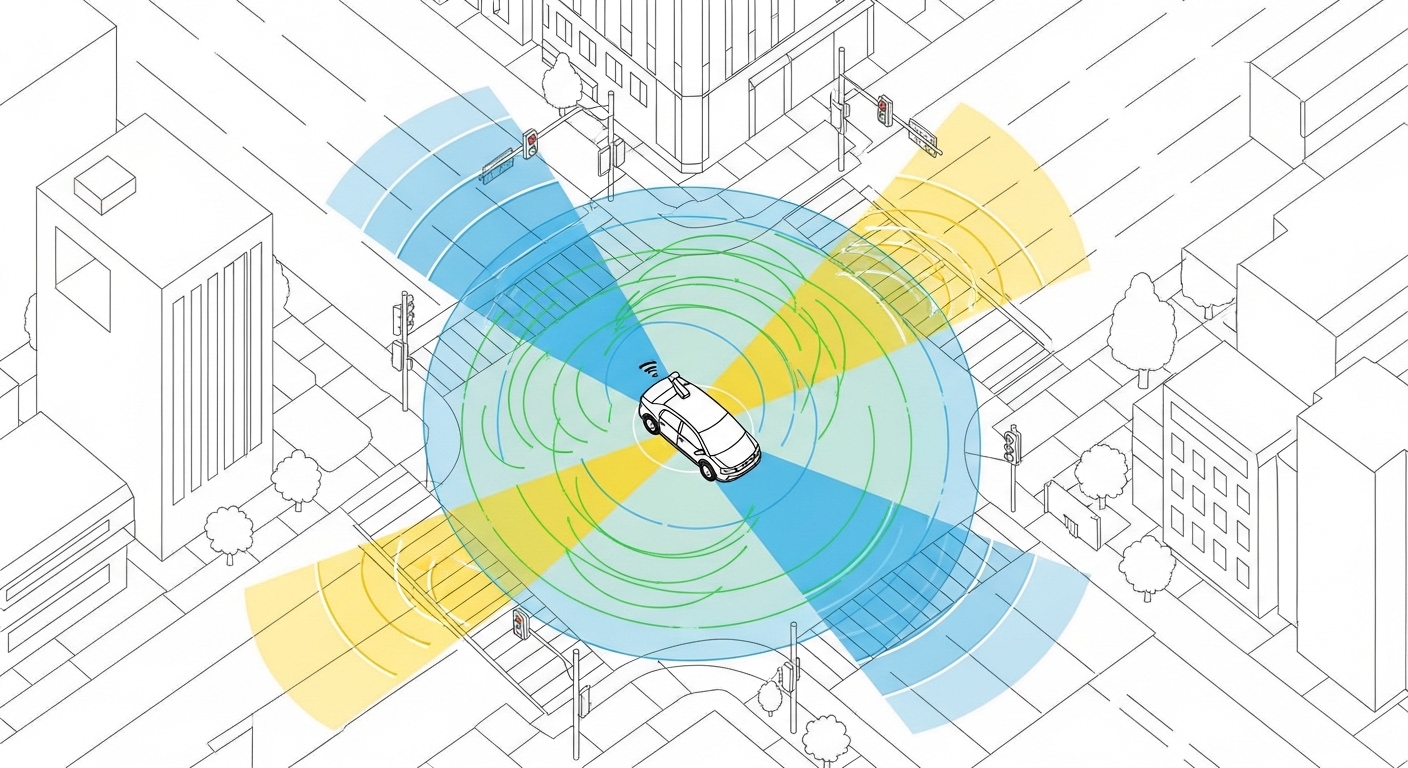
Every autonomous vehicle relies on a combination of sensors, because no single sensor type is good enough on its own. Cameras provide rich visual detail — color, texture, lane markings — but struggle in heavy rain or direct glare. Radar is excellent in bad weather and can measure velocity directly, but its resolution is too low to identify object types reliably. LiDAR (Light Detection and Ranging) fires millions of laser pulses per second to build a precise 3D point cloud of the environment, but it's expensive and can be confused by heavy precipitation.
The real engineering challenge is sensor fusion — combining all of these inputs into a single coherent picture of the world. When a camera says 'there's something ahead' and radar says 'it's moving at 30 km/h' and LiDAR says 'it's roughly the size of a pedestrian,' the system has to reconcile those readings in milliseconds and decide: is that a person, a shopping cart, or a blowing plastic bag?
One underappreciated detail: the placement of sensors matters as much as their type. A LiDAR unit mounted too low can be blinded by road spray. A camera positioned behind glass picks up windshield reflections at night. The physical engineering of the sensor rig is as consequential as the software interpreting it.
Sensor fusion isn't just about combining data — it's about knowing which sensor to trust more when they disagree, and under exactly which conditions.
High-Definition Maps as a Hidden Backbone
Most autonomous systems don't navigate purely from live sensor data. They rely heavily on pre-built high-definition (HD) maps — centimeter-accurate 3D maps of roads, lane boundaries, traffic signs, and even typical lighting conditions. The live sensors are used to localize the vehicle within that map and to detect anything the map doesn't know about, like a stopped truck or a construction zone.
This is why autonomous vehicles often struggle in areas that haven't been mapped yet, or where the map is outdated. It's a fundamental architectural dependency that rarely gets mentioned in promotional materials.
How the Decision-Making System Actually Works
Prediction, Planning, and Control
Once the car knows what's around it, it has to figure out what everything is about to do. This is the prediction layer. The system models the likely behavior of every nearby object — other cars, cyclists, pedestrians — based on their current trajectory, speed, and context. A car signaling right at an intersection is probably about to turn right. A pedestrian stepping off a curb is probably about to cross.
From those predictions, the planning layer generates a set of possible paths the vehicle could take, scores them against criteria like safety, comfort, and traffic rules, and selects the best one. Then the control layer translates that chosen path into actual steering, throttle, and braking commands sent to the vehicle's hardware.
This three-layer architecture — perceive, predict, plan — is common across most autonomous systems, though the specific implementation varies widely between companies.
Where Machine Learning Fits In
Early autonomous vehicle research leaned heavily on hand-coded rules: if the light is red, stop; if the lane curves left, steer left. The problem is that real driving contains an almost infinite variety of edge cases that no rulebook can fully anticipate. A mattress falling off a truck. A police officer manually directing traffic against the signal. A child on a bicycle weaving unpredictably.
Modern systems use machine learning — particularly deep neural networks — to handle perception and increasingly to assist with prediction and planning. These networks are trained on enormous datasets of real driving footage, learning to recognize objects and situations from millions of examples rather than explicit rules. The counterintuitive part: even the engineers who built these networks often can't fully explain why the system makes a specific decision in a specific moment. That opacity is a genuine regulatory and safety challenge.
(Opinion: The 'black box' nature of neural network decision-making in safety-critical systems is the part of this technology that deserves far more public scrutiny than it currently gets. We've broadly accepted that we can't always explain why the car did what it did — and that's a remarkable thing to accept.)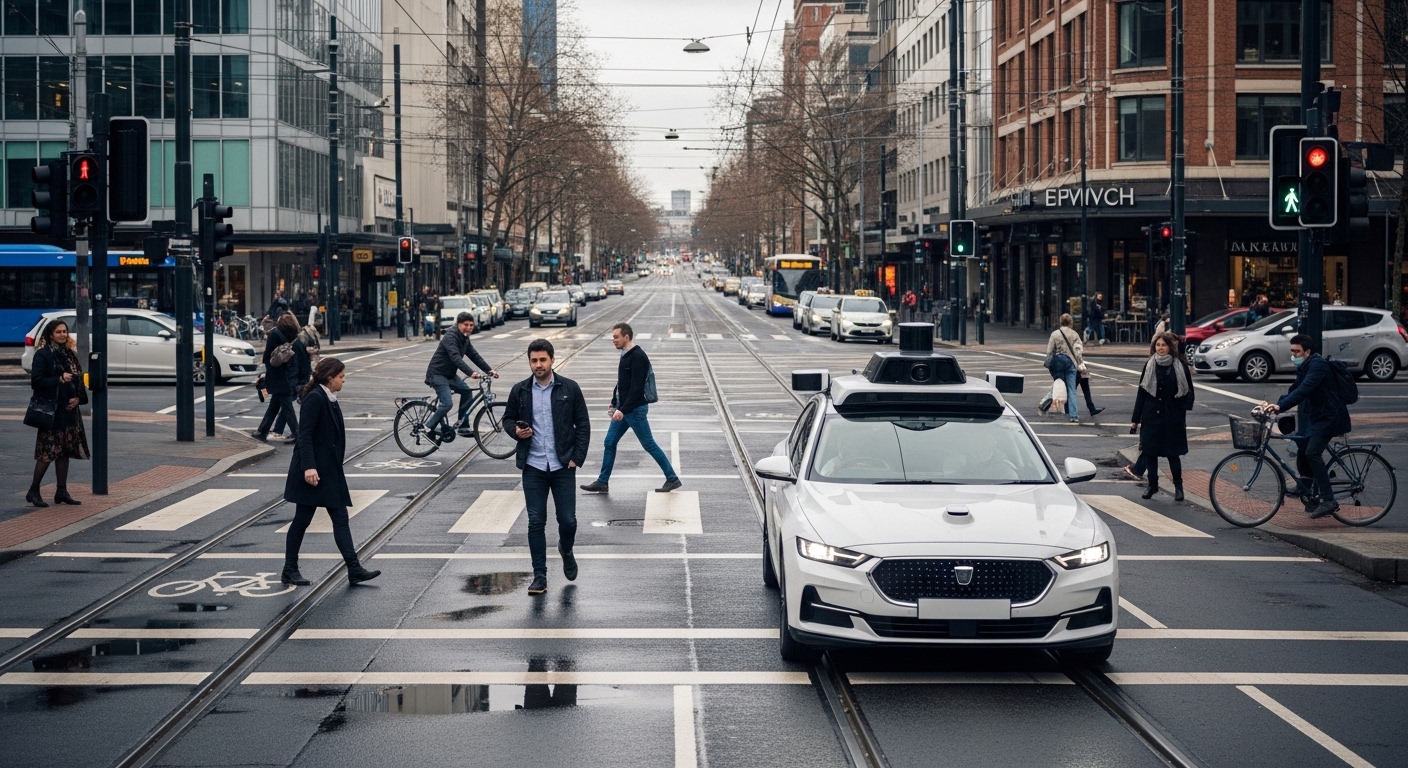
Why Self-Driving Cars Still Struggle — and Where They Work Best
The Long Tail Problem
Engineers use the phrase 'long tail' to describe the vast collection of rare, weird, and unpredictable scenarios that a vehicle might encounter only once in millions of miles — but still needs to handle correctly. A highway in clear weather is a relatively constrained environment. A busy urban intersection in a snowstorm, with a construction crew, a jaywalking pedestrian, and a malfunctioning traffic light, is not.
Waymo's robotaxi service — one of the most mature commercial deployments — operates within carefully defined geographic zones called operational design domains (ODDs). The vehicles know these areas intimately, the HD maps are kept current, and the range of scenarios is deliberately limited. That's not a limitation they're hiding; it's the honest engineering answer to the long tail problem.
The areas where autonomous vehicles work best are precisely the areas where the environment has been made predictable — which tells you something important about the technology's current limits.
Weather, Edge Cases, and the Unexpected
Heavy snow is particularly brutal for autonomous systems. It obscures lane markings that cameras rely on, degrades LiDAR returns, and can bury the physical landmarks that HD maps reference. Several autonomous vehicle programs have effectively paused winter testing in certain regions because the failure modes are too unpredictable to manage safely at scale.
There's also the social dimension. Human drivers communicate through eye contact, hand waves, and subtle body language. A pedestrian making eye contact with a driver signals 'I see you, I'll wait.' Autonomous vehicles can't participate in that informal negotiation — and other road users don't always know they're dealing with a machine that can't read those cues.
Frequently Asked Questions
Are self-driving cars safer than human drivers?
The honest answer is: it depends on the context and how you measure it. In well-mapped, controlled environments like specific urban zones, some autonomous systems have demonstrated impressive safety records. But direct comparisons to human driving are difficult because autonomous vehicles currently operate in carefully selected conditions, not the full range of situations human drivers encounter. The data is promising in some areas and genuinely incomplete in others.
Why don't self-driving cars use GPS to navigate?
GPS is accurate to within a few meters at best — nowhere near precise enough for lane-level navigation. Autonomous vehicles use GPS as one rough reference point, but they primarily localize themselves using HD maps combined with real-time sensor data. The car is constantly comparing what its sensors see to what the map says should be there, achieving centimeter-level positioning that GPS alone could never provide.
Can a self-driving car be hacked?
Researchers have demonstrated that autonomous systems can be vulnerable to adversarial attacks — for example, subtly altered road signs that fool camera-based recognition systems while appearing normal to human eyes. Cybersecurity is a serious and active area of concern in the industry. Modern systems use multiple redundant sensors partly because a single-sensor system is easier to fool than one that requires consistent deception across radar, LiDAR, and cameras simultaneously.
The technology that makes a car drive itself is, at its core, an attempt to compress decades of human perceptual learning into a system that can run on silicon in real time. What's striking isn't how far autonomous vehicles have come — it's how much the remaining problems reveal about how little we understood human driving in the first place. We never had to explain to ourselves how we knew a ball rolling into the street meant danger. We just knew. Teaching that to a machine has turned out to be one of the most illuminating engineering challenges of the century — not because the machines are failing, but because the attempt keeps exposing how much of human intelligence is invisible even to the humans who have it.


Comments
Post a Comment