How Do Animals Navigate? The Amazing Science of Migration
A bar-tailed godwit — a shorebird roughly the size of a pigeon — flies nonstop from Alaska to New Zealand, covering over 11,000 kilometers without landing once. No GPS. No landmarks. No rest. It arrives within days of the same date every year. The fact that we still don't fully understand how it does this is one of the most humbling puzzles in biology.

What Is Animal Navigation — and Why Is It So Hard to Explain?
More Than Just Following Instinct
Animal navigation isn't a single sense or a single skill. It's a layered system — sometimes using multiple independent mechanisms simultaneously — that allows creatures to move with extraordinary precision across distances that would challenge modern technology. A salmon returning to the exact stream where it hatched. A monarch butterfly reaching a specific grove of trees in Mexico it has never visited. These aren't random. They're repeatable, heritable, and shockingly accurate.
What makes this hard to study is that animals don't use just one method. They combine cues — magnetic fields, star patterns, smell, sound, polarized light — and weight them differently depending on conditions. Strip one cue away, and many species compensate using another. That redundancy is elegant, but it makes isolating any single mechanism frustratingly difficult for researchers.
The Scale of the Problem
Consider what 'knowing where you are' actually requires. You need a map (where am I relative to where I want to go?) and a compass (which direction is that?). Humans built instruments for both over centuries. Animals evolved them over millions of years, embedding them directly into biology. Some of those biological instruments are more sensitive than anything we've manufactured.

How the Magnetic Sense Works — and Why It's Stranger Than You Think
Earth as a Built-In Compass
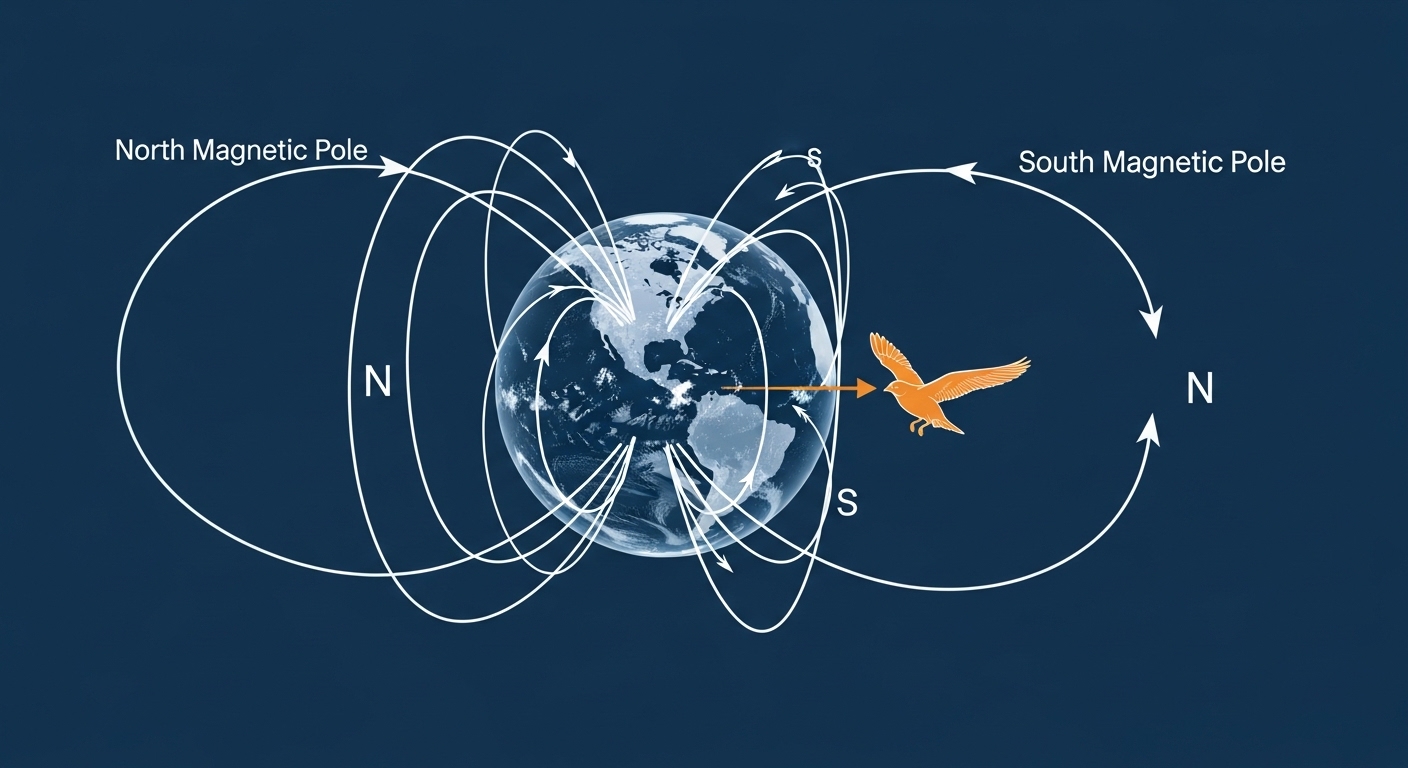
Earth's magnetic field isn't uniform. It varies in intensity and inclination angle depending on latitude, which means an animal sensitive to it can extract both directional and positional information — essentially reading coordinates from an invisible grid. Research on sea turtles, in particular, has shown that hatchlings can distinguish between different magnetic field signatures and use them to stay within the North Atlantic gyre. They're not just following a compass heading; they're reading a map encoded in magnetism.
Two competing mechanisms have been proposed for how animals detect magnetic fields. The first involves magnetite — tiny crystals of iron oxide found in the beaks of birds, the noses of salmon, and the abdomens of honeybees. These crystals physically move in response to magnetic fields, potentially triggering nerve signals. The second mechanism is stranger: a quantum effect in proteins called cryptochromes, found in the eyes of birds. The idea is that magnetic fields influence chemical reactions in these proteins, creating a kind of visual overlay — birds may literally 'see' the magnetic field as a pattern of light or shadow superimposed on their vision.
A bird may not just sense magnetic north — it may see it, as a faint pattern projected across its visual field. That's not metaphor; it's a leading hypothesis in magnetoreception research.
The Disruption Problem
Here's where it gets practically unsettling. Artificial light at night, power lines, and even weak radiofrequency electromagnetic fields have been shown in lab studies to disrupt the magnetic compass of European robins. The quantum mechanism is apparently that sensitive. This raises real questions about what urban environments are doing to migratory birds that pass through cities — a question researchers are still working to answer.
How Animals Use Stars, Sun, and Smell to Find Their Way
Celestial Navigation Isn't Just for Sailors
Nocturnally migrating birds — warblers, thrushes, many sparrows — use the stars. Specifically, they use the rotation pattern of the night sky to identify north, imprinting on this pattern as nestlings before they ever migrate. Experiments in planetariums, where researchers altered the apparent center of stellar rotation, produced birds that oriented toward the artificial 'north' the planetarium sky implied. The birds weren't memorizing constellations; they were tracking rotation.
Daytime migrants use the sun, but with a critical adjustment: they compensate for the sun's movement across the sky using an internal circadian clock. Disrupt that clock — by exposing birds to an artificial light cycle shifted by several hours — and their navigation shifts by a predictable angle. The sun compass is real, it's calibrated, and it depends on a functioning biological clock to work correctly.
The Salmon's Nose
Pacific salmon navigate thousands of kilometers of open ocean using magnetic cues, then switch to olfactory navigation as they approach freshwater. Each river and tributary has a distinct chemical signature, imprinted on the salmon during early life. They follow that scent upstream with enough precision to return to within meters of their birth location. Experiments blocking salmon olfaction with zinc sulfate confirmed this — chemically 'blinded' fish couldn't home accurately. The nose, in this case, is the final GPS.
(Opinion: The salmon's olfactory homing might be the most underappreciated navigation feat in the animal kingdom. The magnetic sense gets all the press, but threading a specific tributary by smell after years at sea is, if anything, more impressive.)
Why Migration Science Matters Beyond Biology
Engineering Lessons Hidden in Animal Brains
The redundancy built into animal navigation systems is something robotics engineers actively study. A system that seamlessly switches between magnetic, celestial, olfactory, and landmark-based cues — degrading gracefully when one fails — is exactly what autonomous vehicles and drones need. Current GPS-dependent systems have a single point of failure. Migratory animals, by contrast, have been stress-tested by evolution for millions of years.
The bar-tailed godwit's nonstop transoceanic flight isn't just a biological record — it's a proof of concept that redundant, multi-modal navigation can outperform any single-sensor system we've built.
Conservation Consequences
Understanding navigation also has urgent practical stakes. Light pollution disrupts star-based orientation. Magnetic interference from infrastructure may affect magnetoreception. Climate change is shifting the timing of food availability at stopover sites, decoupling the cues animals use to trigger migration from the conditions they arrive to find. A bird that departs on schedule based on day length may arrive at a breeding ground where the insect peak has already passed.
Monarch butterfly populations have declined sharply over recent decades — estimates vary, but the drop is severe enough that the species has been listed as endangered by the IUCN. Their navigation is intact; the problem is that the milkweed they depend on and the overwintering forests in Mexico face mounting pressure. Navigation is only useful if the destination still exists.

Frequently Asked Questions
Do all migratory animals use the same navigation methods?
No — and that's part of what makes this field so complex. Birds tend to rely on a combination of magnetic sensing, celestial cues, and landmarks. Salmon lean heavily on olfaction for the final leg of their journey. Sea turtles appear to use magnetic map coordinates with remarkable precision. Most species use multiple overlapping systems, and the weighting between them can shift depending on conditions or life stage.
Can animals get lost?
Yes, though it's rarer than you'd expect. Vagrancy — when a bird ends up far outside its normal range — happens regularly and is well-documented. Young birds on their first migration are most vulnerable, since they're calibrating their systems with limited experience. Severe magnetic storms, unusual weather patterns, and disorienting artificial light can all push animals off course. Some vagrant individuals eventually correct; others don't.
Why don't we just implant GPS trackers and solve the mystery?
Tracking technology has actually transformed migration science — miniaturized GPS tags have revealed routes and stopover sites that were completely unknown. But tracking tells you where an animal went, not how it knew to go there. The mechanism question requires a different toolkit: controlled experiments, neurological studies, and molecular biology. Knowing the godwit flew 11,000 kilometers is the easy part. Understanding what told it to turn left over the Pacific is the hard part.
The deeper you look at animal navigation, the more it resembles a kind of sensory world humans simply don't have access to. We built compasses because we couldn't feel magnetic north. We built clocks because we couldn't keep biological time precisely enough to navigate by the sun. Animals didn't need any of it — and the systems they evolved are, in several measurable ways, still better than ours. That's not a comforting thought for anyone who assumes technology has closed the gap between us and the natural world.



Comments
Post a Comment