The Pros and Cons of Remote Work: A Balanced Look
Remote work was once a perk reserved for a handful of tech roles and freelancers. Then, practically overnight, it became the default for hundreds of millions of workers worldwide — and the experiment has never really ended. Years later, the debate is no longer 'can it work?' but 'for whom, under what conditions, and at what cost?' The answers are messier than either side usually admits.
| Option | Best For | Our Pick |
|---|---|---|
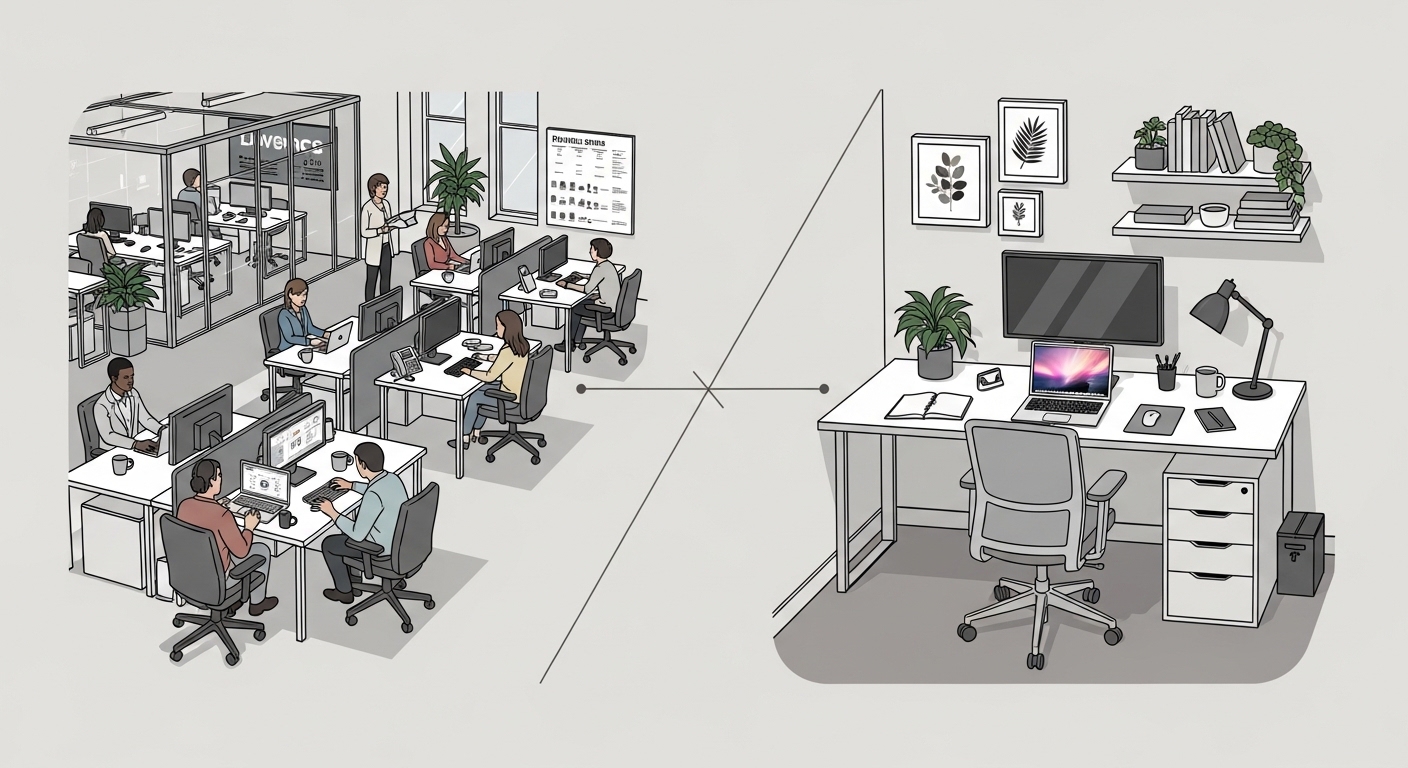
| Fully Remote | Independent, experienced workers in async-friendly roles | Strong choice if boundaries are managed well |
| Hybrid | Teams needing collaboration without full commute burden | Best fit for most knowledge workers |
| Fully In-Office | Roles requiring physical presence, hands-on training, or tight coordination | Necessary for some, unnecessary for many |
The Pros — What Makes Remote Work Worth Considering
Flexibility That Actually Changes Daily Life
The single biggest draw is control over your own schedule and environment. You can take a midday run, attend a school pickup, or simply work during your most productive hours instead of the ones your commute dictates. Research consistently suggests that workers with schedule flexibility report higher job satisfaction and lower stress — though the magnitude varies widely by role and household situation.
The commute elimination alone is significant. Estimates suggest the average commuter in a major city spends somewhere between 200 and 400 hours per year traveling to and from work. Getting even half of that back is a meaningful life change, not just a minor convenience.
Access to a Wider Talent Pool — for Both Sides
Remote work broke the geographic constraint that once forced companies to hire whoever lived within driving distance of their office. A small company in a mid-sized city can now hire a specialist who lives across the country, and that specialist doesn't have to uproot their family to take the job. This has been genuinely transformative for both employers struggling to find niche skills and for workers in regions with limited local opportunities.
For employees, it also opened up salary arbitrage — the ability to earn a salary benchmarked to a high-cost city while living somewhere far cheaper. That gap has narrowed as companies have adjusted location-based pay policies, but it hasn't disappeared entirely.
Productivity Gains — With an Asterisk
Multiple studies over the past several years have found that remote workers often report higher productivity, particularly for focused, individual tasks. Fewer interruptions, no open-plan office noise, and the ability to customize your workspace all contribute. Stanford economist Nicholas Bloom's research on remote work is among the most cited in this space, and his findings generally support a productivity benefit for hybrid arrangements.
The asterisk: productivity gains are highly uneven. They tend to show up most clearly for experienced workers doing independent tasks. For newer employees, collaborative roles, or people in cramped or noisy home environments, the picture is far less rosy.
- Elimination of daily commute time and cost
- Greater autonomy over work environment and schedule
- Access to jobs outside your geographic region
- Reduced overhead costs for employers (office space, utilities)
- Lower carbon footprint from reduced commuting — though home energy use offsets some of this
- Better work-life integration for caregivers and those with health considerations

The productivity debate misses the real question: productive at what, compared to whom, and measured how? Most studies capture output, not creativity, mentorship, or institutional knowledge transfer.
The Cons — What Could Go Wrong
Isolation Is a Real and Underreported Problem
The social architecture of an office — the hallway conversations, the impromptu lunches, the ambient sense of being part of something — disappears when you work from home. For extroverts, this is immediately obvious. For introverts, it often sneaks up on them after months of what initially felt like blissful solitude. Loneliness in remote workers has been flagged in multiple workplace surveys as one of the top reported challenges, often ranking higher than technical issues or workload.
There's also a professional isolation that's distinct from the social kind. When you're not physically present, you miss the informal information flow — who's getting promoted, which projects are gaining momentum, what the leadership team is actually worried about. That kind of ambient intelligence is hard to replicate on Slack.
The Boundary Problem Nobody Warns You About
When your office is your home, the psychological separation between work and rest erodes. Many remote workers report working longer hours than they did in-office — not because they're more dedicated, but because the natural stopping cues (packing up, commuting, physically leaving) no longer exist. The laptop is always there. The notifications don't stop.
Anyone who has found themselves answering emails at 10pm 'just to clear the queue' knows exactly how this plays out. The flexibility that makes remote work appealing can quietly become the mechanism by which work expands to fill all available time.
Career Development and Visibility Gaps
This is the con that tends to get dismissed in remote work advocacy, but the data is uncomfortable. Multiple studies suggest that remote workers — particularly those who are fully remote while their managers are in-office — receive fewer promotions and smaller raises over time compared to in-office peers with equivalent performance. The effect is sometimes called 'proximity bias,' and it's not unique to bad managers. It's a structural feature of how humans assess contribution and potential.
Junior employees and career-changers face a steeper version of this problem. Early-career development depends heavily on observation, informal mentorship, and being in the room when decisions get made. Remote work compresses or eliminates those pathways in ways that are difficult to fully compensate for with structured check-ins.
- Social isolation and loneliness, especially over long periods
- Blurred work-life boundaries leading to longer effective working hours
- Proximity bias disadvantaging remote workers in promotion decisions
- Weaker onboarding and mentorship for new or junior employees
- Home environment inequity — not everyone has a quiet, dedicated workspace
- Collaboration friction for complex, creative, or highly interdependent work
- Technology and cybersecurity overhead for employers

Who Remote Work Actually Works Best For — and Who It Doesn't
The Profiles That Thrive
Remote work tends to work best for people who are already established in their careers, have a clear sense of their own working style, and operate in roles with measurable, independent outputs. Think: experienced software engineers, writers, analysts, consultants, and project managers who can define their own daily structure without external scaffolding. Add a dedicated home workspace and a household that supports focused work, and the setup is genuinely excellent.
It also works well for people with specific life circumstances — caregivers, people managing chronic health conditions, those in geographic areas with poor job markets locally, or anyone for whom the commute was genuinely punishing. For these groups, remote work isn't just a preference; it's a meaningful quality-of-life improvement.
The Profiles That Struggle
New graduates entering their first professional role face a real disadvantage working fully remote. The informal learning that happens by sitting near experienced colleagues — watching how they handle a difficult client call, how they structure a proposal, how they navigate internal politics — simply doesn't transfer well over video calls. This isn't a soft concern; it has measurable effects on skill development timelines.
People in shared or cramped living situations face a different but equally concrete problem. A studio apartment shared with a roommate, or a house with young children and no dedicated office space, creates working conditions that no amount of 'async-first culture' can fully fix. The remote work conversation often implicitly assumes a certain kind of home — and a lot of workers don't have it.
(Opinion: The most honest version of the remote work debate would stop pretending it's a universal good or a universal failure, and start asking who specifically benefits and who bears the hidden costs. The loudest advocates tend to be people whose home environments and career stages make remote work work for them — which is a real selection bias that shapes the whole conversation.)Remote work redistributes costs rather than eliminating them. Commuting costs shift to home energy bills, ergonomic setups, and the psychological cost of never fully leaving work.

Our Verdict — How to Think About This Decision
The Hybrid Middle Ground Is Probably Right for Most People
Fully remote works well for a specific profile of worker in a specific kind of role. Fully in-office is genuinely necessary for some jobs and genuinely wasteful for others. Hybrid arrangements — where teams come together for collaboration, onboarding, and relationship-building while preserving remote flexibility for focused work — tend to capture most of the benefits while limiting the worst downsides.
The research from Nicholas Bloom and others broadly supports this: two to three days remote per week appears to be a sweet spot for many knowledge workers, balancing productivity, collaboration, and career visibility. That said, 'hybrid' has become a word that means almost nothing without specifics — a mandatory Tuesday-Thursday in-office policy is a very different thing from 'come in whenever you feel like it.'
What to Actually Evaluate Before Deciding
If you're weighing a remote role, ask yourself four questions. First, where are you in your career — do you still need the informal learning that proximity provides? Second, what does your home environment actually look like — not ideally, but right now? Third, is your role one where output is clearly measurable, or does it depend heavily on relationship-building and visibility? Fourth, where is your manager physically located — because that proximity gap matters more than most job listings acknowledge.
For employers making policy decisions, the honest question is whether the push back to office is driven by genuine collaboration needs or by a preference for visible workers over productive ones. Those are different problems with different solutions.
Frequently Asked Questions
Does remote work actually hurt your chances of getting promoted?
Research suggests it can, particularly when your manager and key decision-makers are working in-office. This proximity bias effect has been documented across multiple industries. It doesn't mean remote workers never get promoted, but the structural disadvantage is real and worth factoring into career planning — especially for roles where advancement depends on visibility and relationship capital.
Is remote work better or worse for mental health?
The honest answer is: it depends heavily on the individual and their circumstances. Some people report significantly lower stress without commutes and with greater schedule control. Others experience increased loneliness, anxiety from blurred work-life boundaries, or depression from reduced social contact. Research suggests the mental health effects of remote work are highly variable, not uniformly positive or negative.
Can companies really save money by going remote?
They can reduce real estate and facilities costs, which can be substantial for large organizations. However, those savings are partially offset by increased technology infrastructure, cybersecurity requirements, home office stipends, and the harder-to-quantify costs of slower onboarding and reduced informal knowledge transfer. Estimates vary, but the net savings are typically smaller than the headline real estate figures suggest.
The most revealing thing about the remote work debate is how much of it is conducted by people who have already made their choice and are defending it. The worker who loves their home setup and the executive who wants full floors of visible employees are both rationalizing a preference, not following the evidence. The evidence itself is more ambiguous — and more interesting — than either side usually lets on. What remote work really exposed is how much of office culture was never about productivity in the first place.



Comments
Post a Comment