Quantum Physics Explained: A Beginner's Guide to the Universe's Strangest Rules
A single electron fired at two slits simultaneously passes through both of them at once — not one, then the other, but genuinely both, at the same time. That sentence is either deeply fascinating or deeply maddening depending on your tolerance for weirdness. Either way, it's experimentally confirmed, and it points to something fundamental: the universe at its smallest scales does not behave the way anything in your daily life does.

What Quantum Physics Actually Is — Not the Buzzword Version
The Scale Where Normal Rules Break Down
Quantum physics — sometimes called quantum mechanics — is the branch of physics that describes how matter and energy behave at the scale of atoms and subatomic particles. At that level, the familiar rules of classical physics, the ones that govern how a ball rolls or how a car brakes, simply stop working. They're not wrong exactly; they're just incomplete.
The word 'quantum' comes from the Latin for 'how much,' and it refers to the fact that energy isn't continuous. It comes in discrete packets called quanta. Think of it like the difference between a ramp and a staircase — classical physics sees a ramp, quantum physics reveals a staircase where you can only stand on specific steps, never between them.
This was first proposed seriously by Max Planck in 1900, when he was trying to explain why hot objects glow the colors they do. He didn't love his own idea at first — he called it 'an act of desperation.' But it worked, and it opened a door that physics has been walking through ever since.
Why It Took So Long to Discover
Quantum effects are essentially invisible at human scales. The staircase steps are so small that at the size of everyday objects, they blur into what looks like a smooth ramp. You'd never notice quantum behavior watching a tennis ball, which is exactly why it took until the early 20th century — and extremely precise experiments — to find it.

How Quantum Mechanics Works — The Core Ideas Without the Math
Superposition: Being in Two States at Once
The most counterintuitive idea in quantum mechanics is superposition. A quantum particle doesn't have a single definite state until you measure it. Before measurement, it exists in a combination of all possible states simultaneously. The electron passing through both slits at once isn't a metaphor — it's a literal description of what's happening.
The famous thought experiment here is Schrodinger's cat, proposed by physicist Erwin Schrodinger in 1935 — partly as a critique of how strange the theory had become. A cat in a sealed box with a quantum trigger is, according to the math, simultaneously alive and dead until someone opens the box and looks. Schrodinger found this absurd. Most physicists today would say the absurdity is real, just confined to quantum scales.
Superposition isn't a gap in our knowledge — it's not that the particle secretly has a definite state and we just don't know it. The particle genuinely has no single definite state until measured.
Wave-Particle Duality: It Depends on How You Look
Quantum objects behave like waves when you're not watching them and like particles when you are. Light, for instance, travels as a wave — it diffracts, interferes, spreads out. But when it hits a detector, it arrives as a discrete photon, a point-like packet of energy. The act of measurement itself changes what you find.
This isn't a limitation of our instruments. It's built into the structure of reality at that scale. The double-slit experiment demonstrates this directly: fire electrons one at a time at two slits with no detector, and you get an interference pattern on the back wall — a wave effect. Add a detector to see which slit each electron uses, and the interference pattern vanishes. The electrons 'know' they're being watched, in a sense.
The Uncertainty Principle: A Hard Limit, Not a Measurement Problem
Werner Heisenberg's uncertainty principle states that you cannot simultaneously know both the exact position and the exact momentum of a particle. The more precisely you pin down one, the fuzzier the other becomes. This is often misunderstood as a practical limitation — like saying our instruments aren't good enough. It isn't. It's a fundamental feature of nature.
The reason is that particles are described by wave functions, and a wave spread over a large area has a well-defined frequency (momentum) but no precise location. A wave compressed to a point has a precise location but an undefined frequency. You can't have both. It's geometry, not engineering.
Quantum Entanglement — What Einstein Called 'Spooky Action'
How Entanglement Actually Works
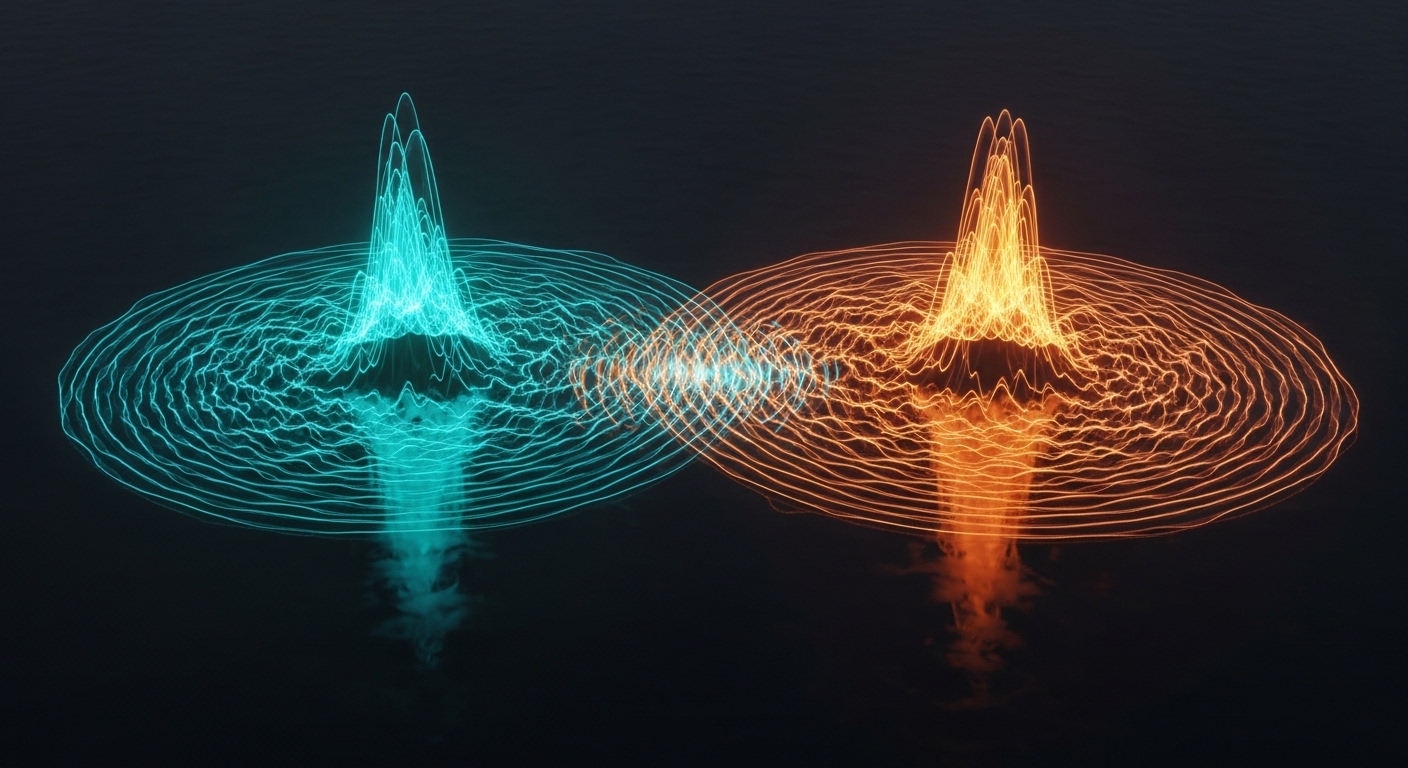
When two particles become entangled, their quantum states are linked — measure one, and you instantly know something about the other, no matter how far apart they are. Einstein famously called this 'spooky action at a distance' and spent years trying to prove it was incomplete physics rather than real physics. He was wrong.
Experiments beginning in the 1970s and refined significantly since — most notably by physicist John Bell, who devised a mathematical test to distinguish genuine entanglement from hidden variables — confirmed that entanglement is real. Two particles can be separated by vast distances and still behave as a correlated system.
The counterintuitive detail that trips people up: entanglement does not allow faster-than-light communication. When you measure your particle, you get a random result. Your distant partner also gets a random result. Only when you compare notes — through classical, slower-than-light channels — do you see the correlation. The universe is weird, but it's not breaking its own speed limit.
Entanglement is real and experimentally confirmed, but it cannot be used to send information faster than light — the randomness of each individual measurement prevents it.
Why Entanglement Matters Beyond the Lab
Entanglement is the backbone of quantum computing and quantum cryptography. In quantum cryptography, entangled particles can be used to create encryption keys that are physically impossible to intercept without disturbing — and thus revealing — the eavesdropping. Several national research programs and private companies have demonstrated this over increasing distances, including via satellite links.

Where Quantum Physics Shows Up in the Real World
The Technology Running Your Life Right Now
Quantum mechanics isn't just a theoretical curiosity. The transistor — the basic building block of every computer chip, smartphone, and digital device — was invented directly from quantum mechanical principles in the late 1940s. Without understanding how electrons behave quantum mechanically inside semiconductors, none of modern electronics exists.
Lasers are another quantum technology. They work by stimulating electrons to drop between specific energy levels and emit photons in lockstep — a process that only makes sense through quantum mechanics. MRI machines in hospitals use a quantum property called nuclear spin to image soft tissue. The list goes on: LED lights, solar cells, electron microscopes, GPS timing systems that rely on atomic clocks.
Anyone who has used a smartphone today has benefited from quantum physics dozens of times before lunch. The technology is so embedded in modern infrastructure that separating 'quantum applications' from 'everyday technology' is almost meaningless.
Quantum Computing — What It Can and Can't Do
Quantum computers use qubits instead of classical bits. A classical bit is either 0 or 1. A qubit, exploiting superposition, can be 0, 1, or both simultaneously — which allows certain calculations to be performed exponentially faster than any classical machine could manage.
The important caveat: quantum computers are not universally faster. They excel at specific problem types — factoring large numbers, simulating molecular behavior, optimizing complex systems. For most everyday computing tasks, a classical laptop is still the right tool. The hype around quantum computing often skips this distinction.
(Opinion: The public conversation about quantum computing has been badly distorted by both overclaiming and underclaiming. Companies announcing 'quantum supremacy' for narrow benchmark tasks, and skeptics dismissing the whole field as vaporware, are both missing the more interesting and accurate story: this is a genuinely useful but highly specialized tool that will matter enormously in chemistry, materials science, and cryptography — just not for running your spreadsheets.)
Frequently Asked Questions
Is quantum physics the same as quantum mechanics?
Essentially yes. 'Quantum mechanics' refers specifically to the mathematical framework describing quantum behavior, while 'quantum physics' is a slightly broader term that includes related areas like quantum field theory. In casual use, the two terms are interchangeable, and most people — including most physicists — use them that way.
Does the observer effect mean human consciousness affects quantum particles?
No — and this is one of the most persistent misconceptions in popular science. 'Observation' in quantum mechanics means any physical interaction that registers information about the particle's state, including a detector, a photon bouncing off the particle, or any other physical process. Human consciousness is not required. A camera with no one watching it still collapses a quantum state. The confusion comes from the word 'observer,' which sounds more mystical than it is.
Can quantum effects happen at human scales?
Rarely, and only under very specific conditions. Superconductivity and superfluidity are quantum effects that occur at macroscopic scales when temperatures drop near absolute zero. Some researchers also believe quantum coherence plays a role in biological processes like bird navigation and photosynthesis, though this remains an active area of research with no settled consensus. Under normal room-temperature conditions, quantum effects average out and classical physics takes over.
What makes quantum physics genuinely strange isn't that it's complicated — plenty of things are complicated. It's that it forces a reckoning with the idea that reality at its most fundamental level is not a fixed, definite thing waiting to be discovered. It's probabilistic, contextual, and in some deep sense shaped by the act of looking. That's not a gap in the theory. After more than a century of experimental tests, it appears to be exactly how the universe is built.



Comments
Post a Comment