Cosmic Fireworks: How Do Meteor Showers Happen?
Every August, millions of people spread blankets on lawns and rooftops to watch streaks of light tear across the sky — and most of them have no idea they're watching comet debris burn up in Earth's atmosphere. Meteor showers are not random. They happen on a precise, repeating schedule, tied to the orbital paths of comets that may not have visited the inner solar system in decades or centuries. The mechanics behind them are surprisingly elegant, and a little unsettling once you understand the scale involved.
What Is a Meteor Shower, Really?
Shooting Stars Are Not Stars
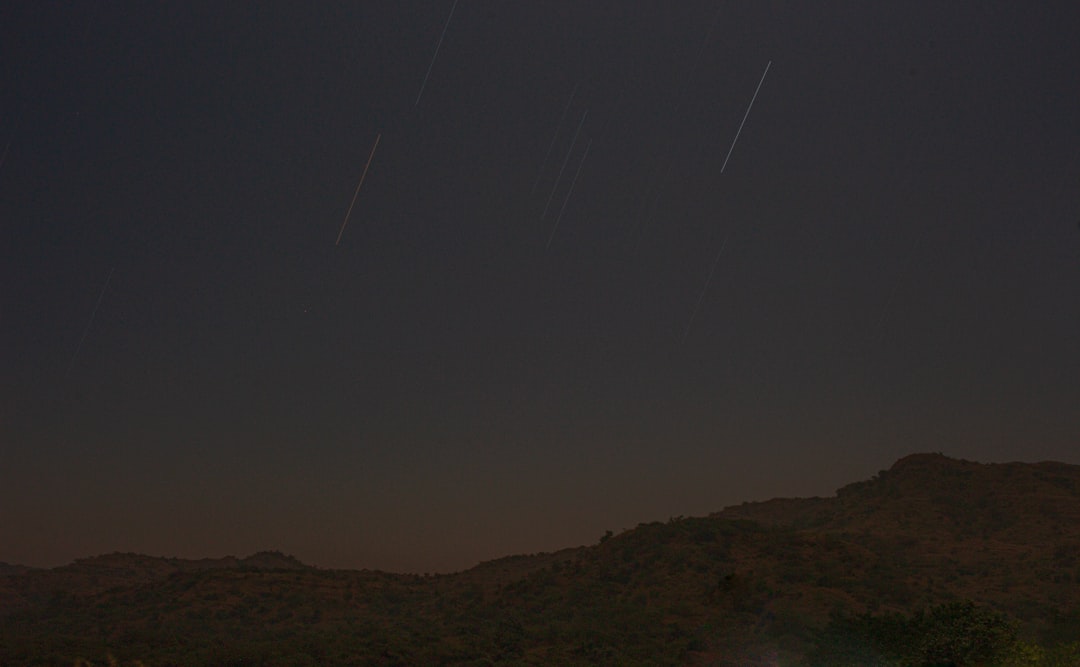
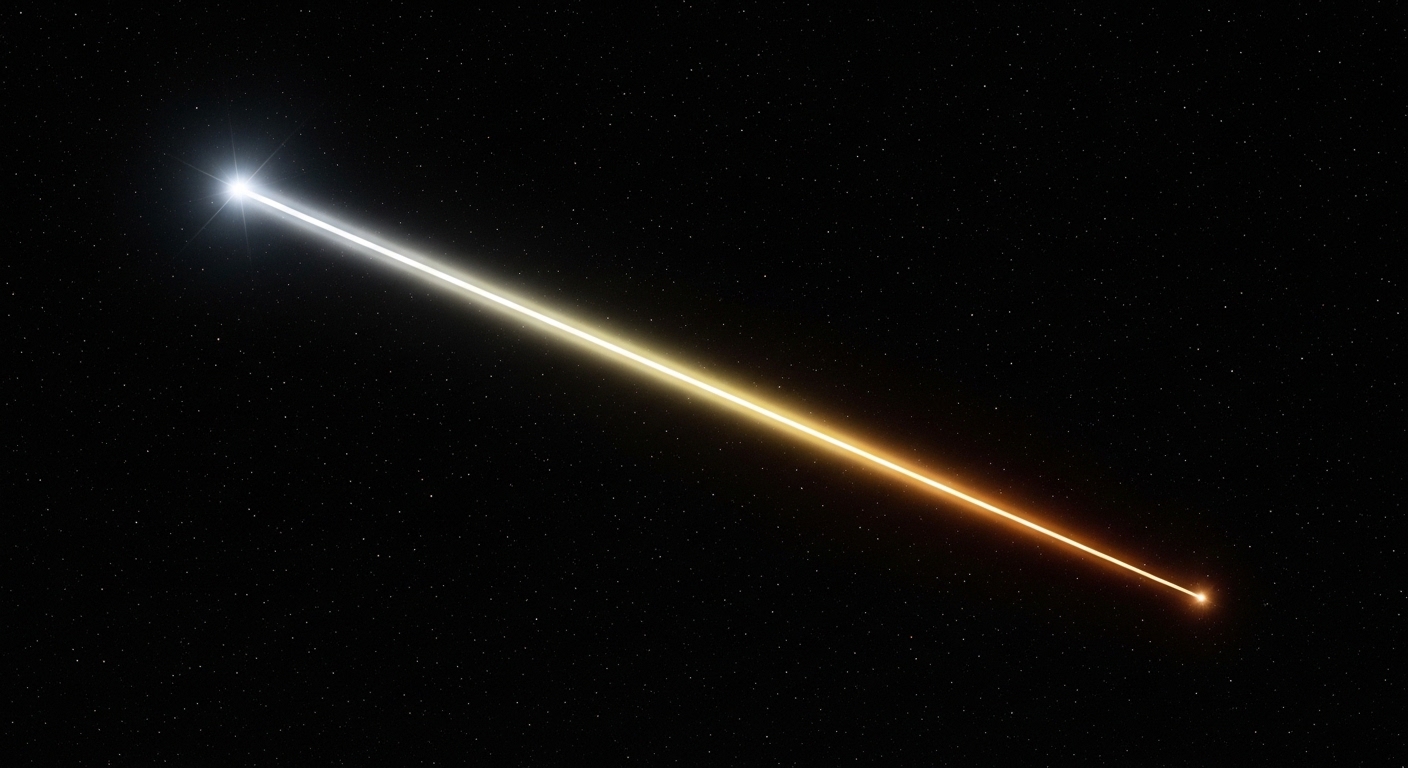
A meteor is what happens when a small piece of space debris — usually no larger than a grain of sand or a pea — slams into Earth's upper atmosphere at tens of kilometers per second. The friction and compression of air molecules heats the particle so intensely that it vaporizes, leaving a glowing trail of ionized gas. That streak of light is the gas, not the rock itself. The rock is usually gone in milliseconds.
A meteor shower is what happens when Earth passes through a dense trail of this debris all at once. Instead of the occasional random meteor you might spot on any clear night, you get dozens or even hundreds per hour, all appearing to radiate from the same point in the sky — a point called the radiant. The radiant is simply a perspective effect, like standing in a tunnel and watching the walls converge ahead of you.
Why They Repeat on a Schedule
Earth follows the same orbital path around the Sun every year. If a debris field is sitting in that path, Earth will plow through it at roughly the same time each year. The Perseids, for example, peak reliably around mid-August every year. The Geminids peak in mid-December. You can set a calendar reminder and trust it more than most things in life.
Where Does the Debris Actually Come From?
Comets Leave a Trail Behind Them
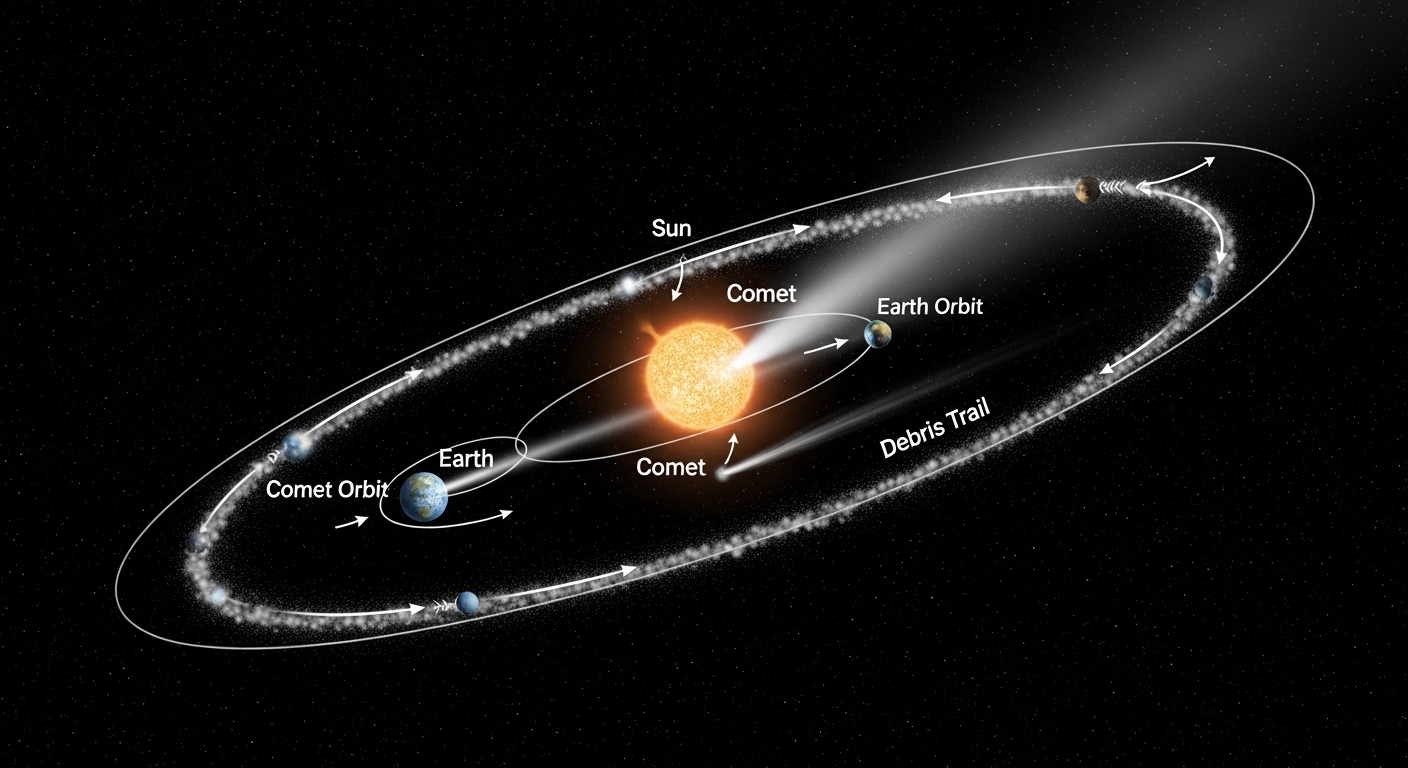
The source of most major meteor showers is cometary debris. As a comet approaches the Sun, solar radiation and the solar wind heat its icy surface, causing it to shed gas and dust — that's the tail you see in photographs. But not all of that material escapes cleanly into space. Much of it drifts along the comet's orbital path, spreading out over time into a diffuse stream of particles called a meteoroid stream.
The Perseids, the most-watched shower in the Northern Hemisphere, come from Comet Swift-Tuttle, which has an orbital period of roughly 130 years. The comet itself won't be back until the 2120s, but the debris it shed on previous passes is still sitting in its orbital lane, waiting for Earth to drive through it every August. That's a strange thought — you're watching the ghost trail of a comet that hasn't been visible in the sky for decades.
A meteor shower is not a live event. You're watching debris shed by a comet that may have passed through the inner solar system before your grandparents were born.
The Geminids Are the Exception
Here's the counterintuitive one: the Geminids, which are arguably the most intense annual shower with rates sometimes exceeding 120 meteors per hour under ideal conditions, do not come from a comet. Their source is 3200 Phaethon, an asteroid — or possibly a 'rock comet,' an object that behaves like a comet near the Sun but is rocky rather than icy. Scientists still debate exactly how Phaethon shed enough material to produce such a prolific stream. The Geminids were only identified as a shower in the mid-1800s, which is relatively recent in astronomical terms, and their origin remains one of the more genuinely puzzling questions in planetary science.
How Scientists Predict Meteor Shower Intensity
It's Not as Simple as 'More Debris Equals More Meteors'
Predicting how active a shower will be in a given year involves tracking the structure of the meteoroid stream itself. Debris doesn't spread evenly along a comet's orbit — it clumps. Older material drifts further from the comet's core path, while fresher ejecta stays closer. When Earth passes through a particularly dense clump, you get an outburst: a shower that dramatically exceeds its normal rate for a few hours.
The 1999 Leonid meteor storm is a well-documented example. The Leonids, which originate from Comet Tempel-Tuttle, typically produce modest rates. But in November 1999, Earth passed through a dense filament of relatively fresh debris, and observers in parts of Europe and the Middle East reported rates exceeding a thousand meteors per hour for a brief window. Predicting that kind of event requires modeling the gravitational perturbations that Jupiter and Saturn exert on the debris stream over decades — not trivial math.
The Moon Is the Shower's Biggest Enemy
Astronomers can predict shower peaks to within hours, but a bright moon near peak time washes out all but the brightest meteors. This is a genuine operational constraint that affects public viewing every year. A shower that would show 80 meteors per hour under a moonless sky might appear to produce only 15–20 under a full moon. The geometry of the Moon's phase relative to the shower date matters more to casual observers than any other factor — and it's something the forecasts always account for.

Why Meteor Showers Look Different Depending on Where You Watch
The Radiant's Position Changes Everything
The radiant point — the spot in the sky all the meteors appear to stream from — rises and sets like any other point on the celestial sphere. If the radiant is below your horizon, you won't see the shower at all. This is why the Perseids favor Northern Hemisphere observers: the radiant sits in the constellation Perseus, which stays reasonably high in northern skies throughout the August nights. Southern Hemisphere observers see fewer Perseids simply because Perseus doesn't climb as high above their horizon.
There's also a subtler effect: meteors near the radiant appear short and stubby because you're looking nearly straight down their path. Meteors far from the radiant appear longer and more dramatic because you're seeing them from the side. The most visually spectacular meteors are usually the ones that streak across a wide arc of sky, which means the best-looking ones are often the ones furthest from the radiant — not closest to it.
Altitude and Atmospheric Conditions
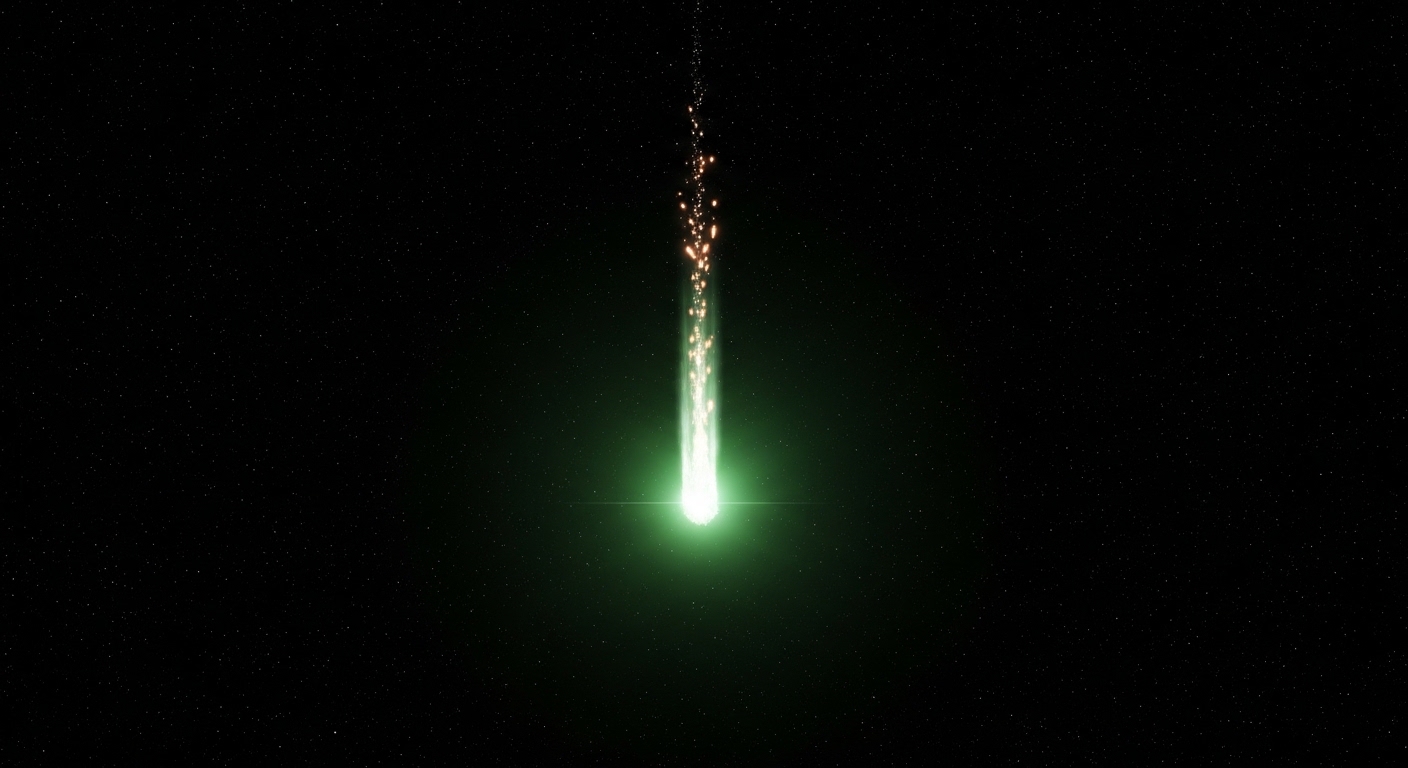
Most meteors burn up between roughly 80 and 120 kilometers above the surface. That's well above commercial aviation altitude, well above weather systems, and well above any human-made structure. The atmosphere at that altitude is thin enough that a particle can travel a significant distance before fully vaporizing, which is why some meteors produce long, lingering trails. Occasionally a larger fragment survives long enough to become a fireball — a meteor bright enough to cast shadows — and in rare cases, a fragment survives all the way to the ground and becomes a meteorite.
(Opinion: The fireball category is criminally underappreciated in popular coverage of meteor showers. A single bright fireball is more visually arresting than a hundred faint streaks, and they happen more often than most people realize — they're just easy to miss if you're not watching at the right moment.)The most dramatic thing you can see during a meteor shower isn't a high count — it's a single fireball bright enough to light up the ground beneath your feet.
Frequently Asked Questions
What is the best time of night to watch a meteor shower?
The hours between local midnight and pre-dawn are almost always the most productive. After midnight, your location on Earth is rotating into the direction of orbital motion — essentially facing forward into the debris stream. Before midnight, you're on the trailing side, and the atmosphere has to 'scoop up' meteors from behind, which reduces the rate significantly. The difference can be dramatic: you might see two or three times as many meteors after midnight compared to the evening hours.
Can meteor showers be dangerous?
The particles that produce most meteor shower displays are tiny — often smaller than a grain of rice — and they vaporize completely in the upper atmosphere. The actual risk to people on the ground is negligible. Satellites in low Earth orbit face a slightly elevated risk of microparticle impacts during intense showers, and satellite operators do occasionally adjust orientations to minimize exposed surface area during predicted outbursts, but this is a precautionary measure rather than a response to a serious threat.
Why do some years have stronger showers than others if the debris trail is always there?
The debris in a meteoroid stream is not uniformly distributed. Gravitational nudges from Jupiter and Saturn slowly shift the positions of debris filaments over time, meaning Earth doesn't pass through exactly the same density of material each year. Additionally, comets shed more material on some passes than others, creating denser clumps in certain sections of the stream. When Earth's path intersects one of those denser filaments, the result is an outburst year — sometimes dramatically so.
The next time you hear someone call a meteor shower 'shooting stars,' you can let it go — the phrase is harmless enough. But what's actually happening is stranger and more specific: Earth is plowing through the ancient litter of a comet's orbit at roughly 30 kilometers per second, and the atmosphere is doing the work of vaporizing it before any of it reaches you. The sky is not putting on a show. You're just finally noticing the debris field that's been there all along.


Comments
Post a Comment