Mastering the Art of Apology: Effective Ways to Say You're Sorry
A bad apology can make things worse than no apology at all. Most of us have been on the receiving end of a 'sorry you feel that way' or an 'I apologize if anyone was offended' — and we know exactly how hollow those land. The difference between an apology that repairs a relationship and one that quietly destroys it comes down to a handful of specific, learnable moves. This guide breaks down what actually works, why most apologies fail, and how to say sorry in a way that people actually believe.

What You Need Before You Start Apologizing
Get Clear on What You Actually Did Wrong
Before you open your mouth, you need to understand the specific harm — not your version of events, but the actual impact on the other person. This sounds obvious, but most people skip it entirely. They rehearse what they plan to say without first sitting with the question: 'What did my action cost this person?'
Research in interpersonal psychology suggests that apologies fail most often not because of poor delivery, but because the apologizer never fully grasped the scope of the harm. If your friend cancelled plans on them the night before a difficult event, the issue isn't just the cancelled plans — it's that they faced something hard alone. That's the thing you're apologizing for.
Check Your Own Emotional State
Apologizing while you're still defensive is a trap. You'll start with 'I'm sorry' and end up explaining why you did what you did, which the other person will correctly read as an excuse. If you're not genuinely ready to prioritize their experience over your own discomfort, wait. A delayed sincere apology almost always lands better than an immediate defensive one.
One practical check: if you're still mentally building a case for why you weren't entirely wrong, you're not ready. That doesn't mean you have to agree with every interpretation the other person has — it means you need to be able to set that aside long enough to acknowledge the real impact.

Step-by-Step Instructions for a Real Apology
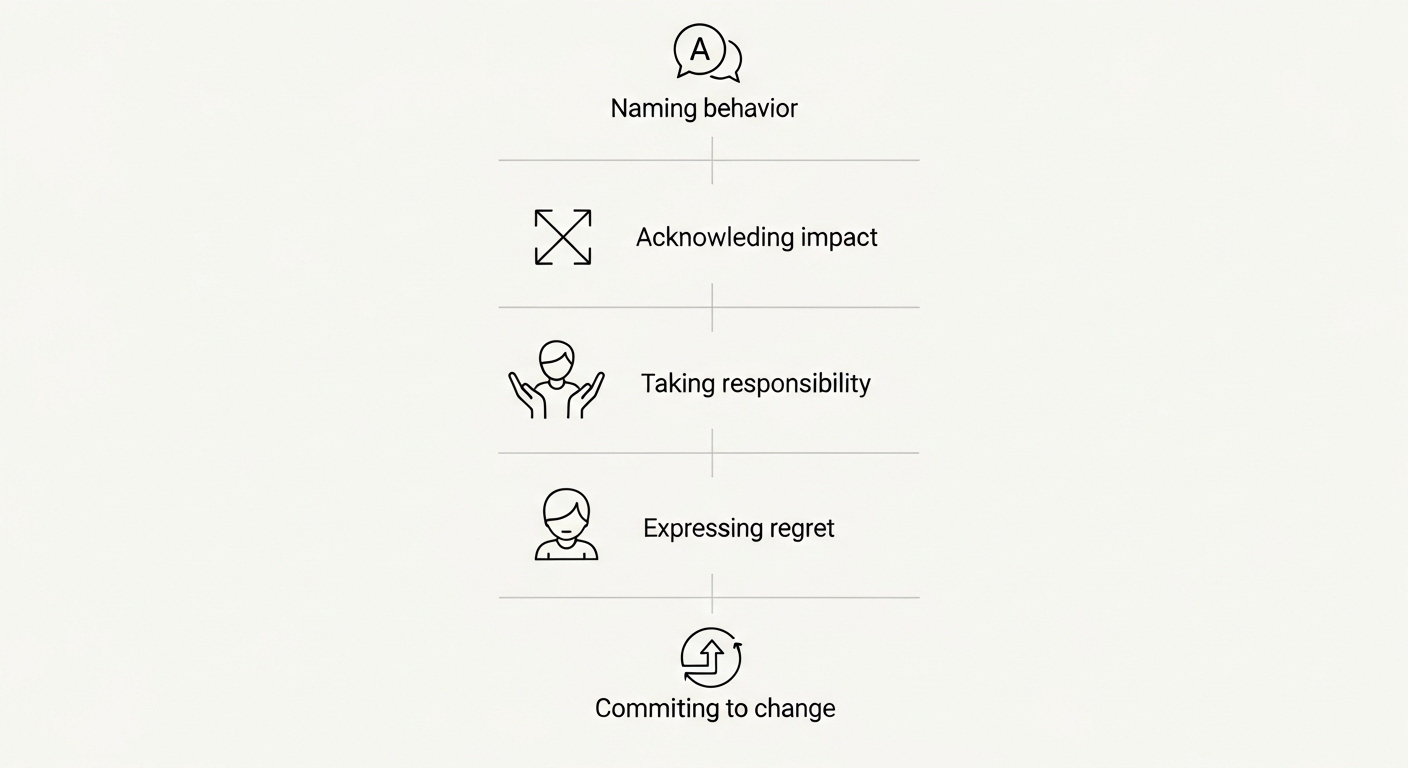
Step 1 — Name the Specific Behavior
Start with exactly what you did, not a vague gesture toward it. 'I'm sorry I raised my voice during our argument on Tuesday' is categorically different from 'I'm sorry things got heated.' The specificity signals that you were paying attention — that you actually know what happened. Vague apologies feel like they're designed to end a conversation, not repair one.
Step 2 — Acknowledge the Impact Without Minimizing It
This is where most apologies collapse. The phrase 'I'm sorry you felt hurt' shifts the problem onto the other person's feelings rather than your actions. Instead: 'I understand that what I said made you feel dismissed, and that was a real consequence of my behavior.' You don't have to agree that your intent was malicious — but intent and impact are two different things, and a good apology addresses the impact directly.
Intent explains your behavior. Impact is what the other person actually experienced. A real apology addresses the impact — even when the intent was innocent.
Step 3 — Take Responsibility Without Conditions
The word 'but' is the single most destructive word in an apology. 'I'm sorry I snapped at you, but I was exhausted' is not an apology — it's a negotiation. The 'but' signals that you're still trying to distribute the blame. Drop the conjunction entirely. If context matters, you can share it after you've completed the apology, not embedded inside it.
Step 4 — Express Genuine Regret
This is the emotional core. It's not enough to acknowledge what happened — you need to communicate that you actually wish it hadn't. This doesn't require dramatic language. Something as simple as 'I genuinely regret that I handled it that way' carries weight when it's said plainly and without performance. People are remarkably good at detecting sincerity, and they're equally good at detecting its absence.
Step 5 — State What You'll Do Differently
An apology without a behavioral commitment is just a description of the past. Tell the person what specifically will change. Not 'I'll try to be better' — that's too vague to be meaningful. Something like: 'When I'm feeling overwhelmed, I'll tell you I need a few minutes instead of taking it out on you.' Concrete, observable, specific. That's what makes an apology feel like a turning point rather than a ritual.
Common Pitfalls to Avoid When Saying Sorry
The Non-Apology Apology
Phrases like 'I'm sorry if you were offended,' 'I'm sorry you feel that way,' or 'I'm sorry, but...' are so common they've become cultural shorthand for avoiding accountability. The problem is that the person on the receiving end almost always recognizes them for what they are. Using one of these in a high-stakes relationship moment can do more damage than the original offense.
There's a specific variant worth calling out: the apology that's really a complaint in disguise. 'I'm sorry I can't be perfect like you want me to be' is not an apology. It's a counterattack wearing an apology's clothing. If you catch yourself constructing something like this, stop and start over.
Apologizing Too Quickly to End the Discomfort
Speed-apologizing — rushing through 'I'm sorry' to escape an uncomfortable moment — is a form of self-protection, not repair. The other person can feel the difference between an apology that's meant to close the subject and one that's meant to address it. If you're apologizing primarily to make the tension stop, that's worth noticing about yourself.
Apologizing quickly to end discomfort is a strategy for your own relief, not theirs. The timing of an apology signals whose needs it's actually serving.
Over-Apologizing Until It Loses Meaning
Repeated, excessive apologies can actually burden the other person — they end up having to reassure you that it's okay, which reverses the dynamic entirely. One clear, complete apology is almost always more effective than five anxious ones. Say it once, say it well, and then give the other person space to respond on their own terms.

Pro Tips to Make Your Apology Actually Land
Match the Medium to the Magnitude
Texting 'sorry about that' for a minor scheduling mix-up is fine. Texting it for a serious breach of trust is not. The medium you choose communicates how seriously you're taking the situation. A significant apology delivered in person — or at minimum by voice — signals that you're willing to be uncomfortable, which is itself a form of accountability. Anyone who has received a breakup text knows exactly how much the medium matters.
Don't Demand Forgiveness as Part of the Apology
Ending an apology with 'so are we good?' or 'I hope you can forgive me' puts immediate pressure on the other person to perform reconciliation before they're ready. Forgiveness is something the other person gets to decide, on their own timeline. Your job is to apologize well — not to manage their response to it.
Follow Through Visibly
The behavioral commitment in Step 5 only means something if you actually follow through. And here's the counterintuitive part: one visible instance of doing the thing you promised — pausing before reacting, checking in before making a decision that affects them — often does more relationship repair than the original apology did. Actions that match words are surprisingly rare, which is exactly why they're so powerful.
(Opinion: The most underrated part of any apology is the silence after it. Most people rush to fill that space — to explain more, to check if it worked, to get some signal that they're forgiven. Sitting quietly and letting the other person take their time is genuinely hard, and it's also genuinely respectful.)

Frequently Asked Questions
What if the other person doesn't accept my apology?
That's their right, and it doesn't invalidate your apology. A genuine apology isn't a transaction where acceptance is guaranteed — it's an acknowledgment of harm and a commitment to change. If the other person needs more time, or decides not to forgive you, the most respectful response is to accept that without pushing back. Pressuring someone to forgive you after an apology undermines the apology itself.
Is it possible to apologize too late?
Rarely. A late apology is almost always better than none, as long as you acknowledge the delay directly rather than pretending it didn't happen. Something like 'I should have said this much sooner, and I'm sorry for that too' addresses the gap honestly. The exception is when the delay itself caused additional harm — in that case, the delay needs to be part of what you're apologizing for.
Do written apologies work as well as in-person ones?
For serious situations, in-person is generally more effective because it requires you to be present and uncomfortable, which communicates sincerity in a way text can't fully replicate. That said, a written apology has one real advantage: the other person can read it on their own terms, return to it, and process it without feeling put on the spot. For someone who needs time and space to process, a thoughtful written apology can actually land better than an in-person one they weren't ready for.
The strange thing about a real apology is that it asks you to prioritize someone else's experience at the exact moment you're most focused on protecting your own. That's not a communication technique — it's a small act of character. And the people in your life will remember, often for years, whether you were capable of it.



Comments
Post a Comment