Why Earth's Orbit Doesn't Always Mean Hotter Summers
Earth is closest to the Sun in early January — not July. If you live in the Northern Hemisphere and just experienced a sweltering August, that fact probably feels wrong. But it's true: Earth reaches perihelion, its nearest point to the Sun, around January 3rd each year, when most of North America and Europe are buried in winter. The distance difference is roughly 3%, and yet that 3% clearly isn't running the show when it comes to seasonal temperatures. Something else is.

What Actually Drives Earth's Seasons — It's Not Distance
The Real Culprit: Axial Tilt
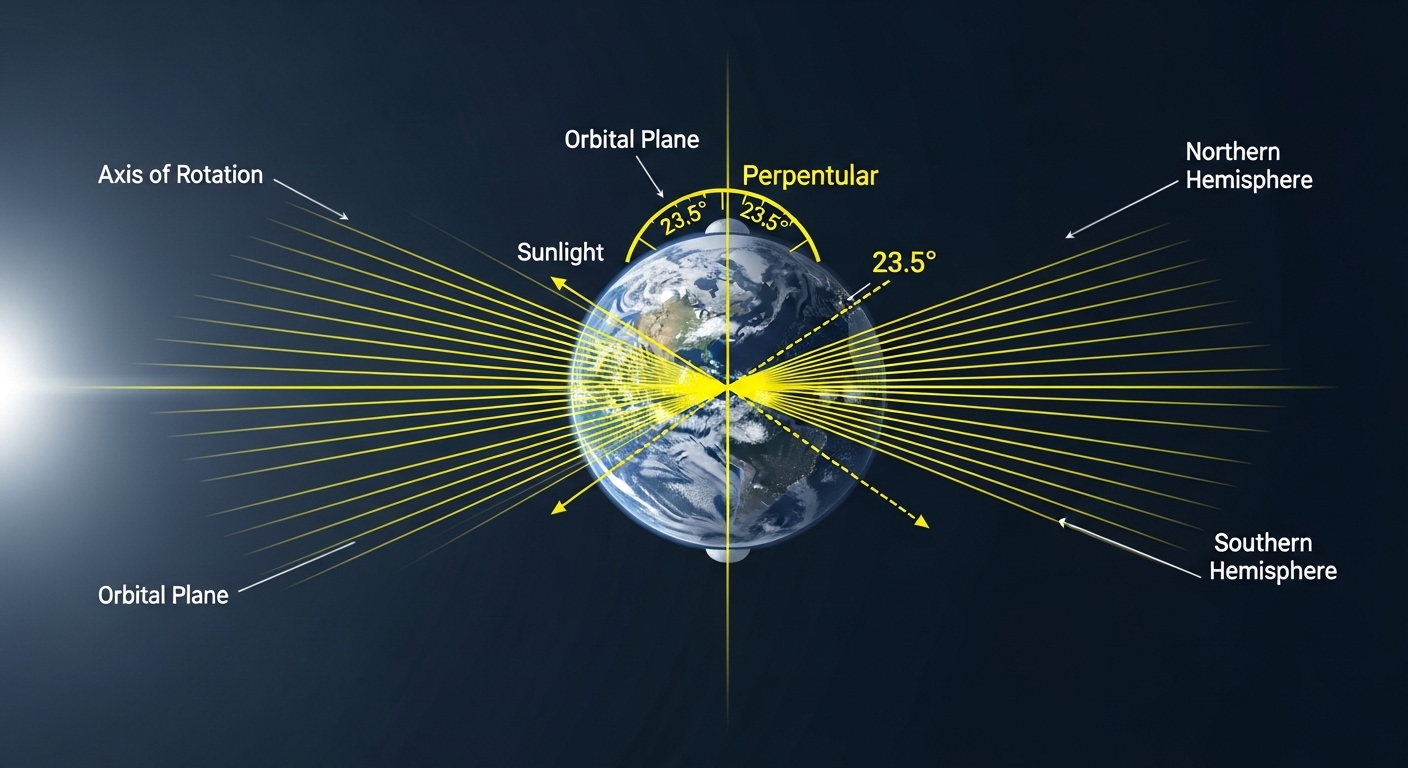
Earth's axis is tilted at about 23.5 degrees relative to its orbital plane. That tilt — not the planet's distance from the Sun — is what creates seasons. When the Northern Hemisphere is tilted toward the Sun (June through August), sunlight hits at a steeper angle, concentrating more energy per square meter of ground. When it tilts away (December through February), the same sunlight spreads across a larger surface area and delivers less heat per unit.
Think of it like a flashlight beam. Shine it straight down at a table and you get a tight, bright circle. Tilt the flashlight and that same beam stretches into a wide oval — dimmer, less intense. Earth's tilt does exactly this to incoming solar radiation across the seasons.
Why Angle Beats Distance Every Time
The Sun's energy output doesn't change meaningfully across that 3% orbital distance variation. The intensity difference between perihelion and aphelion (Earth's farthest point, reached in early July) amounts to roughly 7% more solar energy in January than July. And yet January is cold in the Northern Hemisphere. The geometry of the tilt overwhelms the distance effect completely.
Axial tilt is doing almost all the heavy lifting in Earth's seasonal cycle — orbital distance is a footnote that most climate models treat as background noise.
How Earth's Orbital Shape Changes Over Thousands of Years
Milankovitch Cycles: The Long Game
Here's where orbital mechanics gets genuinely strange. Over tens of thousands of years, Earth's orbit isn't fixed — it wobbles, stretches, and shifts in three distinct rhythmic patterns. Serbian mathematician Milutin Milankovitch mapped these out in the early 20th century, and they're now called Milankovitch cycles. They operate on timescales of roughly 26,000, 41,000, and 100,000 years respectively.
The three cycles are: axial precession (the slow wobble of Earth's rotational axis, like a spinning top winding down), obliquity (the tilt angle itself varying between about 22 and 24.5 degrees), and eccentricity (how elliptical or circular the orbit becomes). Right now, Earth's orbit is nearly circular. At peak eccentricity, the distance difference between perihelion and aphelion becomes large enough to actually matter.
When Orbital Distance Did Matter
About 20,000 years ago, during the Last Glacial Maximum, the alignment of these cycles contributed to dramatically cooler Northern Hemisphere summers — cold enough that ice sheets extended as far south as what is now the northern United States. The Milankovitch cycles didn't cause the ice ages single-handedly, but they set the pacing. Glacial and interglacial periods correlate remarkably well with the 100,000-year eccentricity cycle in particular.
This is the counterintuitive part: orbital distance matters enormously over geological time, but is nearly irrelevant for the season you're experiencing right now. The same mechanism operates at completely different scales.

Why the Southern Hemisphere Has Milder Seasons Than the North
Ocean Coverage Changes Everything
Here's a detail most seasonal explainers skip entirely: the Southern Hemisphere actually receives slightly more solar energy during its summer (December–February) because that's when Earth is closest to the Sun. By rights, Southern Hemisphere summers should be hotter than Northern Hemisphere summers. They're not — and the reason is water.
About 81% of the Southern Hemisphere's surface is ocean. Water has a much higher heat capacity than land, meaning it absorbs and releases heat slowly. The Southern Ocean acts as a massive thermal buffer, moderating temperature swings in both directions. Northern Hemisphere summers are hotter partly because there's more land — and land heats up fast.
The Asymmetry Nobody Talks About
This land-ocean asymmetry means the two hemispheres experience the same orbital mechanics very differently. A person in Buenos Aires and a person in Madrid are both tilted toward the Sun at their respective summer peaks, but the Spaniard is more likely to experience extreme heat waves because continental landmasses amplify temperature swings. Anyone who has driven across a sun-baked interior plain in July already has an intuitive sense of this — the coast feels different for a reason.
The Southern Hemisphere gets slightly more solar energy in summer due to orbital timing — but its oceans absorb the difference so efficiently that you'd never notice.

What This Means for Understanding Climate Change
Separating Natural Cycles from Human-Driven Warming
Milankovitch cycles are sometimes cited — incorrectly — as an alternative explanation for current warming trends. The logic goes: 'Earth's orbit changes naturally, so maybe that's what's happening now.' But the timescales don't match. Milankovitch cycles operate over tens of thousands of years. The warming observed since the mid-20th century has occurred over decades. Natural orbital forcing simply cannot produce change at that speed.
Orbital mechanics are well understood enough that scientists can calculate where we should be in the natural cycle. By that calculation, Earth should currently be in a very slow, gradual cooling trend heading toward the next glacial period — not warming. The fact that it's warming instead is itself evidence that something else is driving the change.
Why Tilt Stability Is Quietly Crucial
Earth's axial tilt is stabilized by the Moon's gravitational influence. Without the Moon, some models suggest Earth's tilt could vary chaotically — swinging between near-zero and extreme angles over millions of years. Mars, which lacks a large stabilizing moon, has experienced dramatic tilt variations over geological time, and its climate history reflects that instability. The Moon's role as a tilt stabilizer is one of those engineering constraints in Earth's habitability story that rarely gets mentioned in casual conversation.

Frequently Asked Questions
If Earth is closest to the Sun in January, why is January cold in the Northern Hemisphere?
Because distance has almost nothing to do with seasonal temperatures. The Northern Hemisphere is tilted away from the Sun in January, meaning sunlight arrives at a shallow angle and spreads across a larger surface area — delivering less heat per square meter. The 3% distance difference is simply overwhelmed by the geometry of the tilt.
Do Milankovitch cycles affect climate today?
They operate on timescales of tens of thousands of years, so their effect on any given century is negligible. The current warming trend is happening far too quickly to be explained by orbital cycles. Milankovitch cycles are relevant for understanding ice ages and long-term climate history, not decade-to-decade temperature changes.
Would Earth still have seasons if its axis weren't tilted?
Essentially no — not in any meaningful sense. Without axial tilt, every location on Earth would receive the same amount of sunlight year-round, and the concept of summer and winter would disappear. There would still be minor variations due to orbital eccentricity, but they'd be far too small to produce the seasonal temperature swings we experience. The tilt is the whole story.
The Moon keeping Earth's tilt stable at 23.5 degrees isn't just a curious astronomical fact — it's one of the reasons complex life had a stable enough climate to evolve over billions of years. Change that angle significantly, and the seasonal patterns that shaped ecosystems, agriculture, and human civilization would look completely different. Earth's orbit is doing less work than most people assume, and a piece of rock orbiting 384,000 kilometers away is doing far more.

Related Posts
- 📄 How Do Satellites Stay in Orbit Without Falling Down?
- 📄 Are Our Days Actually Getting Longer? The Science of Earth's Slowing Spin
- 📄 Living on Mars Time: How NASA Scientists Adapt to a 24.6-Hour Day
- 📄 What Are Planetary Conjunctions? Explaining Celestial Alignments
- 📄 Why Isn't Gravity the Same Everywhere on Earth?


Comments
Post a Comment