How Do Scientists Create Maps of the Milky Way Galaxy?
We live inside the thing we are trying to map. That single fact makes charting the Milky Way one of the strangest cartographic challenges in science — roughly equivalent to trying to draw a floor plan of your house while being permanently locked in one room with no windows. And yet astronomers have managed to produce surprisingly detailed maps of a galaxy that spans roughly 100,000 light-years, using instruments that never leave Earth's surface or its immediate orbit.
What Is a Galactic Map — and Why Is Ours So Hard to Make?
The Inside-Out Problem
A map of the Milky Way is not a photograph. No spacecraft has ever traveled far enough to look back and snap a picture of the whole galaxy — the fastest probes humanity has launched would take tens of thousands of years just to reach the nearest star. Every map you have ever seen of our galaxy is an inference, stitched together from measurements taken at a single vantage point: a small rocky planet about two-thirds of the way out from the galactic center.
The difficulty compounds because the Milky Way is full of dust. Not the kind you wipe off a shelf — interstellar dust clouds block visible light so effectively that optical telescopes cannot see more than a few thousand light-years through the galactic plane. For most of human history, astronomers genuinely did not know whether the Milky Way was a spiral, an elliptical, or something else entirely. The spiral structure was only confirmed in the mid-twentieth century, and the details are still being revised.
What We Are Actually Mapping
Galactic maps track several overlapping things at once: the positions of stars, the distribution of gas and dust, the locations of star-forming regions, and the overall shape of the spiral arms. Each of these requires different tools and different methods. There is no single technique that does it all.
How Radio Waves Revealed the Galaxy's Hidden Structure
The 21-Centimeter Line — Astronomy's Secret Weapon
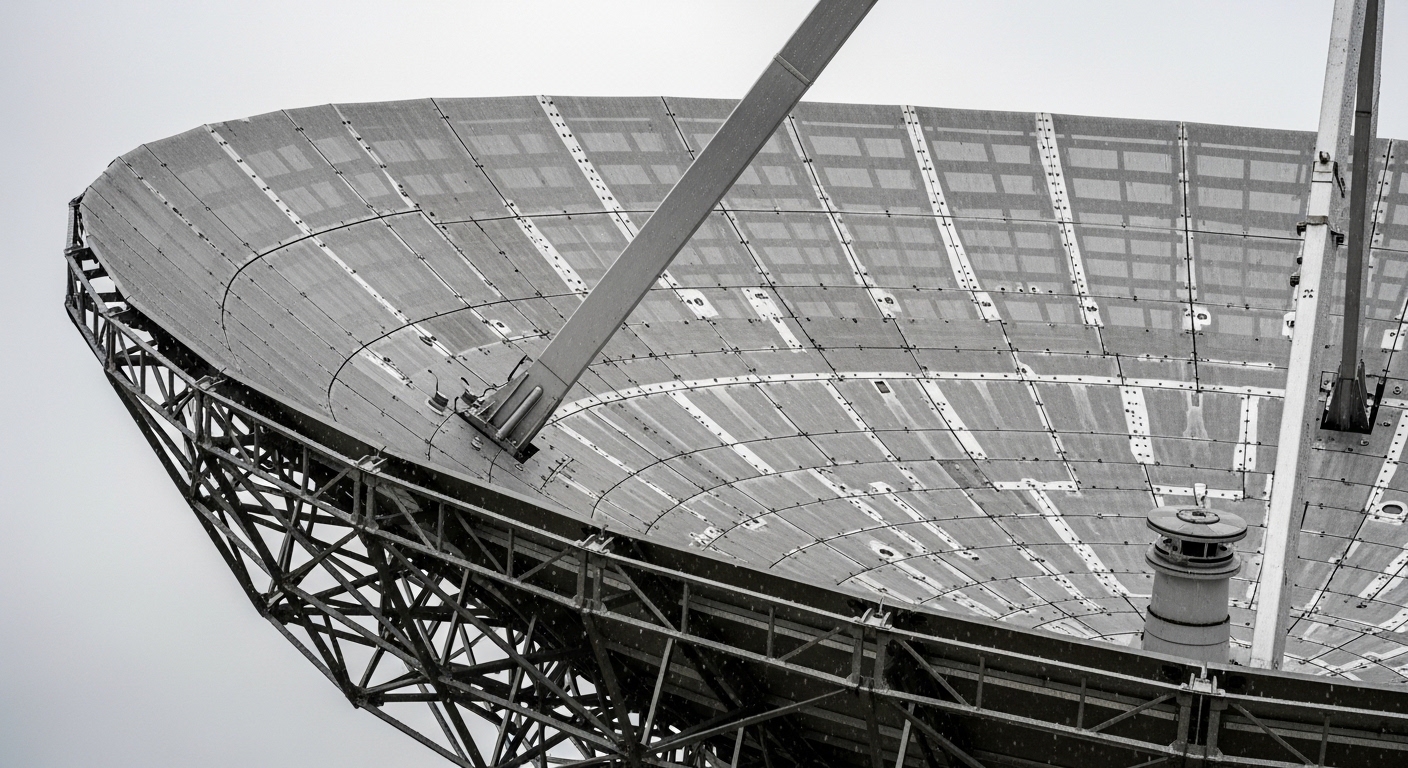
The breakthrough that allowed astronomers to actually map the Milky Way's spiral arms came in 1951, when researchers detected radio emissions from neutral hydrogen gas at a wavelength of 21 centimeters. This was a prediction that had been made theoretically during World War II, and confirming it changed everything. Radio waves pass straight through interstellar dust clouds that stop visible light cold.
Hydrogen is the most abundant element in the galaxy. Wherever there is a spiral arm, there is a dense concentration of hydrogen gas. By pointing a radio telescope at different parts of the sky and measuring both the intensity and the Doppler shift of the 21-centimeter signal, astronomers could calculate how fast that gas was moving relative to Earth — and from that, estimate its distance. It is a bit like tracking cars on a highway by listening to how their engine pitch changes as they pass.
Radio waves pass through interstellar dust that blocks visible light entirely — without the 21-centimeter hydrogen line, the spiral arms of the Milky Way might still be a matter of debate.
Doppler Shifts and Distance Estimates
The Doppler technique works because the galaxy rotates, and different parts of it rotate at different speeds depending on their distance from the center. If you know the expected rotation curve of the galaxy — how fast material at a given distance should be orbiting — you can work backward from a measured velocity to estimate a distance. The catch is that this method produces ambiguous results in some directions, where two different distances can produce the same observed velocity. Astronomers have developed workarounds, but it remains an imperfect tool.
How the Gaia Spacecraft Revolutionized Stellar Cartography
Measuring Parallax at Galactic Scale
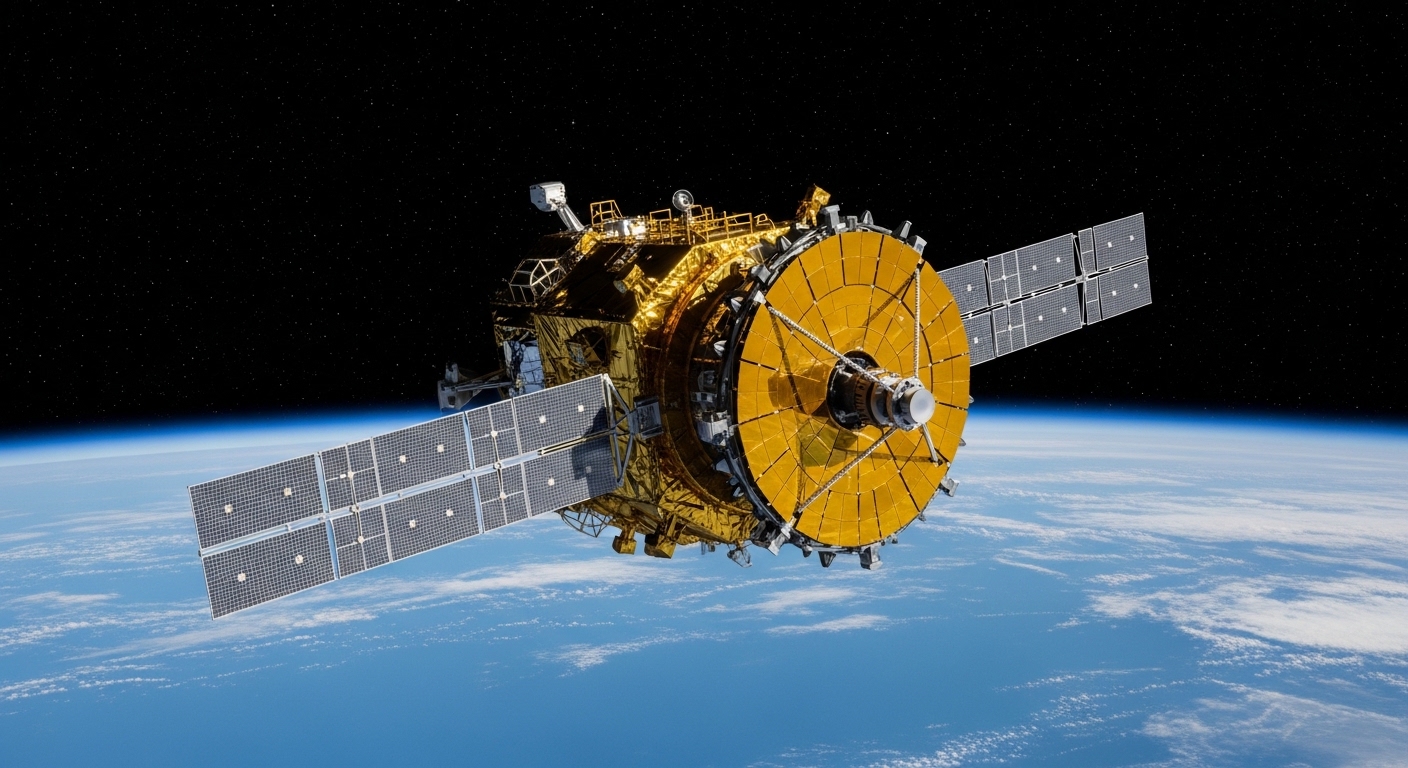
The European Space Agency's Gaia mission, launched in 2013, has produced the most precise three-dimensional map of stars in the Milky Way ever assembled. By the mid-2020s, Gaia had measured the positions, distances, and motions of well over a billion stars with extraordinary precision. The method it uses is ancient in concept: parallax, the same geometric trick that lets your brain judge depth by comparing the slightly different views from each eye.
As Earth orbits the Sun, nearby stars appear to shift slightly against the background of more distant stars. The size of that shift — tiny, measured in milliarcseconds — reveals the star's distance with geometric certainty. Gaia measures these shifts from space, where there is no atmospheric blurring, and it does so repeatedly over years to build up an extremely precise average. For stars within a few thousand light-years, this is the gold standard.
The Limits of Parallax
Parallax becomes less reliable at greater distances because the apparent shift becomes vanishingly small — smaller than the instrument's measurement error. Gaia can reliably measure parallax out to perhaps 10,000–15,000 light-years with high confidence, which covers a significant but still limited slice of a 100,000-light-year galaxy. For the far side of the Milky Way, astronomers need other methods entirely.
How Masers and Standard Candles Fill in the Gaps
Masers — Nature's Precision Rangefinders
For regions beyond Gaia's reliable range, astronomers use a technique called Very Long Baseline Interferometry, or VLBI, to measure the parallax of masers. Masers are natural microwave lasers — coherent radio emissions produced by certain molecules, often near young stars or in star-forming regions. Because they are extremely bright and compact, their positions can be pinpointed with extraordinary precision using networks of radio telescopes spread across continents or even the globe.
The Japanese VERA project and the international BeSSeL survey have used this method to measure distances to star-forming regions scattered across the Milky Way, including some on the far side of the galactic center. These measurements have repeatedly surprised astronomers — the Milky Way's spiral arms are not as neatly symmetrical as earlier models suggested, and the galaxy's overall size has been revised upward more than once.
Masers act as natural GPS beacons embedded in the galaxy — precise enough that a single measurement can anchor an entire spiral arm's position.
Standard Candles — Brightness as a Ruler
When geometric methods fail, astronomers turn to 'standard candles': objects whose intrinsic brightness is known, so that their apparent faintness reveals their distance. Cepheid variable stars, which pulse in brightness at a rate directly tied to their luminosity, have been used for this purpose for over a century. RR Lyrae stars serve a similar role in older stellar populations. More recently, certain types of star clusters and even entire classes of pulsating stars have been calibrated as distance indicators.
The tricky part is that dust dims starlight and makes objects look farther away than they are. Correcting for this 'extinction' requires measuring how much the dust reddens the light — a process that works reasonably well but introduces its own uncertainties. Anyone who has tried to judge how far away a lighthouse is through fog has an intuitive sense of the problem.

What the Current Best Map of the Milky Way Actually Shows
A Four-Armed Spiral — Probably
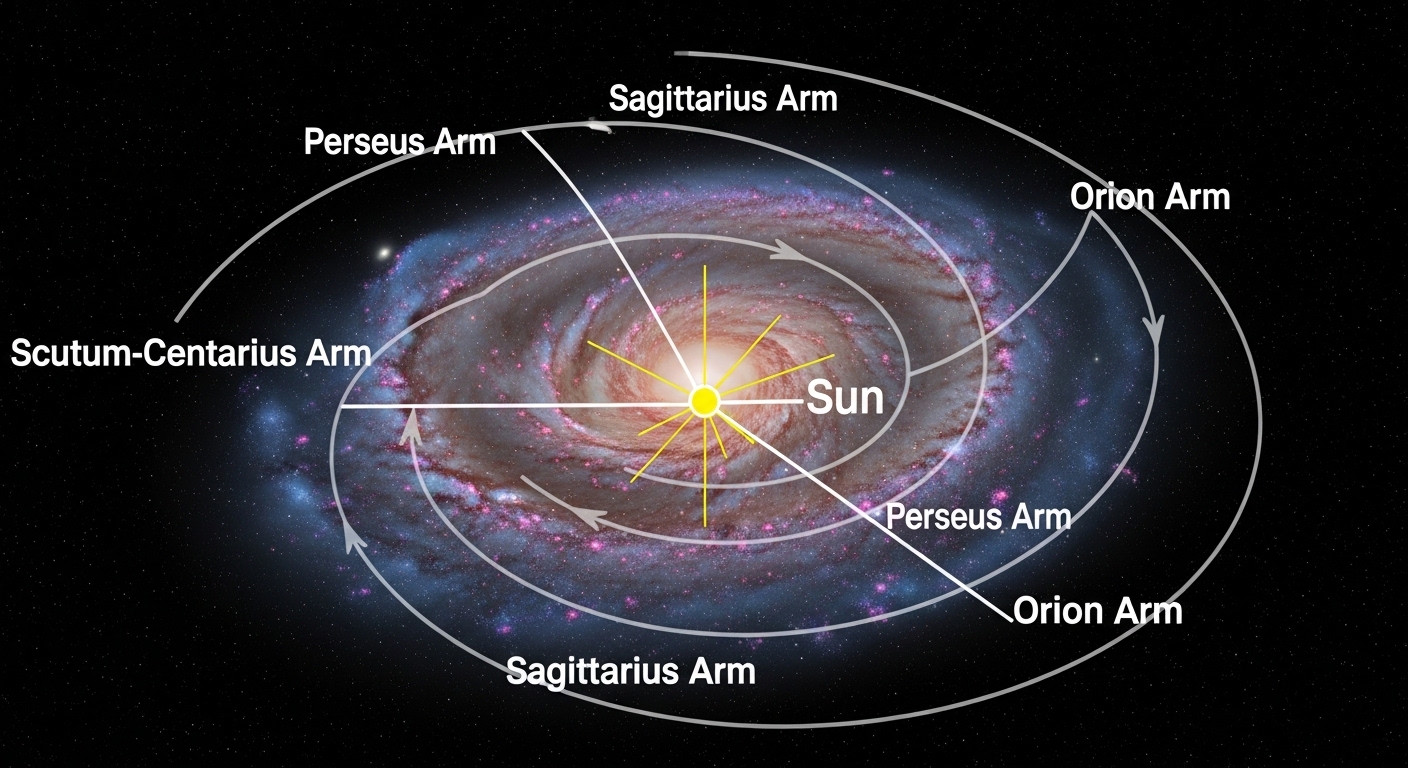
The current consensus picture shows the Milky Way as a barred spiral galaxy with a central bar-shaped structure and roughly four major spiral arms: the Perseus Arm, the Sagittarius Arm, the Centaurus Arm, and the Outer Arm. Our solar system sits in a smaller feature sometimes called the Orion Spur or Local Arm, between the Perseus and Sagittarius arms. The galaxy's total diameter is estimated at roughly 100,000 light-years, though some research suggests the outer disk may extend considerably farther.
The word 'probably' does real work in that sentence. The far side of the galaxy — the region directly opposite us through the galactic center — remains poorly mapped. The galactic center itself is so crowded with dust and gas that even infrared and radio observations struggle to penetrate it cleanly. There are almost certainly structural features we have not yet identified.
The Map Is Always Being Redrawn
Gaia's ongoing data releases continue to refine stellar positions and reveal unexpected structures — warps in the galactic disk, stellar streams from ancient mergers, and moving groups of stars that betray the galaxy's turbulent history. Each data release prompts a round of revised models.
(Opinion: There is something genuinely humbling about the fact that our best map of the galaxy we live in is still provisional. We have mapped the surface of Mars in finer detail than we have mapped our own galaxy's spiral arms. That asymmetry says something interesting about the limits of working from the inside out.)The counterintuitive reality is that astronomers know the structure of distant galaxies — seen face-on from outside — with more visual clarity than they know the Milky Way's own architecture. We can photograph the spiral arms of Andromeda in a single long-exposure image. Our own galaxy requires decades of radio surveys, space missions, and interferometric networks just to sketch the rough outlines.
Frequently Asked Questions
Has any spacecraft ever photographed the entire Milky Way from outside?
No. The farthest human-made object, Voyager 1, is only about 160 astronomical units from Earth — a tiny fraction of the distance needed to see the galaxy from outside. Any image labeled as a 'photo of the Milky Way' is either an artist's rendering, a composite based on data, or a photograph of a different galaxy entirely. We have never had an external view of our own galaxy, and no mission currently planned would achieve one.
Why do maps of the Milky Way keep changing?
Because every new instrument or technique reveals details that previous methods missed or got wrong. Gaia's parallax measurements have corrected distances that were previously estimated using less precise methods, and those corrections shift the inferred positions of entire spiral arm segments. The maps are not wrong so much as perpetually incomplete — each revision is an improvement, not a contradiction.
Can we see the galactic center with a telescope?
Not in visible light — the galactic center is hidden behind roughly 25 magnitudes of dust extinction, meaning visible light is dimmed by a factor of trillions. Infrared and radio telescopes can peer through the dust, and this is how astronomers discovered the supermassive black hole at the galaxy's center, known as Sagittarius A*. The Event Horizon Telescope collaboration produced an image of its shadow in 2022 using radio waves.
The Milky Way map we have today is the product of a century of increasingly clever workarounds — each one invented specifically because the obvious approach was blocked by dust, distance, or the simple fact of being stuck inside. The next major leap will likely come from combining Gaia's stellar census with new radio surveys and infrared space telescopes, gradually filling in the blank regions on a map that, for now, still has more than a few edges marked 'unknown.'


Comments
Post a Comment