From Bone to Stone: How Dinosaur Fossils Are Formed
A dinosaur dies in a floodplain 75 million years ago. Within weeks, scavengers strip the carcass. Within years, the remaining bones are buried under sediment. Within millions of years, those bones are gone — replaced, molecule by molecule, with minerals. What you dig up isn't the original bone. It's a stone replica so precise it can preserve the texture of individual blood vessel channels.
That process — turning biological tissue into rock — is called permineralization, and it's far more selective and improbable than most people realize. The vast majority of animals that have ever lived left no fossil record at all. The ones that did were, in a sense, lucky in ways that had nothing to do with how impressive they were in life.
What Is Fossilization? A Plain-Language Definition
The Basic Idea — and Why It Rarely Works
Fossilization is the process by which the remains of an organism are preserved in rock over geological timescales. The word covers several distinct mechanisms, but when people talk about dinosaur fossils specifically, they almost always mean permineralization — the replacement or infilling of bone tissue with dissolved minerals carried by groundwater.
Here's the catch: bone is already partly mineral. Living bone is roughly one-third organic collagen and two-thirds hydroxyapatite, a calcium phosphate mineral. When an animal dies, the collagen breaks down relatively quickly. What survives long enough to potentially fossilize is the mineral scaffold — but only if it gets buried fast enough to avoid being destroyed by oxygen, bacteria, and physical weathering.
Estimates vary, but paleontologists generally agree that well under one percent of all species that ever existed are represented in the fossil record. Soft-bodied creatures, animals that lived in upland forests, and anything that died in an acidic environment had almost no chance. Dinosaurs, living near rivers and lakes where rapid burial was possible, were comparatively well-positioned — which is part of why we know so much about them relative to, say, Mesozoic insects.
How Permineralization Actually Works — Step by Step
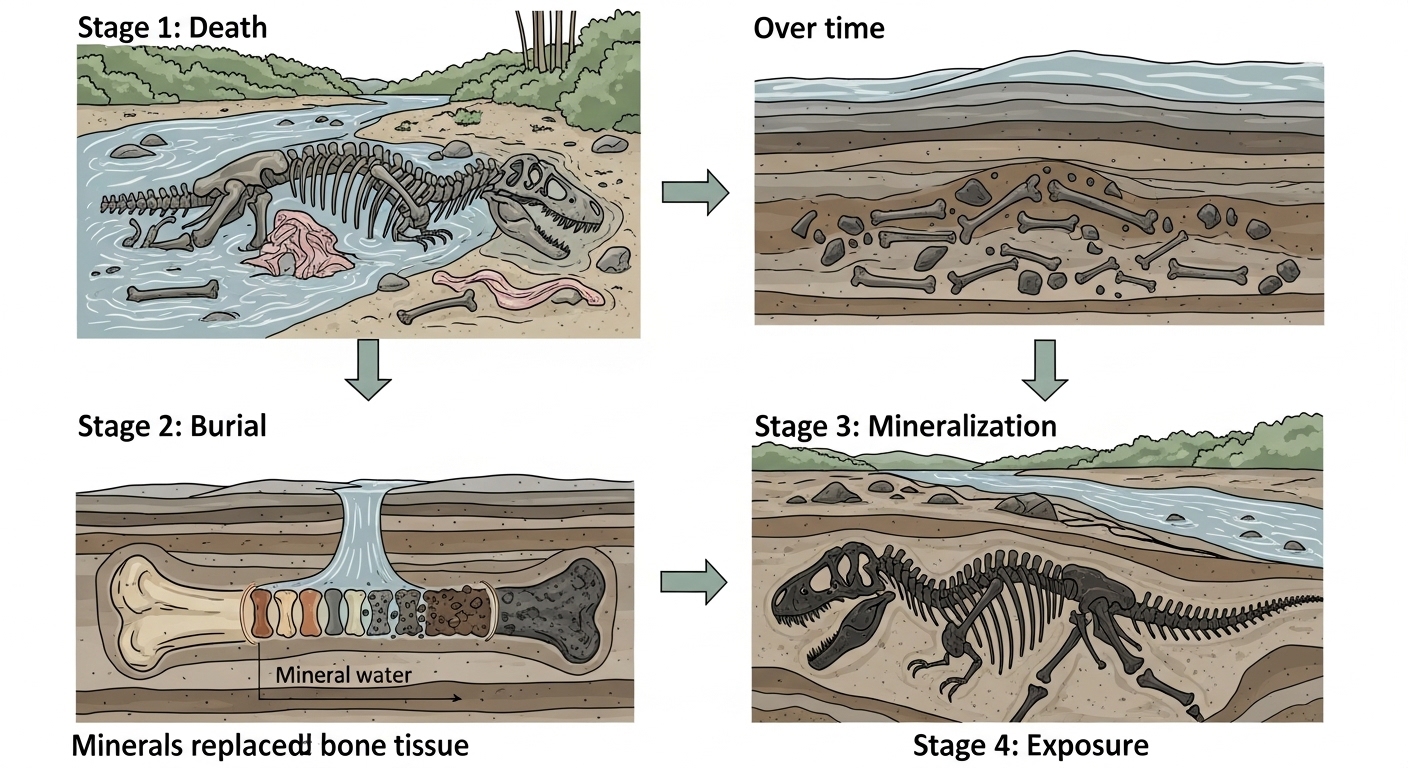
Stage 1: Death, Exposure, and the Race Against Decay
The moment an animal dies, decomposition begins. Soft tissue — muscle, organs, skin — breaks down within days to months depending on temperature, humidity, and scavenger activity. For fossilization to have any chance, the skeleton needs to reach a burial environment before the bones themselves are scattered, gnawed apart, or dissolved by acidic soil chemistry.
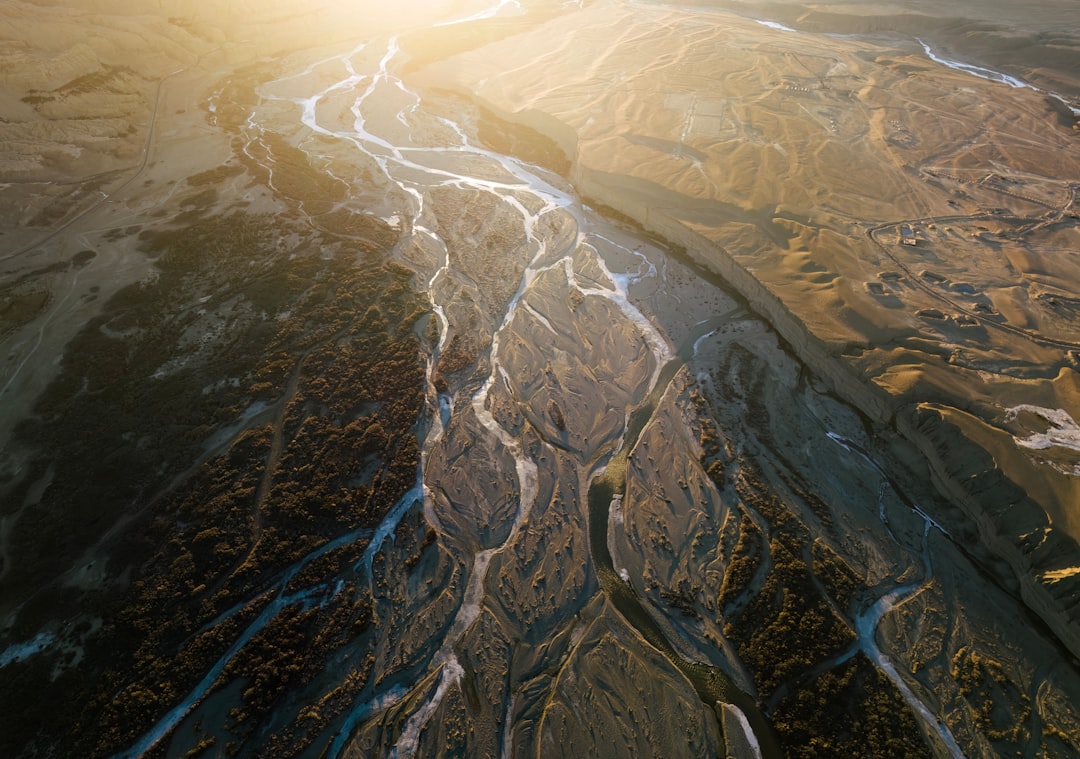
River deltas, lake margins, and coastal mudflats are the classic settings because sediment can bury remains quickly — sometimes within a single flood event. This is why so many famous dinosaur fossil sites are associated with ancient river systems. The Hell Creek Formation in Montana and the Djadokhta Formation in Mongolia, for instance, both represent environments where rapid sediment deposition was common.
Stage 2: Burial and the Mineral Exchange
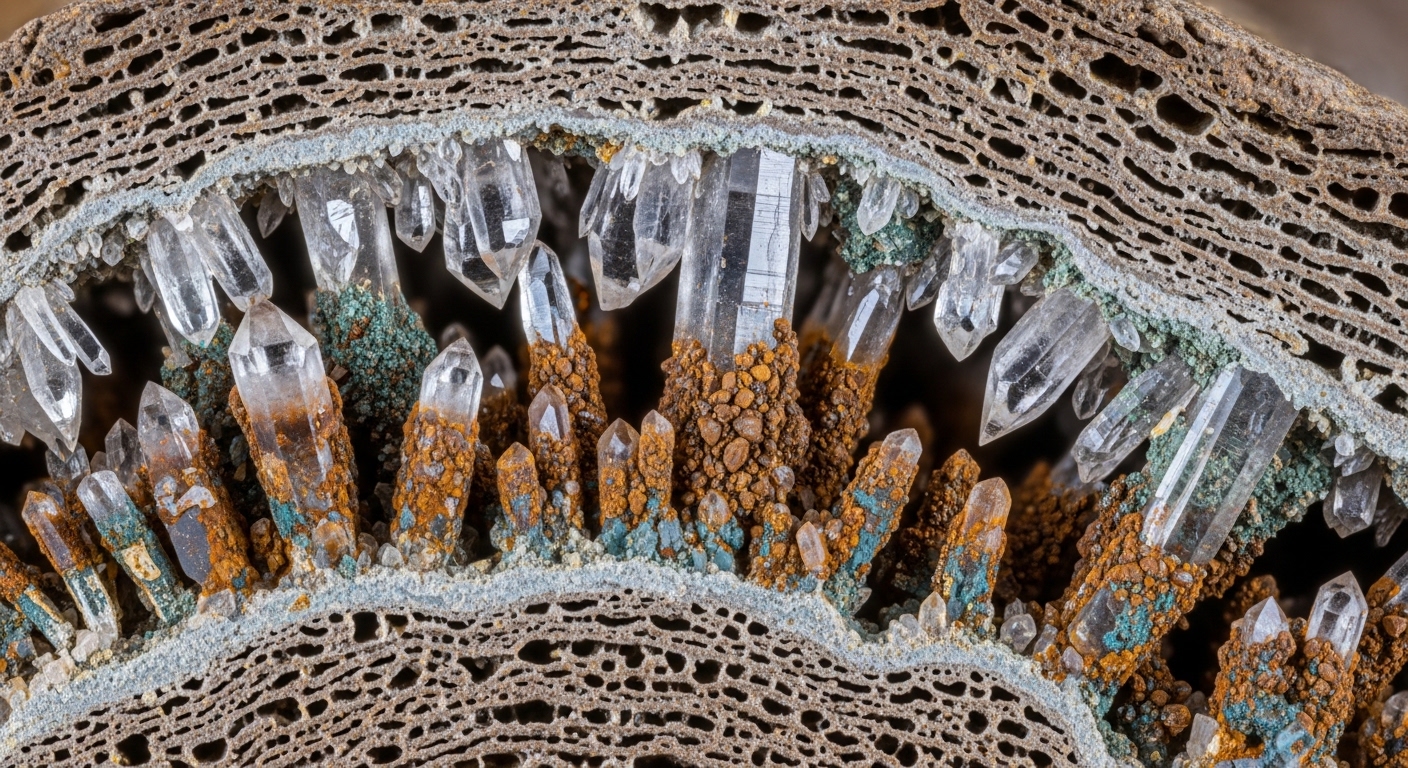
Once buried, the real chemistry begins. Groundwater percolates through the sediment and into the porous spaces inside bone. That water carries dissolved minerals — silica, calcite, iron compounds, and others depending on local geology. These minerals precipitate out of solution inside the bone's microscopic channels and cavities, gradually filling them in.
This isn't a simple swap. The process can take thousands to millions of years, and the specific minerals that end up in a fossil depend entirely on what's dissolved in the local groundwater. That's why fossils from different sites have different colors and weights — a fossil from an iron-rich environment may turn deep red or brown, while one from a silica-rich environment may end up nearly translucent.
Permineralization doesn't preserve the original bone — it uses the bone as a mold. The result is a mineral cast of a structure that no longer exists.
Stage 3: Diagenesis — When the Rock Changes Around the Fossil
As sediment accumulates above the buried bones, pressure and heat slowly convert the loose sediment into sedimentary rock — a process called diagenesis. The fossil is now locked inside rock, and it will stay there until erosion or excavation brings it back to the surface. This phase can last tens of millions of years without any visible change to the fossil itself.
One underappreciated detail: the same diagenetic processes that preserve a fossil can also destroy it. If temperatures get too high — say, from deep burial or nearby volcanic activity — the mineral structure of the fossil can recrystallize or melt entirely. Fossils that end up in metamorphic rock zones are almost always lost. The geological stability of a region matters as much as the original burial conditions.
Other Types of Dinosaur Preservation — Beyond Simple Bone
Trace Fossils, Molds, and the Rare Soft-Tissue Find
Not every dinosaur fossil is a bone. Trace fossils — footprints, trackways, and even fossilized nests — are preserved when an animal leaves an impression in soft sediment that hardens before it's erased. The Paluxy River tracksite in Texas preserves sauropod and theropod footprints in limestone that was once a muddy shoreline. You can read the gait, speed estimates, and even possible social behavior from those tracks.
Mold and cast fossils form when a bone dissolves completely after burial, leaving a cavity in the surrounding rock. If that cavity later fills with a different mineral, you get a cast — a perfect three-dimensional replica of the original bone with no original material remaining at all. Some museum specimens that look like bones are actually casts formed this way.
Then there are the genuinely rare finds. In 2005, paleontologist Mary Schweitzer reported finding what appeared to be flexible, translucent tissue inside the femur of a T. rex specimen from Montana — structures that resembled blood vessels and cells. The discovery was controversial, and the debate over whether original organic material can survive 68 million years is still active. Most researchers now think the structures are real but represent highly degraded, mineralized remnants rather than intact original tissue. Either way, it upended assumptions about the upper limits of preservation.
A fossil trackway can tell you how fast a dinosaur moved. A skeleton can't. Sometimes the absence of bone is more informative than the bone itself.
Why Fossil Formation Matters to Modern Paleontology
What the Preservation Process Tells Us — and What It Hides
Understanding how fossils form isn't just academic. It directly affects how paleontologists interpret what they find. A skeleton discovered with bones in rough anatomical position suggests rapid burial — probably a reliable snapshot of that animal's anatomy. A jumbled assemblage of bones from multiple individuals might represent a drought-related mass death, a river deposit that accumulated over centuries, or a predator's feeding site. The taphonomy — the study of what happened between death and discovery — shapes every conclusion drawn from the fossil.
Preservation bias is a real problem. Large, dense bones fossilize more reliably than small, fragile ones. This means the fossil record systematically underrepresents juveniles, small-bodied species, and animals with lightweight skeletons. For years, paleontologists debated whether certain dinosaur species were genuinely rare or simply poor candidates for fossilization. The answer is often both, and separating the two requires careful taphonomic analysis.
(Opinion: The taphonomic filter is one of the most underappreciated concepts in all of paleontology. Every time someone claims the fossil record 'proves' a species was dominant or rare, they're glossing over the fact that what we have is a profoundly biased sample — shaped by river systems, soil chemistry, and geological luck as much as by biological reality.)The Role of CT Scanning and Micro-Analysis
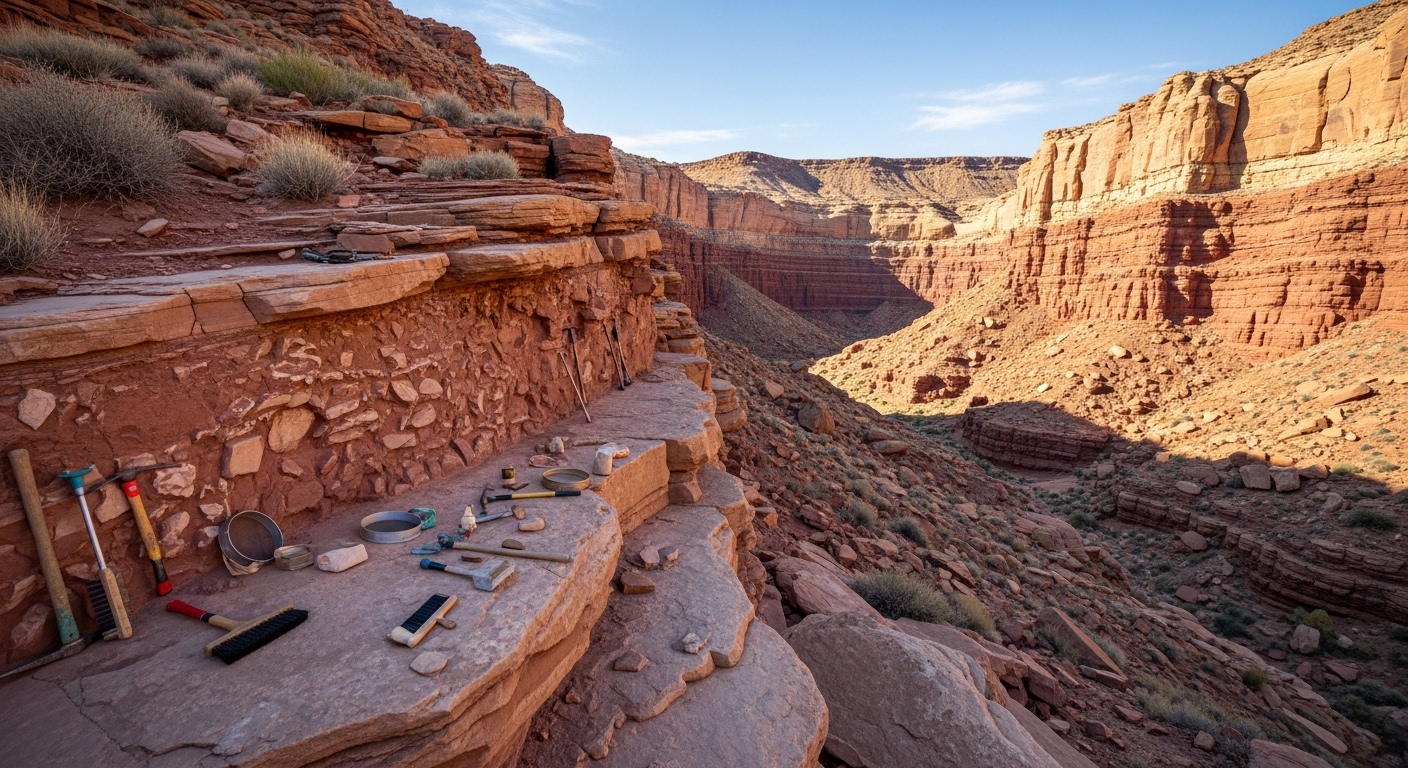
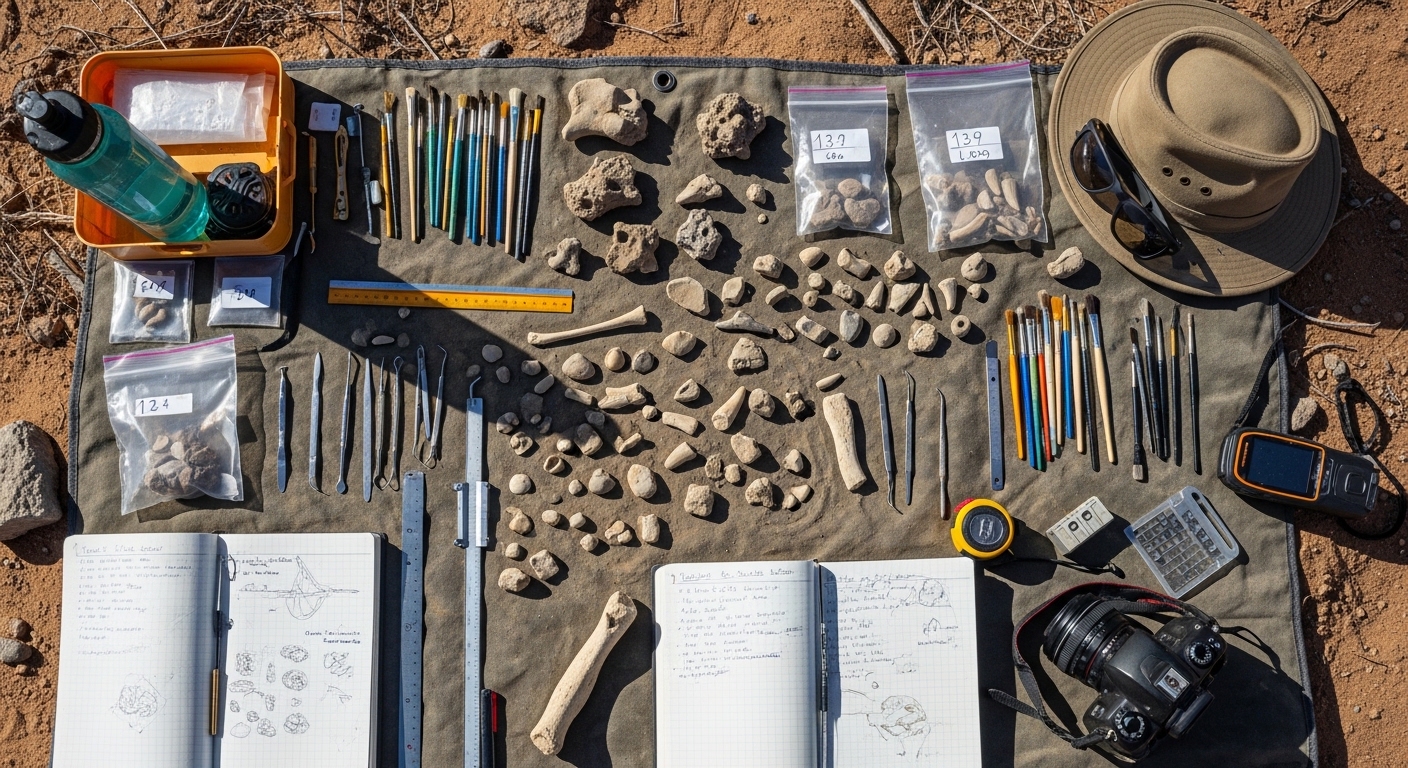
Modern paleontology has moved well beyond chisels and brushes. CT scanning allows researchers to look inside fossils without cutting them open, revealing internal bone structure, sinus cavities, and even the shapes of brain cases. Micro-CT scans of dinosaur teeth have revealed growth rings analogous to tree rings, giving researchers a way to estimate age at death with surprising precision.
Isotopic analysis of the minerals inside fossils can reveal information about diet, migration patterns, and even the temperature of the environment where the animal lived. The fossil isn't just a shape — it's a chemical archive. The catch is that diagenetic alteration can overwrite the original isotopic signature, so every result has to be evaluated against the known geological history of the site.
Frequently Asked Questions
How long does it take for a bone to become a fossil?
There's no single answer — the timeline depends on burial conditions, groundwater chemistry, and local geology. In ideal conditions, significant mineralization can begin within thousands of years. Full permineralization typically takes hundreds of thousands to millions of years. Some exceptionally preserved specimens show that rapid burial can accelerate the process considerably.
Can fossils form today, or is that only a prehistoric thing?
Fossilization is an ongoing geological process. Animals dying near sediment-rich environments today are potential fossils — they just won't be discovered for millions of years, if ever. The conditions required haven't changed. What has changed is the scale of human activity, which disrupts many of the sedimentary environments where fossilization would naturally occur.
Why are complete dinosaur skeletons so rare if fossilization is a natural process?
Even when fossilization occurs, complete skeletons require the body to stay largely intact during burial, the bones to survive millions of years of geological change, and erosion to expose them at the surface without destroying them first. Each of those steps is a filter. A complete, articulated skeleton represents a chain of fortunate circumstances that rarely all align. Most museum 'complete' skeletons include a significant percentage of reconstructed or cast elements.
The next time you stand in front of a museum skeleton, consider what it actually took to get there: a specific death in a specific place, a flood or a mudslide arriving at the right moment, 70 million years of geological stability, and a chunk of eroding hillside that happened to expose the right layer at a moment when someone was walking past. The fossil didn't survive because the animal was important. It survived because the geology was cooperative — and that's a stranger, more humbling thought than most exhibit labels ever let on.


Comments
Post a Comment