Human Echolocation: How Some People 'See' with Sound
Daniel Kish has been blind since he was 13 months old. He navigates mountain bike trails, explores unfamiliar buildings, and reads the shape of a room — all by clicking his tongue and listening to what comes back. This is not a metaphor or a party trick. It is a genuine perceptual skill called human echolocation, and researchers who have studied it have found that it activates the visual cortex in the brains of people who use it well.

What Is Human Echolocation, Really?
The Basic Mechanism
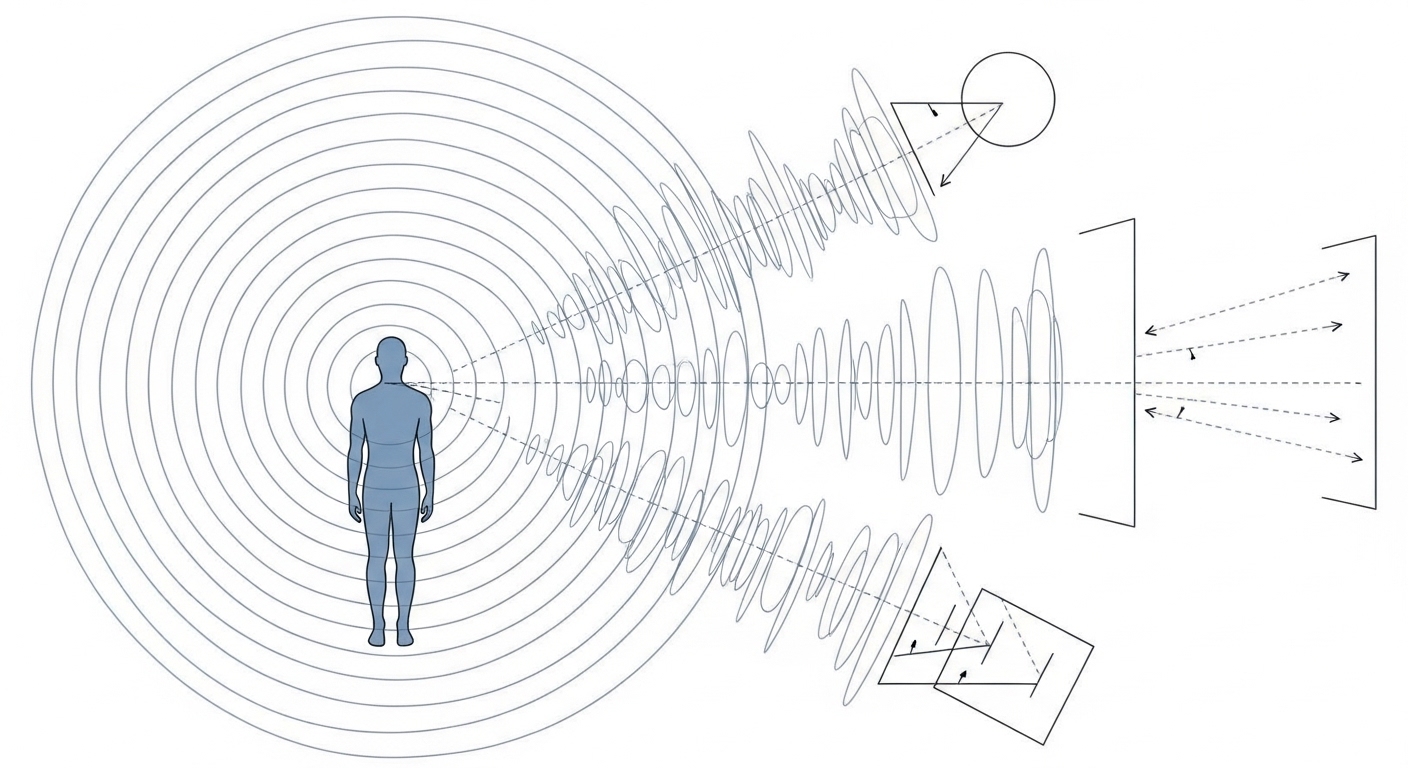
Echolocation is the process of emitting a sound and using the returning echo to build a mental picture of the surrounding environment. Bats do it with ultrasonic pulses. Dolphins do it underwater. Humans do it with sounds well within the normal hearing range — usually tongue clicks, finger snaps, or even footsteps.
The returning echoes carry information about distance, size, texture, and shape. A hard flat wall reflects sound differently than a leafy hedge. An open doorway creates a distinct acoustic 'hole' in the reflected soundscape. With practice, the brain learns to decode these differences into something that functions remarkably like spatial vision.
What makes this genuinely surprising is where that decoding happens. Brain imaging studies have shown that skilled human echolocators process echo information in regions of the brain typically associated with visual processing — not just auditory areas. The brain, it turns out, cares about the spatial information, not the sensory channel it arrives through.
Who Uses It?
Echolocation is most commonly developed by people who are blind or have severely limited vision, often from an early age. Some learn it formally through programs developed by instructors like Daniel Kish, whose organization has taught the technique to blind children around the world. Others develop a version of it spontaneously, without ever being told what they are doing has a name.
Sighted people can learn it too, though typically to a lesser degree of refinement. Research suggests that the earlier someone starts practicing, the more fluently the brain integrates the skill — which mirrors how language acquisition works.

How Does Human Echolocation Actually Work in the Brain?
The Auditory-to-Visual Crossover
For most people, the visual cortex sits idle when there is nothing to see. In skilled echolocators who are blind, it does not. Studies using functional MRI have found that when these individuals process echoes, their primary visual cortex lights up — the same region that responds to light in sighted people. This is a striking example of cortical plasticity: the brain repurposing underused real estate for a new job.
The brain does not care which sense delivers spatial information — it will use whatever channel is available, and rewire itself accordingly.
What is particularly interesting is that this crossover does not appear to happen in sighted people who learn echolocation, at least not to the same extent. The visual cortex in sighted individuals is already busy. In people who have been blind from early in life, that territory is available for reassignment, and the brain takes the opportunity.
What Echolocators Can Actually Detect
Controlled experiments have tested what experienced echolocators can distinguish using only sound. The results are more impressive than most people expect. Skilled practitioners can detect objects roughly the size of a tennis ball at a distance of a meter or more. They can identify whether a surface is smooth or textured. Some can distinguish between objects of different shapes placed side by side.
There are real limits, of course. Fine detail — the kind you get from vision — is not available through echolocation. Colors, facial expressions, and small print are simply beyond what reflected sound can convey. But for navigation, obstacle avoidance, and broad spatial awareness, the technique is genuinely functional.
Where Human Echolocation Shows Up in Everyday Life
Navigation Without a Cane
The most practical application is independent navigation. Daniel Kish famously rides a bicycle using echolocation — clicking rapidly as he moves, building a continuous real-time map of the path ahead. This is not a demonstration of superhuman ability; it is a demonstration of what the human brain can do when it is trained and motivated.
Many blind travelers use a combination of tools: white canes, guide dogs, GPS apps, and echolocation. The tongue-click method adds a layer of ambient spatial awareness that a cane cannot provide — it works at a distance, before physical contact with an obstacle is made. That gap matters enormously when you are moving at speed or in an unfamiliar environment.
A Surprising Historical Note
The phenomenon was documented scientifically as far back as the 1940s and 1950s, when researchers noticed that some blind individuals seemed to detect obstacles without touching them. Early theories attributed it to skin sensitivity or air pressure changes — a hypothesis called 'facial vision.' It took careful experiments, including ones where subjects wore earplugs, to establish that hearing was the actual mechanism. Blocking the ears eliminated the ability entirely. Blocking the face did nothing.
For years, researchers called it 'facial vision' — convinced the skin was doing the sensing. Plugging the ears proved them completely wrong.(Opinion: There is something quietly remarkable about the fact that this skill existed, was used by real people, and was still being misunderstood by scientists well into the mid-twentieth century. It is a useful reminder that human perception is stranger and more flexible than our default assumptions about the senses suggest.)

Why Human Echolocation Matters Beyond Blindness
What It Tells Us About the Brain
Echolocation research has become one of the cleaner demonstrations of neuroplasticity — the brain's ability to reorganize itself in response to experience and need. The finding that visual cortex processes echo information is not just interesting for blindness research. It raises broader questions about how rigidly the brain's regions are actually specialized, and whether that specialization is more about the type of computation being done than the sensory input being processed.
Some neuroscientists now think of the visual cortex as a 'spatial processing region' that happens to be fed primarily by vision in most people — not a region that is exclusively or permanently dedicated to light-based input. That reframing has implications for how we think about rehabilitation, sensory substitution devices, and even the design of assistive technologies.
Practical Applications in Technology
Sensory substitution devices — gadgets that convert visual information into sound or touch — have drawn on echolocation principles for decades. Some devices translate camera input into audio signals that users can learn to interpret spatially. The learning curve is steep, but the underlying principle is the same: give the brain consistent, structured spatial information through a non-visual channel, and it will adapt.
Training programs for human echolocation have also expanded. Research published in peer-reviewed journals has found that structured training can produce measurable improvements in echolocation ability in blind participants within weeks. The skill is not a fixed trait some people are born with — it is learnable, which changes how rehabilitation programs might be designed.
Frequently Asked Questions
Can sighted people learn human echolocation?
Yes, though typically not to the same level of fluency as people who have been blind from an early age. Research suggests sighted people can learn to detect objects using tongue clicks or other sounds, but the brain reorganization seen in long-term blind echolocators — particularly the use of visual cortex — appears to be less pronounced. The skill is still useful and trainable; it just may not reach the same depth of integration.
Is echolocation the same as the 'sixth sense' some blind people describe?
What people sometimes describe as a mysterious sense of obstacles nearby is almost certainly echolocation — specifically, the passive version that uses ambient sound rather than deliberate clicks. Footsteps, traffic noise, and even breathing create echoes that an experienced brain can interpret. It feels intuitive because the processing happens below conscious awareness, which is why early researchers mistakenly attributed it to skin sensitivity rather than hearing.
Does human echolocation work in complete silence?
Active echolocation requires the person to generate a sound, so it works in silence as long as the individual can make noise. Passive echolocation — using ambient environmental sounds — does depend on some background noise being present. In a genuinely anechoic environment with no sound at all, echolocation provides no information. In practice, truly silent environments are rare, so this is rarely a limiting factor in real-world use.
The deeper implication of all this research is not really about blindness. It is about what the brain is actually doing when it perceives the world. If the visual cortex can process spatial information delivered through sound, then 'seeing' was never really about the eyes — it was always about the computation. The eyes are just the most common delivery system. That distinction, small as it sounds, quietly dismantles a lot of assumptions about how perception works and what it means to experience the world.

Related Posts
- 📄 How Do Screen Readers Work? A Simple Guide to Web Accessibility Tech
- 📄 How Do Animals Navigate? The Amazing Science of Migration
- 📄 The Science Behind Silence: How Active Noise Cancellation Works
- 📄 Beyond Siri: How AI Voice Assistants Actually Understand What You Say
- 📄 See It, Then Hear It: The Simple Science of Why Lightning Always Beats Thunder


Comments
Post a Comment