The Invisible Universe: What Is Dark Matter and Dark Energy?
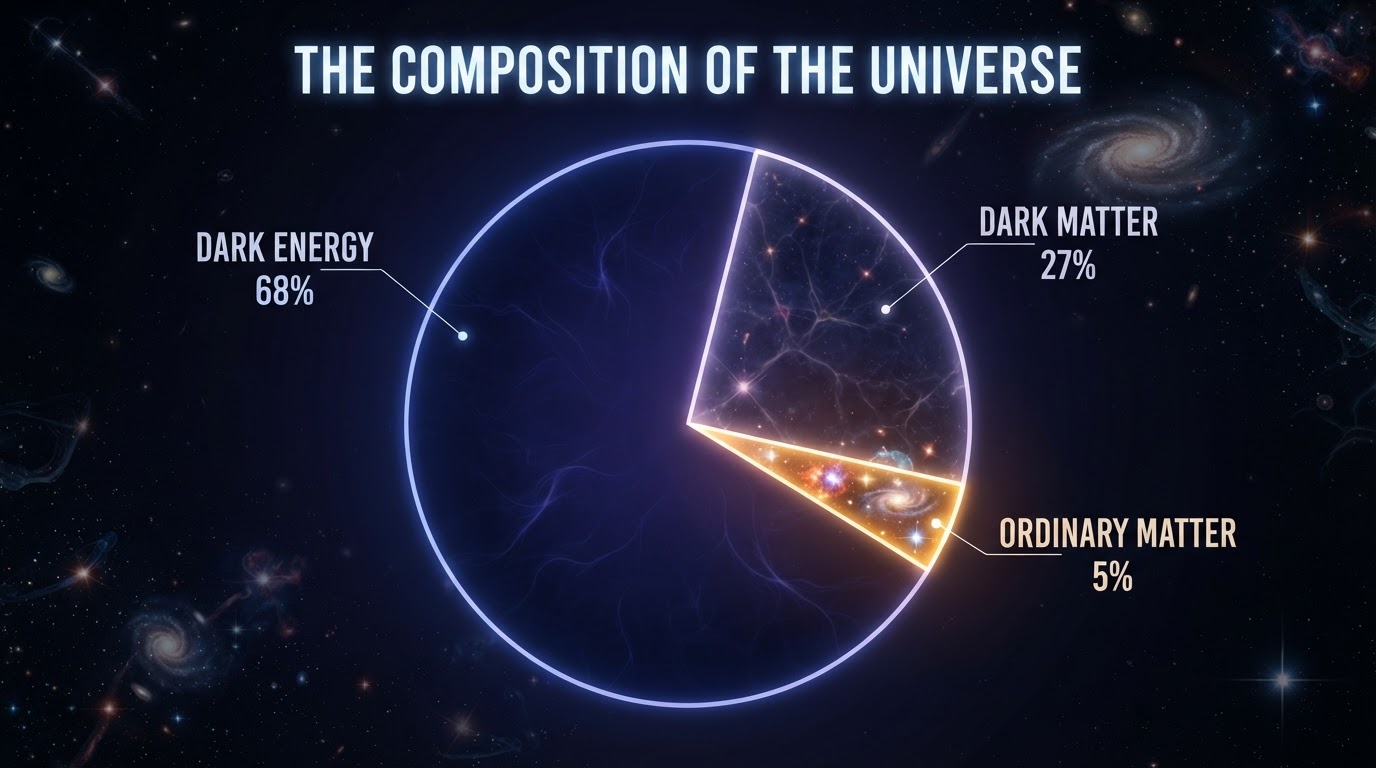
Roughly 95% of the universe is made of stuff we cannot see, touch, or detect directly. The atoms, planets, stars, and galaxies you can observe account for only about 5% of everything that exists. The rest is split between two deeply mysterious components: dark matter and dark energy. They are not the same thing, they do not behave the same way, and understanding the difference between them changes how you see the cosmos entirely.
What Is Dark Matter? A Plain-Language Definition
The Gravity That Shouldn't Be There
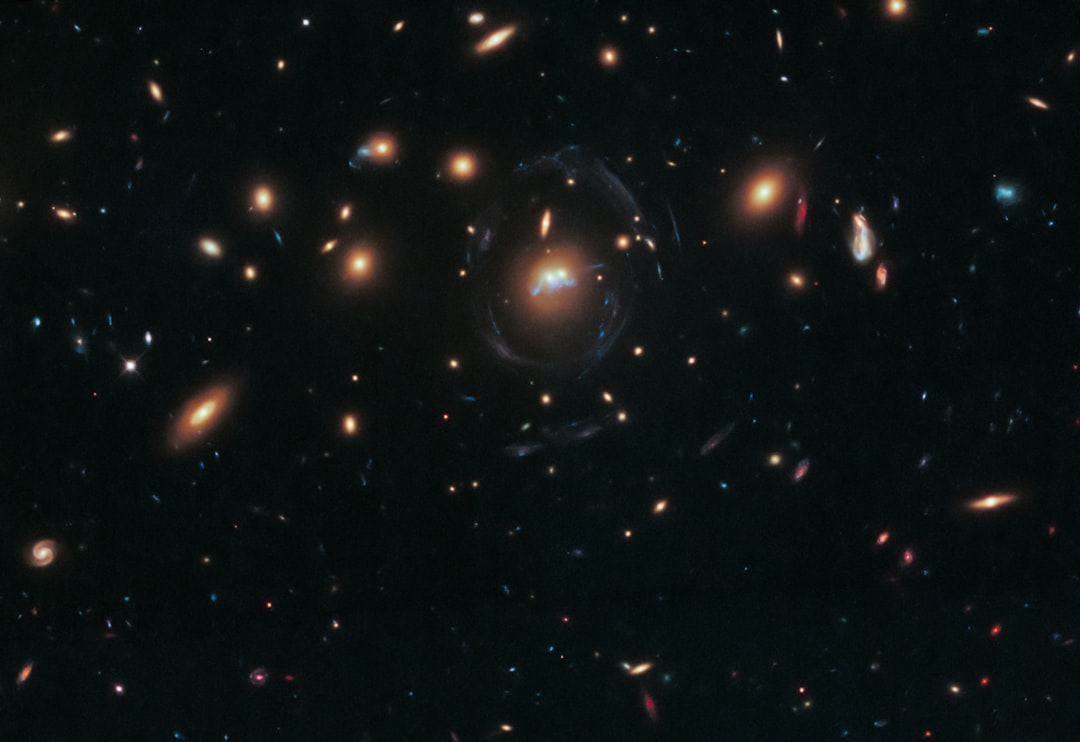
Dark matter is an invisible form of mass that exerts gravitational pull but emits, absorbs, and reflects no light. You cannot photograph it. No telescope — optical, radio, or X-ray — can image it directly. What physicists can do is observe its gravitational effects on the matter they can see, and those effects are unmistakable.
The clearest early evidence came from astronomer Vera Rubin's work in the 1970s. She measured how fast stars orbit the centers of spiral galaxies and found something deeply wrong: stars at the outer edges of galaxies were moving far too fast. According to standard gravity, they should have been flung outward into space, like a ball on a string that snaps. The only explanation that held up was that each galaxy was embedded in a massive, invisible halo of extra matter — dark matter — providing the gravitational glue to keep everything together.
Which sounds like a convenient fix, but the evidence has piled up from multiple independent directions since then. Gravitational lensing — where massive objects bend light from objects behind them — shows distortions that can only be explained by mass that isn't visible. The large-scale structure of the universe, the way galaxy clusters are distributed across cosmic filaments, also matches simulations only when dark matter is included.
What Dark Matter Probably Isn't
One early candidate was ordinary matter we simply couldn't see: dim stars, black holes, rogue planets. Astronomers call these MACHOs (Massive Astrophysical Compact Halo Objects). Surveys looking for their gravitational signatures found some, but nowhere near enough to account for the missing mass. The leading candidates today are exotic subatomic particles — WIMPs (Weakly Interacting Massive Particles) or axions — that interact with normal matter only through gravity and possibly the weak nuclear force. Decades of sensitive underground detectors have not yet confirmed a direct detection, which is either a sign that the particles are even harder to catch than expected, or that the answer lies somewhere else entirely.
How Does Dark Energy Work — and Why Is It So Strange?
The Universe Is Not Just Expanding — It's Accelerating
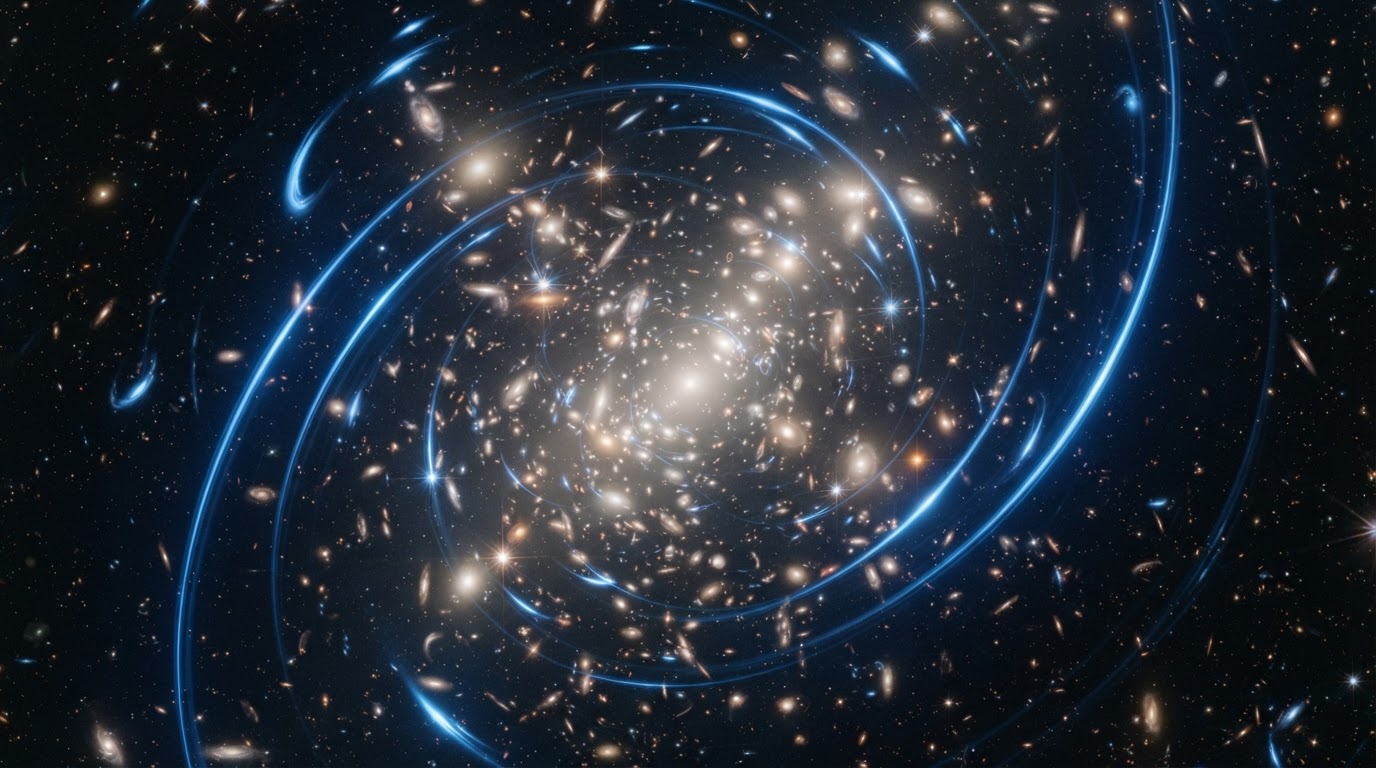
Dark energy is a different beast entirely. Where dark matter pulls things together, dark energy pushes the universe apart. In 1998, two independent research teams studying distant Type Ia supernovae — which act as reliable cosmic distance markers — discovered that the expansion of the universe is not slowing down as gravity should cause it to. It is speeding up. That result was so unexpected it earned the 2011 Nobel Prize in Physics.
The simplest explanation is that empty space itself has energy. Einstein actually introduced a similar concept — the cosmological constant — in 1917, then famously called it his 'greatest blunder' when the universe was found to be expanding. Decades later, it turned out he may have been right for the wrong reasons. Dark energy behaves mathematically like a cosmological constant: a fixed energy density that fills space uniformly and does not dilute as the universe expands. The more space there is, the more dark energy there is, which drives expansion faster, which creates more space. It is a feedback loop built into the fabric of reality.
Dark energy does not just fill space — it is, in some sense, a property of space itself. As the universe expands, dark energy grows with it, which is why its influence becomes stronger over time, not weaker.
The Vacuum Energy Problem
Here is where things get genuinely uncomfortable for physicists. Quantum field theory — one of the most precisely tested theories in science — predicts that empty space should be seething with virtual particles popping in and out of existence, giving the vacuum an enormous energy density. When theorists calculate how large that vacuum energy should be and compare it to the observed value of dark energy, the numbers disagree by somewhere around 120 orders of magnitude. That is not a rounding error. It is the largest discrepancy between theory and observation in the history of physics.
Some researchers suspect there is a cancellation mechanism we have not discovered yet. Others think the cosmological constant is not actually constant — that dark energy evolves over time, which would show up as subtle changes in how the universe's expansion rate has shifted across billions of years. Upcoming surveys are specifically designed to look for that variation.
Where Scientists Actually See Dark Matter's Fingerprints
The Bullet Cluster: The Clearest Case We Have
The Bullet Cluster is the single most compelling piece of direct evidence for dark matter. It consists of two galaxy clusters that collided roughly 150 million years ago. When they passed through each other, the hot gas in each cluster — which makes up most of the visible matter — slammed together, slowed down, and piled up in the middle. But the galaxies themselves, and the dark matter halos around them, passed straight through each other like ghosts, barely interacting.
By mapping the gravitational lensing across the whole system, astronomers could see where the mass was concentrated. It was not in the middle where the gas piled up. It was offset, sitting with the galaxies, in regions where no visible matter had accumulated. The mass had to be there — the lensing proved it — but nothing was emitting light from those locations. That spatial separation between the visible gas and the gravitational mass is about as close to a 'smoking gun' as observational astronomy gets.
The Cosmic Web
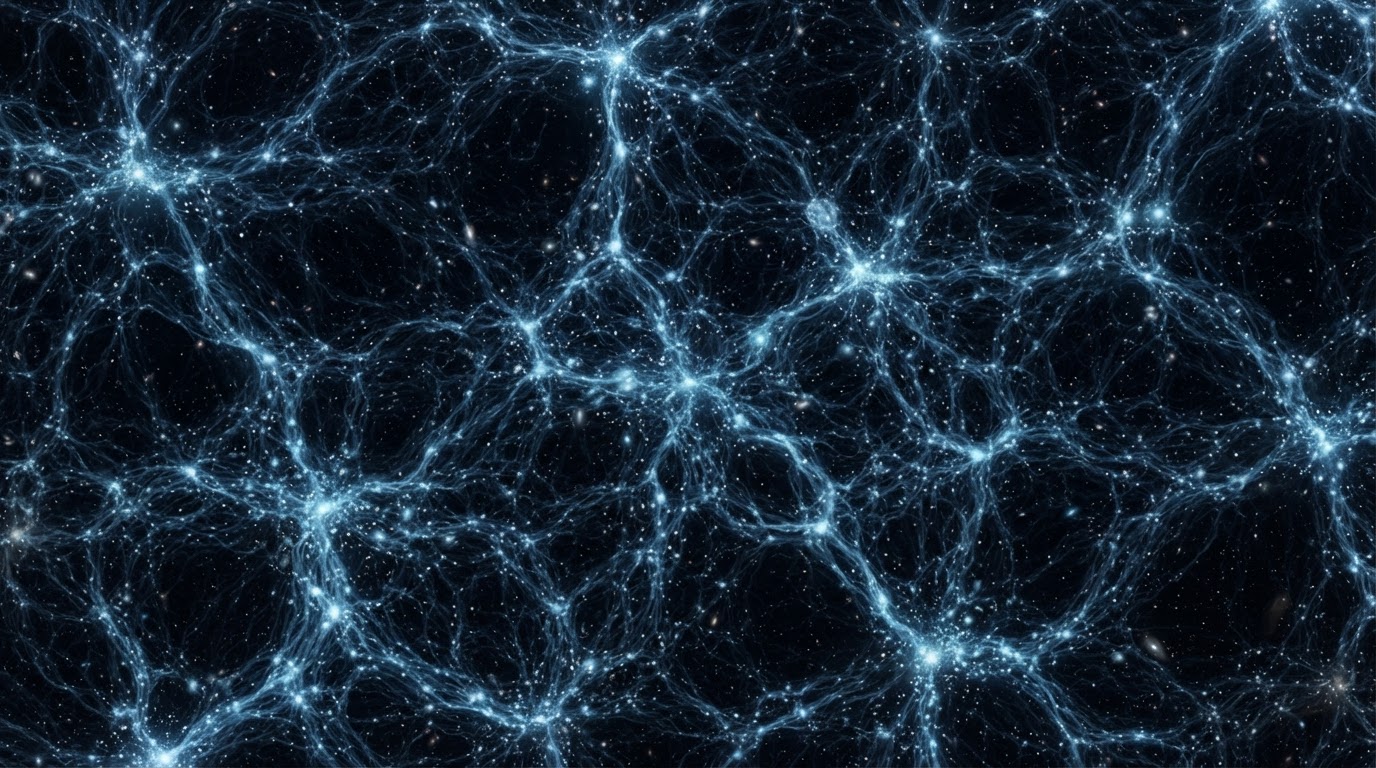
Zoom out far enough and the universe looks like a three-dimensional spider web: vast filaments of galaxies connected at dense nodes, with enormous empty voids in between. This structure did not form randomly. In the early universe, dark matter clumped first under its own gravity, creating the scaffolding. Ordinary matter then fell into those dark matter wells, forming the galaxies and clusters we see today. Run a computer simulation of the universe without dark matter and the cosmic web never forms. The structure we observe only emerges when dark matter is included.
The cosmic web — every galaxy cluster, every filament of structure in the observable universe — was essentially pre-built by dark matter before a single star had ignited.
Why Dark Matter and Dark Energy Matter to Physics Right Now
The Hubble Tension: A Crack in the Standard Model
There is currently a real, unresolved disagreement in cosmology called the 'Hubble tension.' Two different methods of measuring how fast the universe is expanding give results that do not quite match. One method uses the cosmic microwave background — the afterglow of the Big Bang — and our standard cosmological model, which includes dark matter and dark energy. The other uses direct measurements of nearby supernovae and other distance markers. The gap between the two values is small in absolute terms but statistically significant enough that it cannot easily be dismissed as measurement error.
Some physicists think the tension points to new physics — perhaps dark energy is not a simple constant, or dark matter behaves differently than assumed in the early universe. Others suspect systematic errors in one or both measurement chains. Either way, it is an active fault line in our understanding.
What Upcoming Experiments Are Trying to Find Out
The Euclid space telescope, launched in 2023, is mapping the distribution of galaxies across billions of light-years specifically to probe dark energy's behavior over cosmic time. The Vera C. Rubin Observatory — named after the same astronomer whose galaxy rotation work helped establish dark matter — is conducting a decade-long sky survey that will produce an unprecedented map of gravitational lensing across the southern sky. Underground detectors continue searching for WIMP interactions with ever-increasing sensitivity. None of these have delivered a definitive answer yet, but the data volume arriving over the next few years is genuinely unprecedented.
(Opinion: The fact that we have built a precise, predictive model of the entire universe on a foundation of two things we cannot directly identify is either a remarkable triumph of inference or a sign that something fundamental is missing from our picture. Probably both.)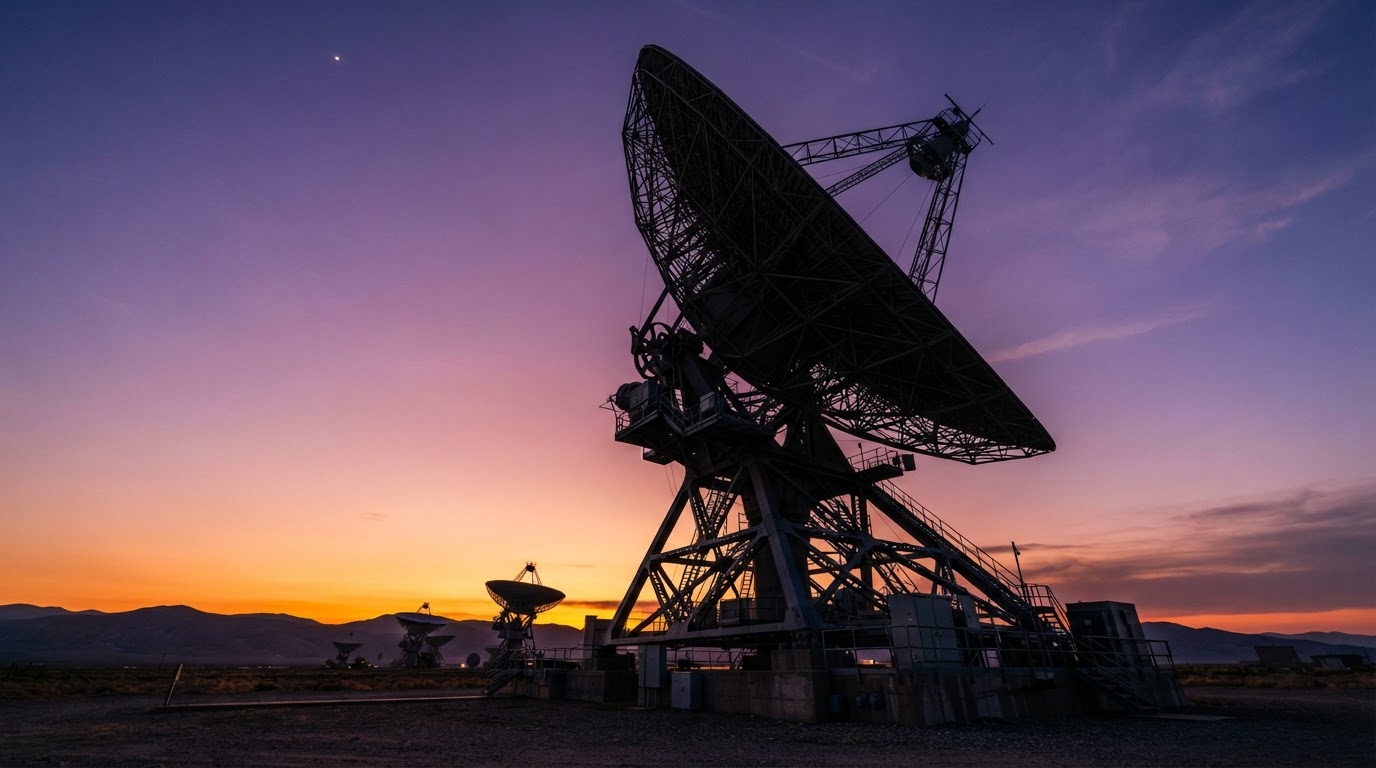
Frequently Asked Questions
Is dark matter the same as antimatter?
No — and this is a common point of confusion. Antimatter is the mirror-image counterpart of ordinary matter, with opposite charge. It interacts with light and has been produced and detected in particle accelerators. Dark matter, by contrast, does not interact with light at all and has never been directly detected. They are completely different concepts, related only by the word 'dark' or 'anti' being attached to 'matter.'
Could dark matter just be a flaw in our theory of gravity?
That is a serious scientific proposal, not a fringe idea. Modified Newtonian Dynamics (MOND) and its relativistic extensions attempt to explain galaxy rotation curves by tweaking how gravity works at low accelerations, without invoking invisible matter. These theories do well on individual galaxies but struggle to explain the Bullet Cluster, the cosmic microwave background, and large-scale structure simultaneously. Most physicists consider a particle-based dark matter explanation more consistent with the full body of evidence, but the debate is not entirely closed.
Will dark energy eventually tear the universe apart?
If dark energy remains constant, the universe expands forever but structures already bound by gravity — galaxies, solar systems — stay intact. The 'Big Rip' scenario, where dark energy grows strong enough to tear apart atoms, only occurs if dark energy increases over time rather than staying constant. Current observations are consistent with a constant value, but the uncertainty is large enough that a slowly strengthening dark energy cannot be ruled out. Estimates suggest any Big Rip, if it happens at all, is tens of billions of years away.
The strangest part of all this is not that the universe contains invisible components — it is that the visible universe, the part made of atoms and light and everything humans have ever studied, turns out to be the exception rather than the rule. Ordinary matter is the minority phase of a cosmos dominated by things that leave no direct trace. Every star you can see at night is part of the 5%. The other 95% is out there, shaping everything, and we are still working out what it actually is.
Related Posts
- 📄 The Four Fundamental Forces of Nature: Explained for Beginners
- 📄 Quantum Physics Explained: A Beginner's Guide to the Universe's Strangest Rules
- 📄 What Are Gravitational Waves? A Simple Guide to Ripples in Spacetime
- 📄 How Do Scientists Create Maps of the Milky Way Galaxy?
- 📄 Cosmic Crashes: What Happens When Galaxies Collide?


Comments
Post a Comment