What Causes a Fire Rainbow? Explaining This Rare Sky Phenomenon
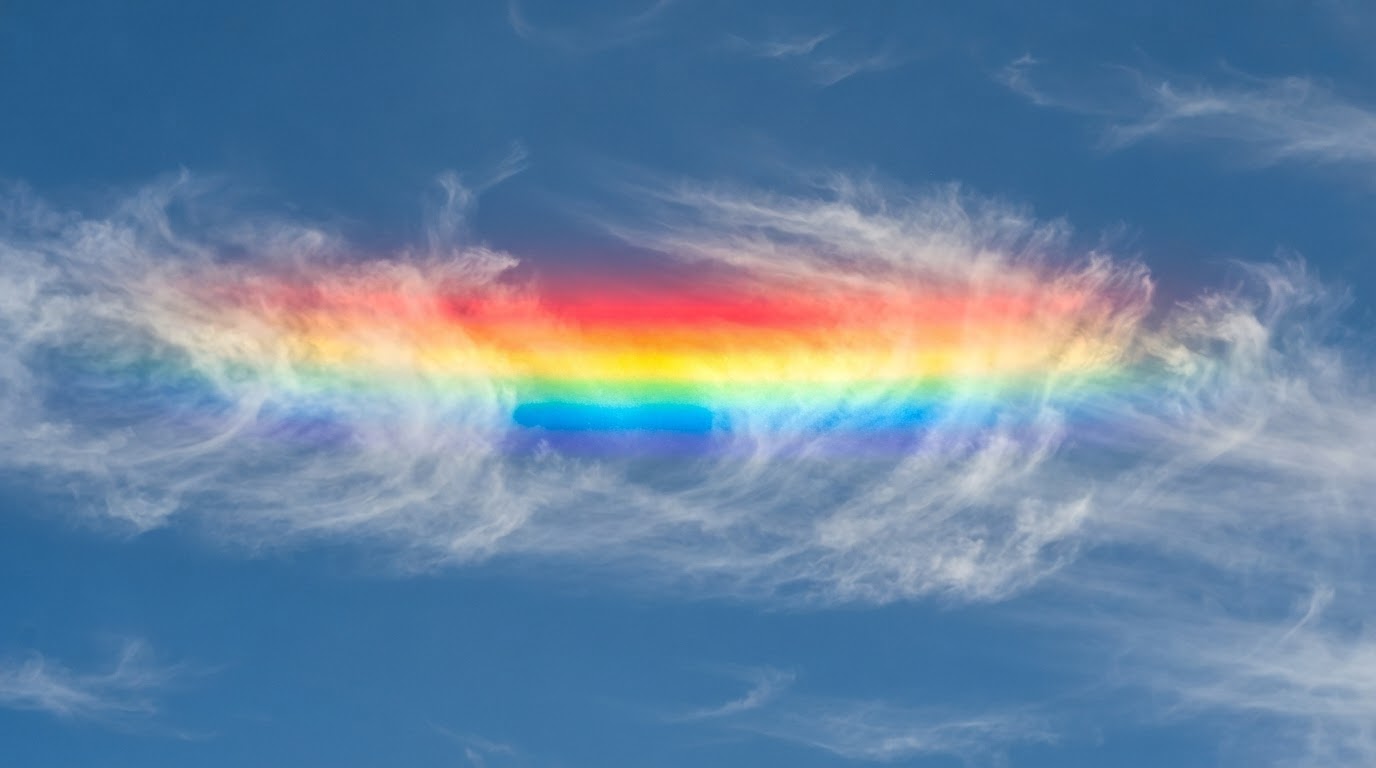
A fire rainbow has nothing to do with fire, and it is not technically a rainbow. It is a circumhorizontal arc — a band of spectral color that appears to float horizontally across the sky, often looking like a section of cloud has been set ablaze with prismatic light. The conditions required to produce one are so specific that in many parts of the world, people go entire lifetimes without seeing one.
What Is a Fire Rainbow, Really?
The Official Name and What It Describes
Meteorologists and atmospheric scientists call this phenomenon a circumhorizontal arc. The name is more descriptive than poetic: it traces a path that runs parallel to the horizon, curving around the sky at a fixed angle below the sun. The colors — red on top, violet on the bottom — are vivid enough that photographs of them routinely get dismissed as edited.
The 'fire' nickname stuck because the colors and the way they appear embedded inside a cloud genuinely do look like something burning. Unlike a traditional rainbow, which forms a curved arc opposite the sun, a circumhorizontal arc sits below the sun and runs horizontally. That distinction matters for understanding why it forms where and when it does.
How It Differs From Other Optical Phenomena
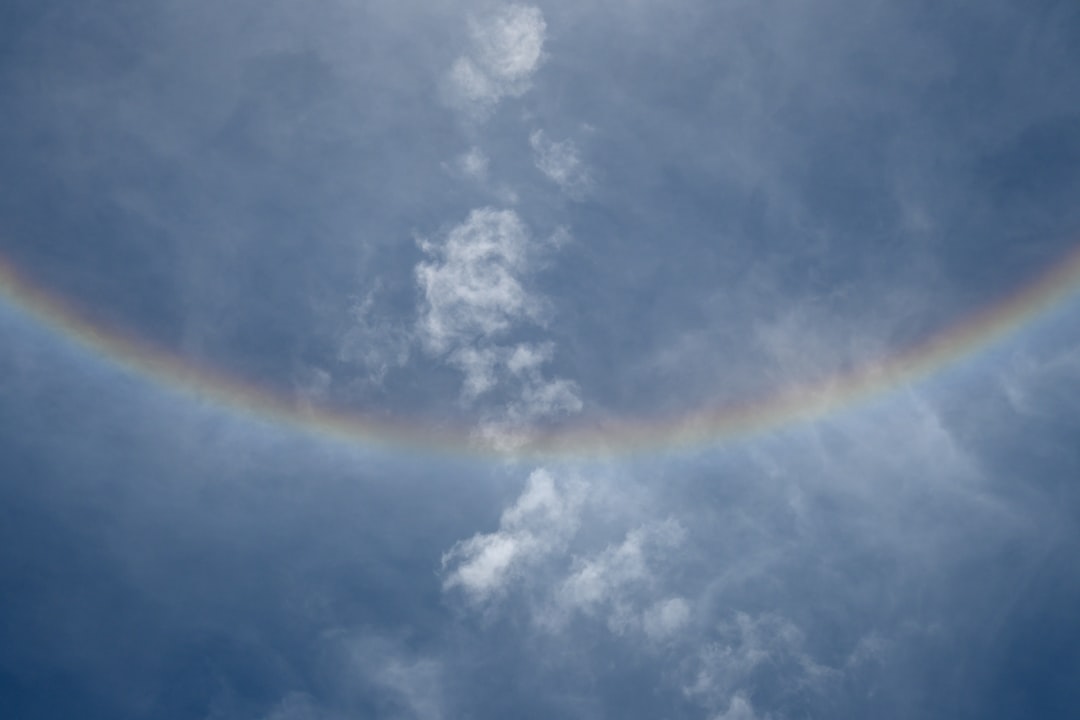
People frequently confuse circumhorizontal arcs with iridescent clouds, sun dogs, or halos. Sun dogs appear as bright spots flanking the sun at roughly the same height. Halos form a complete ring around the sun. Iridescent clouds produce softer, more pastel smears of color. A circumhorizontal arc is sharper, more saturated, and positioned much lower in the sky than any of those.
How Does a Fire Rainbow Form? The Optics Explained
The Role of Ice Crystals in Cirrus Clouds
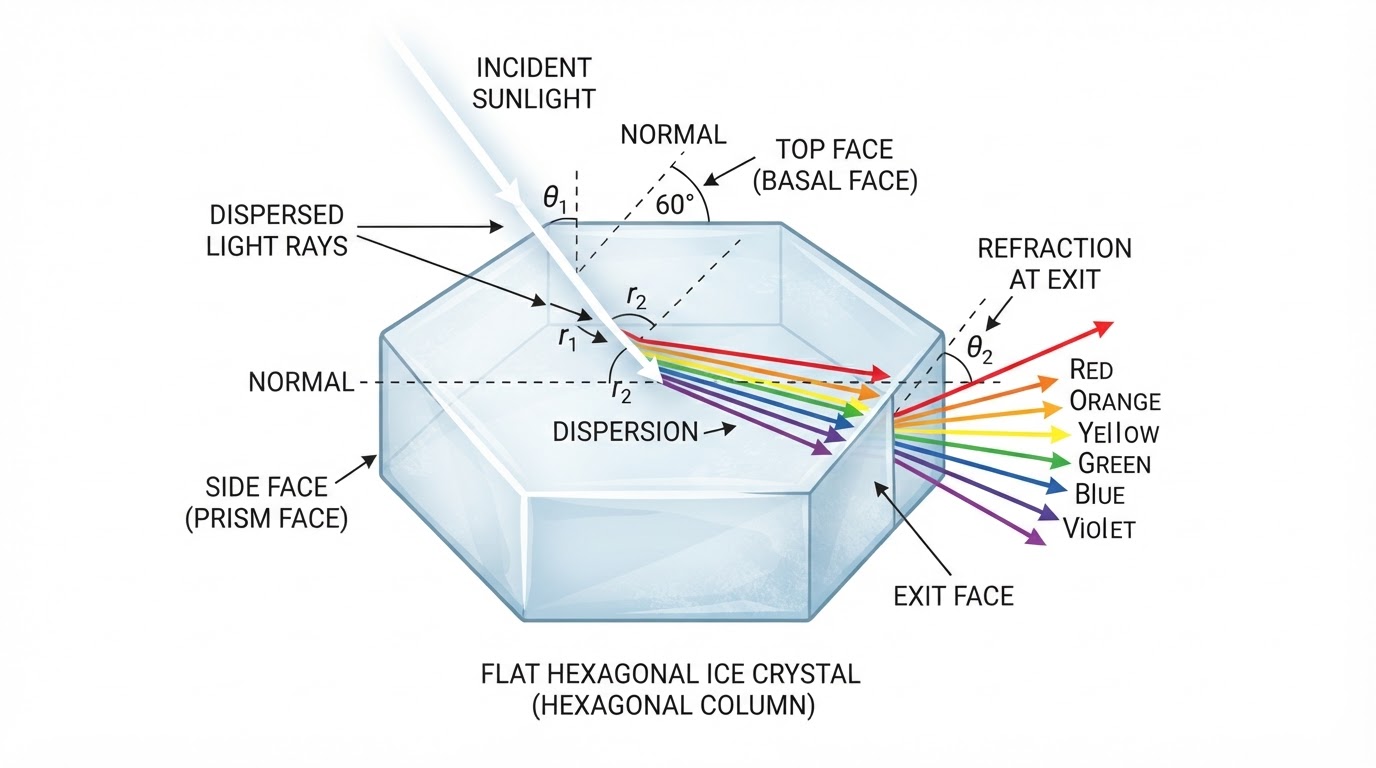
The mechanism is refraction — the same basic process that creates rainbows — but the geometry is completely different. Cirrus clouds, the thin, wispy ones that form at high altitudes (typically above 6 kilometers), are made almost entirely of flat, hexagonal ice crystals. These crystals act like tiny prisms, but only when they are oriented in a very specific way: flat faces pointing downward, aligned nearly horizontally as they drift through still air.
Sunlight enters through the top flat face of each crystal and exits through a vertical side face. That particular entry-exit path bends the light by a minimum of about 46 degrees, and the different wavelengths of light bend by slightly different amounts — which is what separates white sunlight into its component colors. The result is a horizontal stripe of spectrum hanging in the cloud.
The ice crystals have to be oriented like a stack of dinner plates, all lying flat. Even a small amount of turbulence in the cloud scrambles the alignment and the arc disappears entirely.
Why the Sun's Altitude Is the Critical Variable
Here is the constraint that makes this phenomenon genuinely rare: the sun must be at least 58 degrees above the horizon for the geometry to work. That is a steep angle. At most mid-latitude locations, the sun only reaches that height during a narrow window around midday in late spring and summer. In countries above roughly 55 degrees north latitude — most of Scandinavia, Scotland, northern Canada — the sun never climbs high enough, so circumhorizontal arcs are essentially impossible to see from those locations.
In the continental United States, which sits between about 25 and 49 degrees north, the conditions are more favorable. The sun gets high enough during summer months, which is why most documented sightings in the Northern Hemisphere come from the American Southwest and similar mid-latitude regions. Anyone who has spent summers in Arizona or New Mexico has a meaningfully better chance of seeing one than someone living in Oslo.
Where and When Are Fire Rainbows Most Commonly Seen?
Geographic Hotspots and Seasonal Windows
The sweet spot for circumhorizontal arcs is mid-latitude regions during summer. In North America, sightings cluster between May and July. The western United States sees them more frequently than the east, partly because the drier atmosphere supports the formation of high cirrus clouds without obscuring them with lower cloud layers. Parts of southern Europe — Spain, Italy, Greece — also sit in a favorable latitude band.
A well-documented sighting occurred over Idaho in June 2006, when photographs spread widely online and introduced most people to the phenomenon for the first time. That event helped cement the 'fire rainbow' nickname in popular usage, even though scientists had been cataloguing circumhorizontal arcs for much longer under the more clinical name.
Why They Are Harder to See Than You Might Expect
Even when the sun angle and cloud type are both correct, the ice crystals still need to be sufficiently aligned. Turbulent air disrupts the orientation. A cloud that looks like cirrus from the ground might have enough internal mixing to scramble the crystal alignment completely. The window of perfect conditions — right cloud, right altitude, right sun angle, calm enough air — is narrow even in favorable locations.
Getting the sun angle right is necessary but not sufficient. The cloud itself has to be cooperating at the microscopic level, which is why two people standing a hundred kilometers apart on the same afternoon might have completely different experiences.

Why Fire Rainbows Look So Unnaturally Vivid
Saturation Compared to Ordinary Rainbows
A standard rainbow forms when sunlight reflects inside spherical water droplets. The geometry of that reflection causes significant overlap between color bands, which washes out the saturation. Circumhorizontal arcs form through pure refraction with no internal reflection, and the 46-degree minimum deviation angle keeps the color bands cleanly separated. The result is colors that look almost artificially bright — which is why early social media posts of them were so frequently accused of being digitally enhanced.
The colors are also ordered differently from a rainbow. In a standard rainbow, red is on the outside of the arc (top) and violet is on the inside (bottom). In a circumhorizontal arc, red is still on top and violet on the bottom, but the arc is horizontal rather than curved upward. The visual effect is striking enough that even people who know what they are looking at find it slightly disorienting.
The Counterintuitive Detail About Cloud Brightness
Here is something most overviews skip: the arc is often most vivid not in the thickest part of the cirrus cloud, but near the edges where the cloud is thinner. Thicker sections of cirrus can actually dilute the effect because light passing through multiple overlapping crystals in different orientations washes out the color separation. The sharpest, most saturated arcs tend to appear where the cloud is just dense enough to contain well-aligned crystals but thin enough to let the separated colors pass through cleanly.
(Opinion: There is something quietly absurd about the fact that one of the most visually spectacular things the atmosphere produces requires conditions so specific that most of the planet's population will never see it in person. It is the kind of phenomenon that makes you wonder what else is happening overhead that you are simply not in the right place, at the right time, to witness.)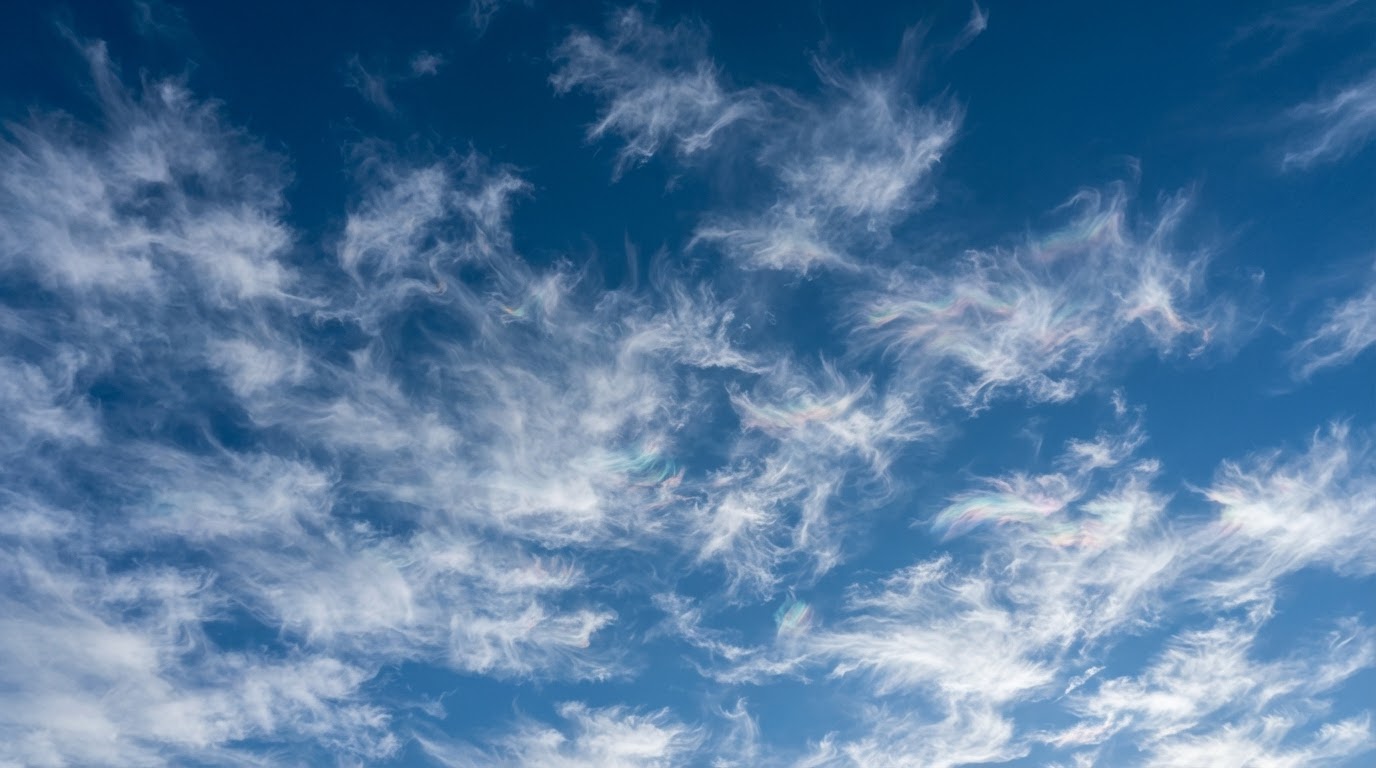
Frequently Asked Questions
Is a fire rainbow the same as a rainbow?
No. A traditional rainbow forms when sunlight reflects inside water droplets and appears as a curved arc opposite the sun. A fire rainbow — properly called a circumhorizontal arc — forms through refraction in flat ice crystals inside cirrus clouds and appears as a horizontal band of color below the sun. The two phenomena share the same color spectrum but have completely different formation mechanisms and geometries.
Can you see a fire rainbow at night or during sunrise?
No. The sun must be at least 58 degrees above the horizon for the refraction geometry to work, which only occurs during midday hours in summer at mid-latitudes. Sunrise and sunset angles are far too low. The moon is never bright enough or positioned at the right angle to produce a lunar equivalent of this phenomenon.
Why do some people see fire rainbows frequently while others never see one?
Location is the dominant factor. People living at latitudes between roughly 25 and 55 degrees north or south have the best chance, since the sun reaches the required elevation angle during summer. Within those regions, local climate matters too — areas with frequent summer cirrus clouds and clear lower atmospheres (like parts of the American West) see them more often. Someone living at a high latitude, or in a region with persistent low cloud cover, may genuinely never see one despite living a full lifetime outdoors.
The next time you are outside on a clear summer afternoon and there are thin, high clouds near the sun, it is worth tilting your head down slightly and looking at those clouds rather than away from them. The arc, if it is there, will not be where you expect it. It will be sitting quietly below the sun, looking like something a computer generated — except no computer put it there.



Comments
Post a Comment