Voice of Deception: What is Vishing and How to Protect Yourself from Phone Scams
A retired teacher in Ohio lost her life savings in 47 minutes — not to a burglar, not to a hacker who broke into her computer, but to someone who simply called her on the phone and sounded completely convincing. Vishing, short for 'voice phishing,' is one of the fastest-growing forms of fraud in the world, and it works precisely because it exploits something we were all taught to do: answer the phone and be polite.

What Is Vishing? A Plain-Language Definition
The Core Concept
Vishing is a social engineering attack carried out over a phone call. The attacker impersonates a trusted authority — a bank fraud department, the IRS, a tech support agent, even a hospital — and manipulates the target into handing over sensitive information or money. Unlike email phishing, there's no link to click and no attachment to open. The weapon is the human voice itself.
What makes it particularly effective is the real-time pressure it creates. Email gives you time to think. A live caller does not. Scammers are trained to keep you on the line, escalate urgency, and prevent you from pausing long enough to question what's happening. That psychological pressure is the whole point.
How Vishing Differs from Regular Phone Scams
Old-school phone scams were blunt instruments — a robocall telling you that you'd won a cruise, a heavily accented stranger claiming to be from 'Windows Support.' Vishing in its modern form is far more sophisticated. Callers now use spoofed numbers that display as your actual bank's phone number. They reference your real name, your partial account number, and sometimes even your recent transactions — data harvested from previous breaches or purchased on dark-web marketplaces.
The term itself emerged alongside 'phishing' in the early 2000s, but the technique exploded in scale once caller ID spoofing became cheap and accessible. What once required technical skill now costs almost nothing to execute at scale.
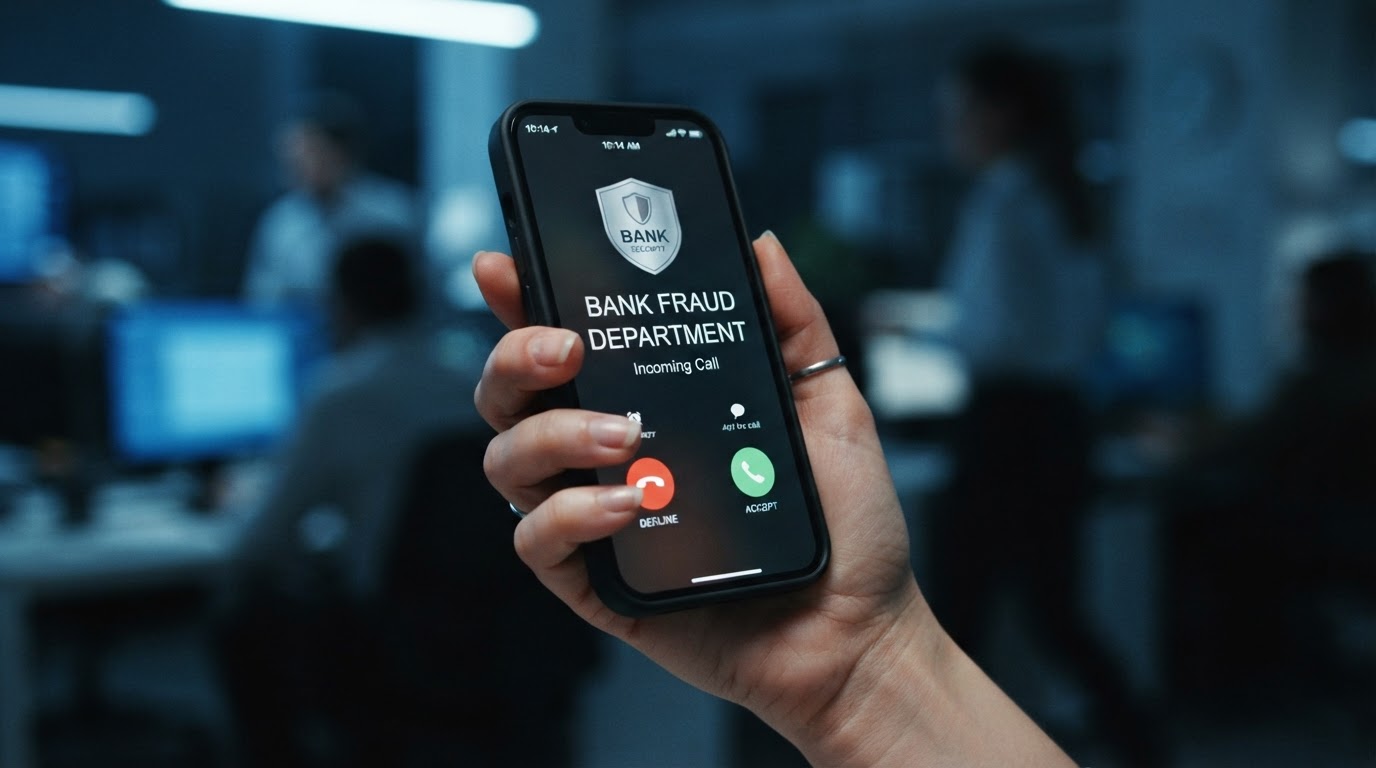
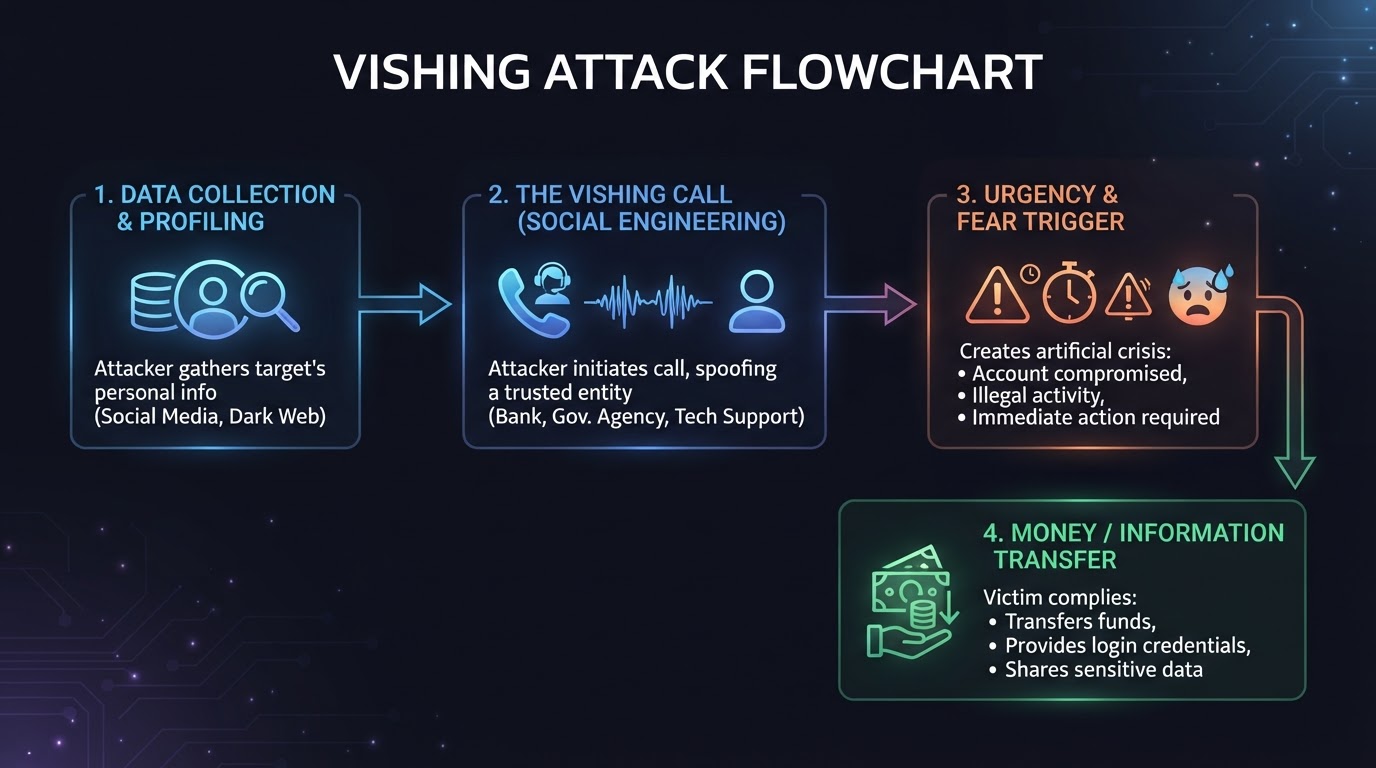
How a Vishing Attack Actually Works — Step by Step
The Setup: Reconnaissance Before the Call
Most serious vishing operations don't start with a random dial. Attackers first gather information — your name, employer, rough location, and sometimes partial financial data — from data breaches, social media profiles, or purchased lists. This is called 'pretexting,' and it's what separates a clumsy scam from one that feels eerily legitimate.
One particularly unsettling technique involves calling a target's company switchboard first, pretending to be an IT vendor, and extracting the employee's direct line and manager's name. Then they call the employee directly, armed with internal-sounding details. Anyone who has worked in a large organization has probably received at least one call that felt slightly off but hard to dismiss outright.
The Call: Pressure, Authority, and Urgency
The call itself follows a predictable psychological script. First, the caller establishes authority — 'This is the fraud prevention team at your bank.' Then they introduce a crisis — 'We've detected unauthorized transactions on your account.' Then comes the ask — 'To secure your account right now, I need to verify your identity.'
The moment a caller creates urgency and asks you to act immediately to prevent a loss, that's not customer service — that's a manipulation script.
Scammers are also trained to handle pushback. If you say 'I'll call the bank back directly,' they'll tell you that will take too long and the fraud will go through. If you say 'I don't feel comfortable,' they'll express sympathy and then reframe the urgency even more sharply. The script has branches for almost every objection.
AI-Generated Voices: The Newest Threat Layer
Here's where things get genuinely alarming. Voice-cloning technology has advanced to the point where a convincing imitation of a real person's voice can be generated from just a few seconds of audio — the kind anyone posts publicly in a video or voicemail. Scammers have used this to impersonate family members in distress, a technique sometimes called the 'grandparent scam,' now turbocharged with synthetic audio.
Verified cases of AI voice fraud have been documented in the UK, Canada, and the US, where targets received calls that sounded exactly like a son, daughter, or grandchild claiming to be in legal trouble and needing emergency wire transfers. The emotional shock of hearing a loved one's voice in apparent distress is a powerful override for rational thinking.
Who Gets Targeted — and Why the Answer Might Surprise You
It's Not Just Older Adults
The popular image of a vishing victim is an elderly person who isn't tech-savvy. That image is misleading. Fraud research consistently shows that younger adults — particularly those in their 20s and 30s — report being victimized by phone scams at rates comparable to or sometimes higher than older demographics. The difference is that older victims tend to lose larger amounts per incident.
Professionals are a high-value target. Finance employees, HR staff, and IT administrators are specifically hunted because they have access to systems, accounts, or data that a scammer can monetize far beyond a single individual's savings. A successful vishing call to the right employee at a mid-sized company can unlock payroll systems or authorize fraudulent wire transfers worth hundreds of thousands of dollars.
Vishing works on smart people too — because it's not testing your intelligence, it's exploiting your trust in authority and your instinct to resolve a crisis quickly.
High-Profile Business Cases
In one well-documented case, a UK energy company's CEO was tricked into wiring the equivalent of roughly $243,000 to a fraudulent account after receiving a call from someone impersonating his parent company's chief executive — using AI-generated voice cloning. The call sounded authentic enough that the CEO complied without additional verification. That case, reported by cybersecurity firm Symantec and widely covered in the press, marked a turning point in how seriously corporate security teams began treating voice-based attacks.

How to Protect Yourself From Vishing Attacks
The Core Defense: Hang Up and Call Back
The single most effective protection against vishing is deceptively simple: hang up, find the official number independently, and call back yourself. Not the number the caller gave you. Not the number that appeared on your caller ID. The number printed on the back of your bank card, listed on the official website, or in your account paperwork.
This one habit defeats the vast majority of vishing attempts because the entire attack depends on keeping you on their line. A legitimate fraud department will never object to you calling back through official channels. If a caller resists that, you have your answer.
Specific Habits That Reduce Your Risk
- Never confirm personal information to an inbound caller — let them tell you what they already know, and verify it through a separate channel before responding.
- Establish a family safe word for emergency calls — a pre-agreed word that a real family member would know, which an AI clone would not.
- Treat urgency as a red flag — legitimate institutions give you time to verify. Pressure to act 'right now' is a manipulation tactic, not a sign of genuine emergency.
- Register with your country's do-not-call list — it won't stop criminal operations, but it reduces the overall volume of unsolicited calls you receive.
- Use call-screening features — most modern smartphones and carriers offer tools that flag likely spam calls before you answer.
- Ask your bank about verbal passwords — many financial institutions allow you to set a verbal security phrase that their agents will use to authenticate themselves to you, not just the other way around.
What to Do If You Think You've Been Targeted
If you gave out information during a call you now suspect was fraudulent, act quickly. Contact your bank or the relevant institution directly using official contact details and report what happened. Change any passwords that may have been compromised. File a report with your national consumer protection agency — in the US that's the Federal Trade Commission, in the UK it's Action Fraud. Early reporting not only helps you but contributes to pattern data that helps investigators track active scam operations.
(Opinion: The fact that we still rely almost entirely on individual vigilance to stop vishing is a systemic failure. Telecom companies have the technical capacity to implement far stronger caller authentication at the network level — the STIR/SHAKEN protocol in the US is a step in the right direction, but adoption has been uneven and enforcement inconsistent. Until the infrastructure catches up, the burden falls unfairly on the person receiving the call.)
Frequently Asked Questions
Can vishing happen through text messages too?
Text-based versions of the same attack are called 'smishing' (SMS phishing). While the delivery method differs, the psychological tactics are identical — spoofed sender IDs, fake urgency, and links or requests designed to extract information. Many modern scam campaigns combine both: a text message followed by a phone call to increase credibility.
Is it safe to answer calls from unknown numbers?
Answering is generally low-risk on its own — the danger comes from engaging with the caller's requests. However, some robocall operations record your voice saying 'yes' and use that clip to authorize fraudulent charges or account changes. A practical habit is to answer unknown calls with a neutral phrase like 'Hello, who's calling?' rather than 'Yes' as your first word.
Can AI voice cloning really fool people who know the person well?
Research suggests that under conditions of emotional stress — which scammers deliberately engineer — even people who know a voice well can be deceived by a convincing clone. The effect is strongest when the call involves a distressing scenario that triggers an emotional response before the listener has time to analyze the audio critically. This is why the family safe-word strategy is worth taking seriously, not just as a precaution but as a genuine countermeasure.
Vishing persists not because people are foolish but because it targets something fundamental — the trust we extend to a voice that sounds authoritative, familiar, or distressed. The technology behind these attacks is only getting cheaper and more convincing. A cloned voice indistinguishable from your child's, calling from a number that looks exactly like your bank's, describing a crisis that demands immediate action — that's not a hypothetical anymore. The only durable defense is a habit of verification that you practice before you need it, because in the moment, the pressure to just comply can override almost everything else.



Comments
Post a Comment