Titan's Mysterious Lakes: Why They're Not Made of Water
Saturn's moon Titan has lakes, rivers, and rain — but none of it is water. The liquid filling those vast basins is methane and ethane, hydrocarbons that exist as gases on Earth but pool quietly on Titan's surface at temperatures around minus 179 degrees Celsius. It's one of the strangest landscapes in the solar system, and in some ways, it mirrors Earth more closely than any other world we've found.
What Are Titan's Lakes Actually Made Of?
The Chemistry Behind the Liquid
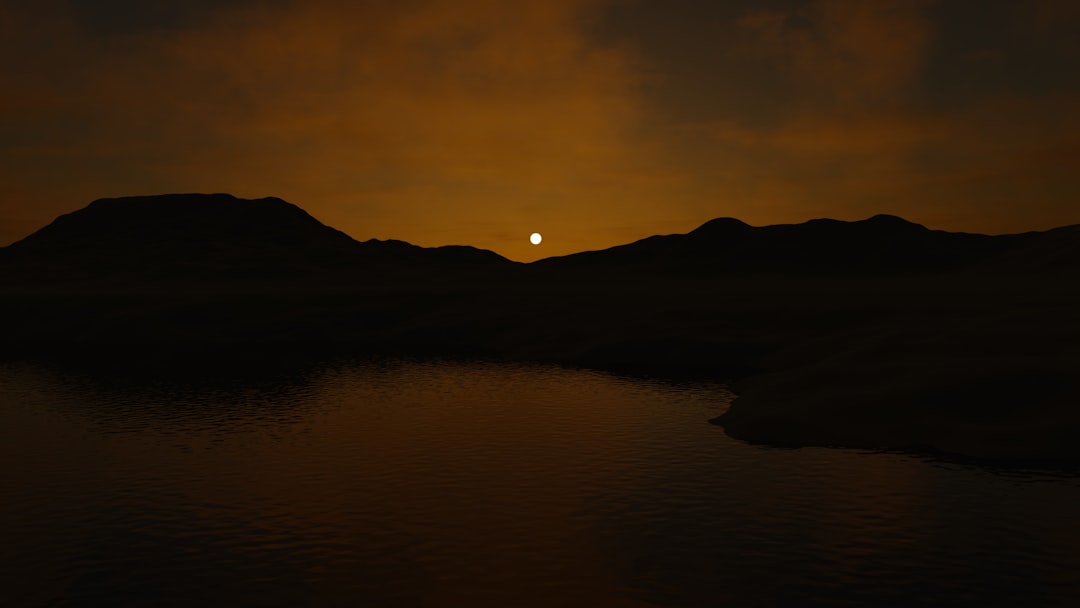
The lakes are primarily liquid methane (CH4), often mixed with ethane and dissolved nitrogen. These aren't exotic alien compounds — methane is the main ingredient in natural gas here on Earth. The difference is temperature. Titan is so cold that methane behaves the way water does on our planet: it evaporates, forms clouds, falls as rain, and collects into lakes and seas.
The largest of these bodies, Kraken Mare, is estimated to be larger than the Caspian Sea. Ligeia Mare and Punga Mare round out the major northern seas. Most of the large lakes cluster around Titan's north pole, though smaller lakes dot the south as well. The asymmetry between the poles is still an active area of research.
One detail that surprises most people: Titan's lakes are almost perfectly calm. Radar data from the Cassini spacecraft showed surfaces so smooth they reflected signals like a mirror. Wind speeds near the surface are low, and the higher viscosity of liquid methane compared to water means waves, if they form at all, are tiny — estimates suggest they'd be just millimeters tall.

How Does Titan's Methane Cycle Work?
A Weather System That Mirrors Earth's — With a Twist
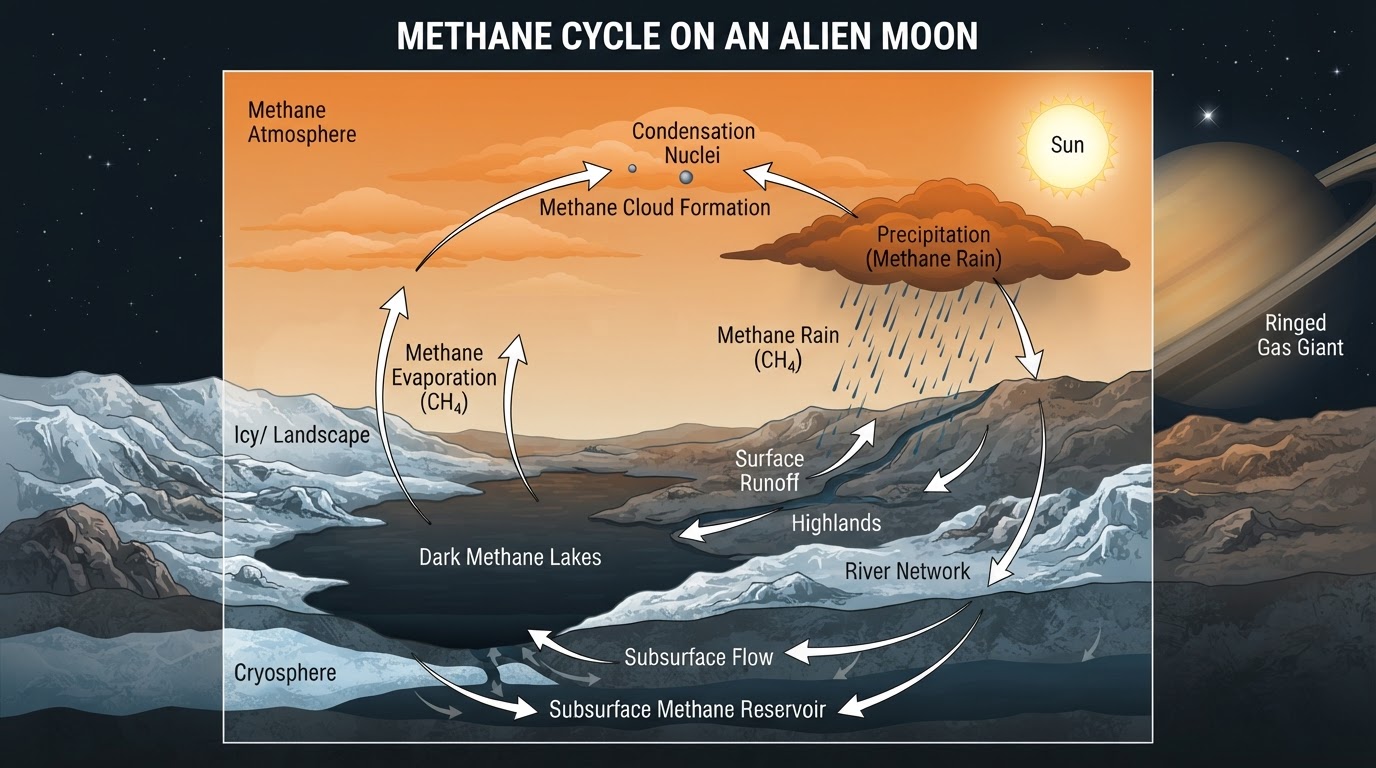
Titan runs what scientists call a 'methane cycle' — a near-perfect analogue to Earth's water cycle. Methane evaporates from the lakes, rises into the thick atmosphere, condenses into clouds, and falls back as rain. Cassini actually photographed cloud systems near the poles and detected what appeared to be fresh rain-darkened terrain near the equator after a storm.
Here's where it gets strange. Methane, once broken down by sunlight in the upper atmosphere, doesn't easily reform. The photochemical destruction of methane is a one-way process on geological timescales. That raises a question nobody has fully answered: where does the methane keep coming from? Some researchers think cryovolcanoes — ice volcanoes that erupt liquid water or methane-rich slush — replenish the supply. Others point to methane trapped in clathrate structures beneath the surface. The honest answer is we don't know yet.
Titan's methane cycle is so structurally similar to Earth's water cycle that the same fluid dynamics equations apply — just swap the molecule and drop the temperature by 260 degrees.
What Happens to the Methane Over Time?
Sunlight continuously breaks methane apart in Titan's upper atmosphere, producing complex organic molecules called tholins. These rain down onto the surface, coating it in a reddish-brown organic sludge. The orange haze you see in images of Titan isn't just atmospheric scattering — it's a smog of complex carbon chemistry building up over billions of years.
If Titan had no methane replenishment mechanism, models suggest the current supply would be depleted on a timescale of tens of millions of years — short by planetary standards. The fact that the lakes still exist implies something is actively refilling them.
How Did We Discover Titan's Lakes?
Cassini's Radar Revealed What Eyes Couldn't See
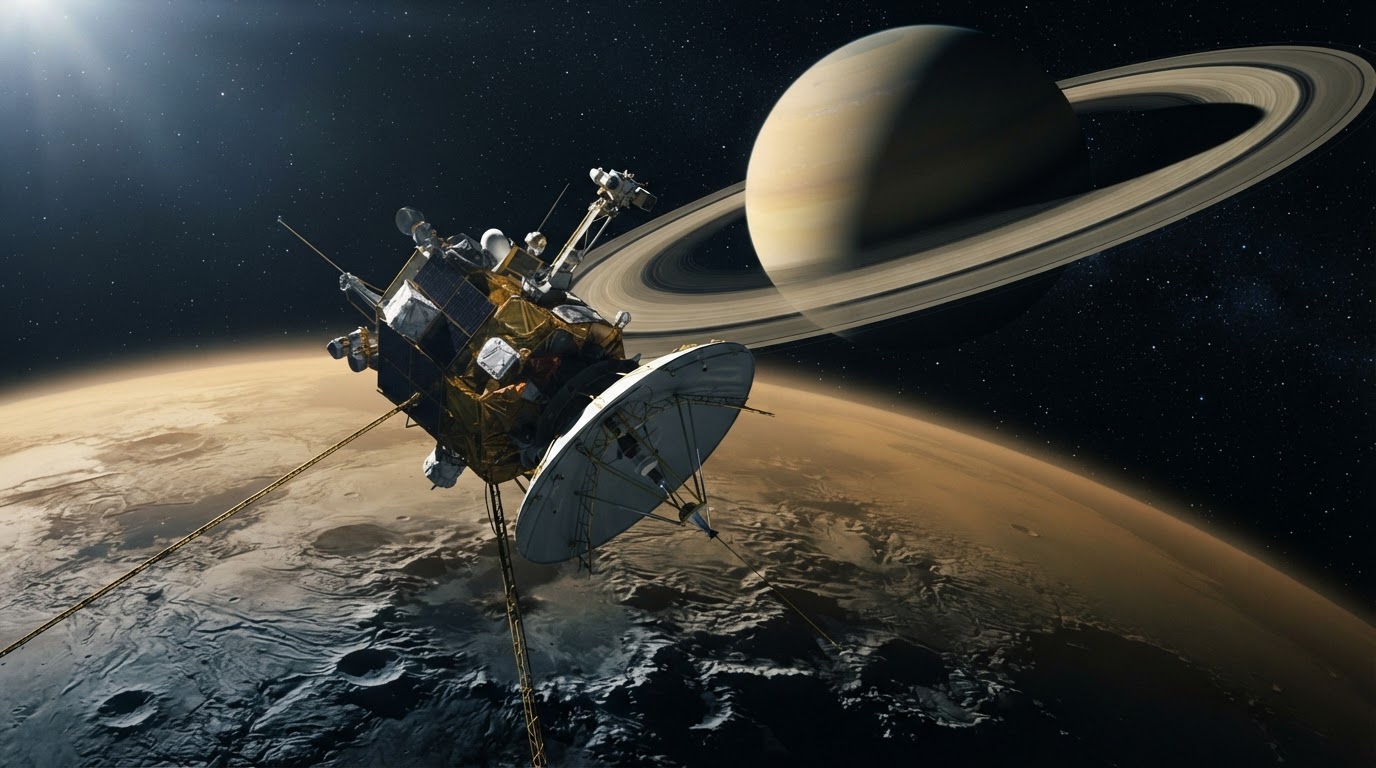
Titan's thick atmosphere blocks visible light from reaching the surface cleanly, which is why early telescopes told us almost nothing about what lay below. The breakthrough came from the Cassini-Huygens mission. Cassini carried a synthetic aperture radar instrument that could pierce the haze, and when it mapped the north polar region in 2006, the dark patches it returned were unmistakable: smooth, flat, radar-dark surfaces — exactly what you'd expect from liquid-filled basins.
The Huygens probe, which descended through Titan's atmosphere in January 2005, gave us the first ground-level view. It landed on a solid surface — not a lake — but photographed rounded pebbles of water ice that appeared to have been shaped by flowing liquid. The probe transmitted data for about 72 minutes after landing, which remains the most distant surface landing in history.
Anyone who followed the Huygens descent in real time probably remembers the strange combination of anticipation and uncertainty — nobody was sure whether it would land on solid ground or splash into a sea. It was a genuine coin-flip moment in planetary science.
Cassini's radar didn't just find lakes — it found shorelines, river channels, and what appear to be dried lake beds, suggesting Titan's liquid geography changes over time.
Why Titan's Lakes Matter for the Search for Life
Could Anything Live in Liquid Methane?
Life as we know it requires liquid water as a solvent. But some researchers have asked a more open-ended question: could life use a different solvent entirely? Liquid methane is a poor solvent compared to water — it's nonpolar, which means it doesn't dissolve salts or most biological molecules the way water does. Building cell membranes or metabolic chemistry in methane would require completely different molecular architecture than anything we know.
A 2015 theoretical study proposed that hypothetical Titan life could use azotosomes — nitrogen-based membrane structures that could function in liquid methane the way phospholipid membranes function in water. This was a thought experiment, not a detection, but it showed the idea isn't physically absurd. The chemistry would be alien in every sense of the word.
(Opinion: The methane-life hypothesis feels like a useful intellectual exercise more than a serious near-term scientific bet. The chemistry barriers are enormous, and we have exactly zero evidence of biology on Titan. But the value of asking the question is that it forces us to define what 'life' actually requires — and that's a question worth taking seriously regardless of what we find.)
What NASA's Dragonfly Mission Hopes to Find
NASA's Dragonfly mission, a rotorcraft lander designed to fly across Titan's surface, is scheduled to arrive in the 2030s. It won't land in a lake, but it will sample surface chemistry — particularly the tholins and organic compounds — to understand how far Titan's prebiotic chemistry has progressed. Titan may not have life, but it might be the best natural laboratory we have for studying the chemistry that preceded life on early Earth.

Frequently Asked Questions
Could a human ever stand near one of Titan's lakes?
Theoretically, the pressure on Titan's surface is about 1.5 times Earth's atmospheric pressure, which is manageable. The real problem is temperature — minus 179 degrees Celsius would require extreme thermal protection. You wouldn't need a pressurized suit in the same way you would on Mars, but you'd need serious insulation. The air itself is mostly nitrogen, not breathable, but not immediately corrosive either.
Why are most of Titan's large lakes near the north pole?
The exact reason is still debated. One leading explanation involves Titan's slightly elliptical orbit around Saturn and the resulting asymmetry in seasonal heating between the poles. The north polar region may receive slightly less solar energy on average, keeping temperatures low enough to preserve larger liquid bodies. Some models also suggest methane is slowly migrating from south to north over long timescales, though this remains an open question.
Is Titan the only moon with surface liquids?
As of current observations, yes — Titan is the only moon in the solar system confirmed to have stable liquid on its surface. Europa, Enceladus, and Ganymede likely have liquid water oceans, but those are buried under thick ice shells, not exposed at the surface. Titan's open lakes make it uniquely accessible for future study, which is part of why Dragonfly is heading there.
What makes Titan genuinely unsettling — in the best scientific sense — is how familiar it looks and how alien it actually is. River deltas, shorelines, rain, seasonal flooding: all the visual grammar of a water world, running on completely different chemistry. If Dragonfly finds complex organic molecules in the surface sediment that don't fit any known abiotic pathway, the conversation about what counts as life will get very uncomfortable, very fast.

Related Posts
- 📄 Organic Matter on Mars: What It Means for Life Beyond Earth
- 📄 What Are Biosignatures and How Do We Search for Them in Space?
- 📄 Beyond Earth: What Makes an Exoplanet Habitable?
- 📄 Why Is Venus Hotter Than Mercury? The Surprising Science Explained
- 📄 Cotton Candy Planets: Exploring the Low-Density Worlds of Our Galaxy


Comments
Post a Comment