Cosmic Crashes: What Happens When Galaxies Collide?
The Andromeda Galaxy is heading straight for us. Not metaphorically — it is physically moving toward the Milky Way at roughly 110 kilometers per second, and in about 4 to 5 billion years, the two galaxies will collide. That sounds catastrophic. The reality is far stranger and more counterintuitive than a simple smash-up.
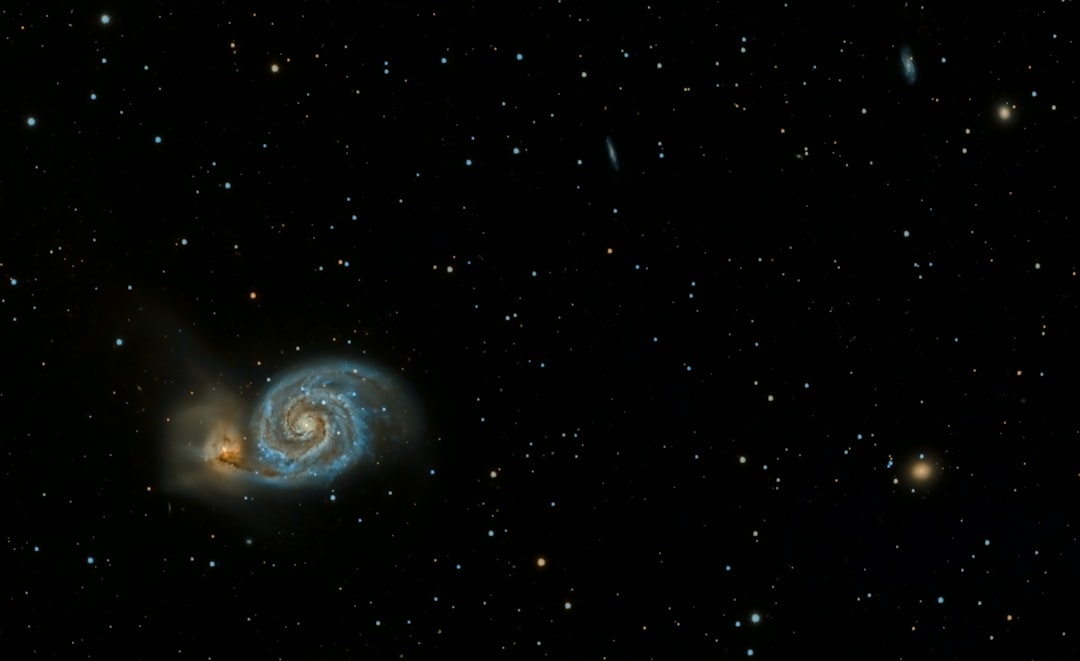
What a Galaxy Collision Actually Is — and What It Isn't
The Counterintuitive Truth About 'Crashes'
When most people hear 'galaxy collision,' they picture something like two cars hitting head-on — debris everywhere, immediate destruction. But galaxies are almost entirely empty space. The average distance between stars inside a galaxy is measured in light-years, which means that when two galaxies pass through each other, the odds of any two individual stars actually colliding are astronomically small.
Think of it this way: if you scaled the Milky Way down so that each star was the size of a grain of sand, those grains would still be separated by roughly 50 kilometers. Two galaxies 'colliding' is less like two crowds of people running into each other and more like two swarms of fireflies drifting through one another in the dark.
What does collide — violently and consequentially — is the gas. Interstellar gas clouds slam together, compress, heat up, and trigger enormous waves of star formation. The stars themselves mostly just get gravitationally redirected onto new paths.
In a galaxy collision, the stars don't crash — the gas does. And that distinction changes everything about what happens next.
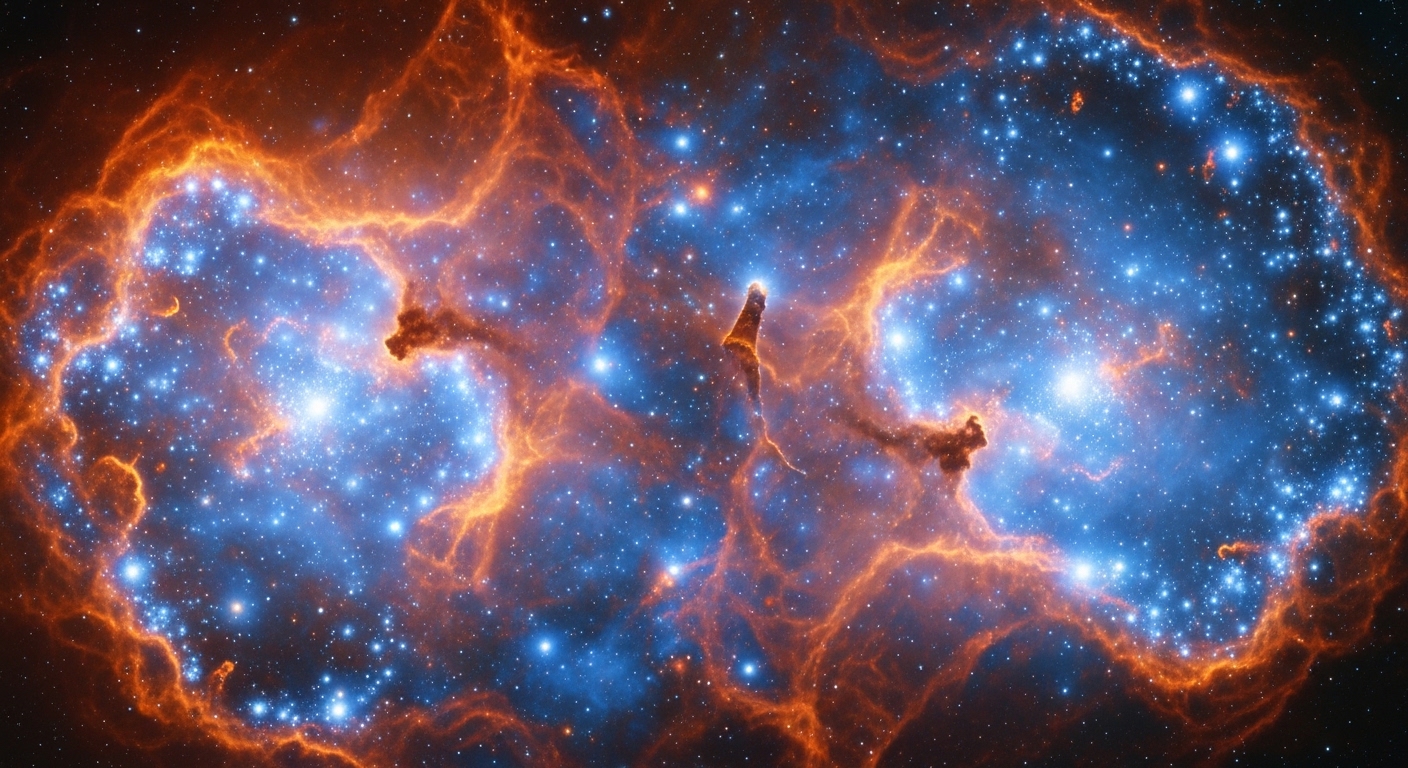
How Galaxy Collisions Work — The Mechanics of a Billion-Year Event
Gravity Does the Heavy Lifting
Galaxy collisions are driven entirely by gravity. As two galaxies approach, their mutual gravitational pull accelerates them toward each other. But they rarely merge cleanly on the first pass. More often, they swing through each other, separate, swing back, and eventually spiral together over hundreds of millions to billions of years. The whole process can take longer than the current age of the Earth.
During each pass, gravity stretches both galaxies into long, curved streams of stars called tidal tails. These tails can extend for hundreds of thousands of light-years and are one of the most visually dramatic signatures of a merger in progress. The Antennae Galaxies — a well-documented pair of colliding galaxies roughly 45 million light-years away — show exactly this structure: two sweeping arcs of stars flung outward while the galactic cores spiral inward.
The Role of Dark Matter
Here is the part that rarely makes it into casual explanations. Each galaxy is embedded in a massive halo of dark matter that extends far beyond its visible disk. When galaxies collide, these dark matter halos interact first, creating a kind of gravitational scaffolding that shapes how the visible matter behaves. Simulations suggest the dark matter halos begin influencing each other long before the galaxies' stars are anywhere near each other.
This is one reason galaxy mergers are so useful to researchers — watching how galaxies deform during a collision gives indirect evidence about the distribution of dark matter that would be impossible to observe directly.
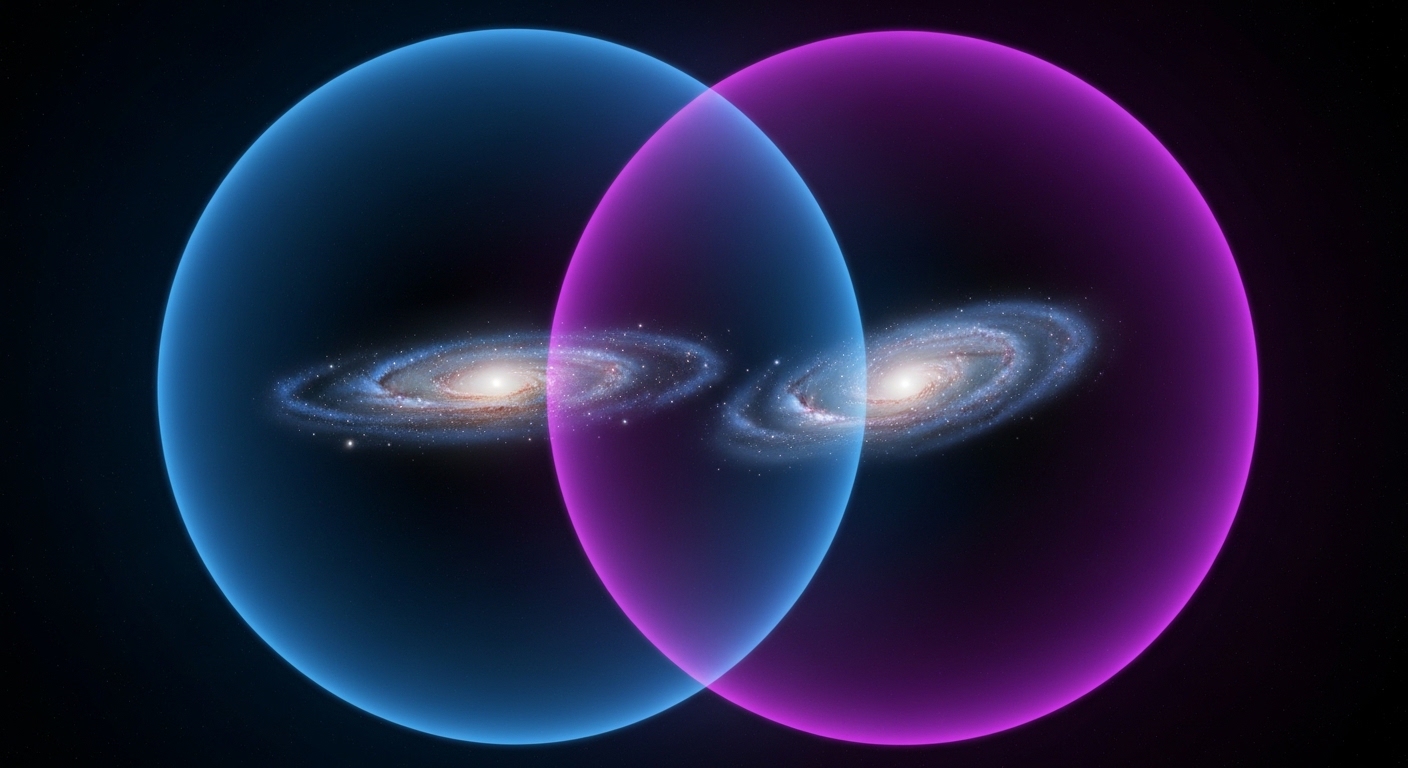
What Actually Happens During and After the Merger
A Burst of Star Formation
The most immediate dramatic effect is a starburst — a period of intense, rapid star formation triggered by the compression of gas clouds. When two galaxies' gas reservoirs collide and compress, the density spikes high enough to trigger gravitational collapse across enormous regions simultaneously. The result is the birth of millions of new stars in a relatively short window of cosmic time.
These newborn stars tend to be massive and hot, burning blue-white and blazing through their fuel quickly. They live fast and die in supernova explosions, seeding the merged galaxy with heavy elements. The Antennae Galaxies are currently producing new stars at a rate estimated to be far higher than the Milky Way's current rate — some estimates put it at hundreds of times faster, though figures vary depending on measurement method.
The Fate of the Central Black Holes
Almost every large galaxy harbors a supermassive black hole at its center. When two galaxies merge, their black holes don't immediately combine. Instead, they sink toward the center of the newly merged system through a process called dynamical friction — essentially, gravitational drag from surrounding stars slowing them down. Over time, the two black holes form a binary pair, orbiting each other at decreasing distances.
The final merger of two supermassive black holes would release an enormous burst of gravitational waves — far more powerful than anything detected so far by instruments like LIGO, which has only captured mergers of stellar-mass black holes. Detecting supermassive black hole mergers is one of the primary goals of planned space-based gravitational wave observatories.
Two supermassive black holes spiraling toward merger is one of the most energetic events the universe can produce — and we have never directly observed the final moment of one.
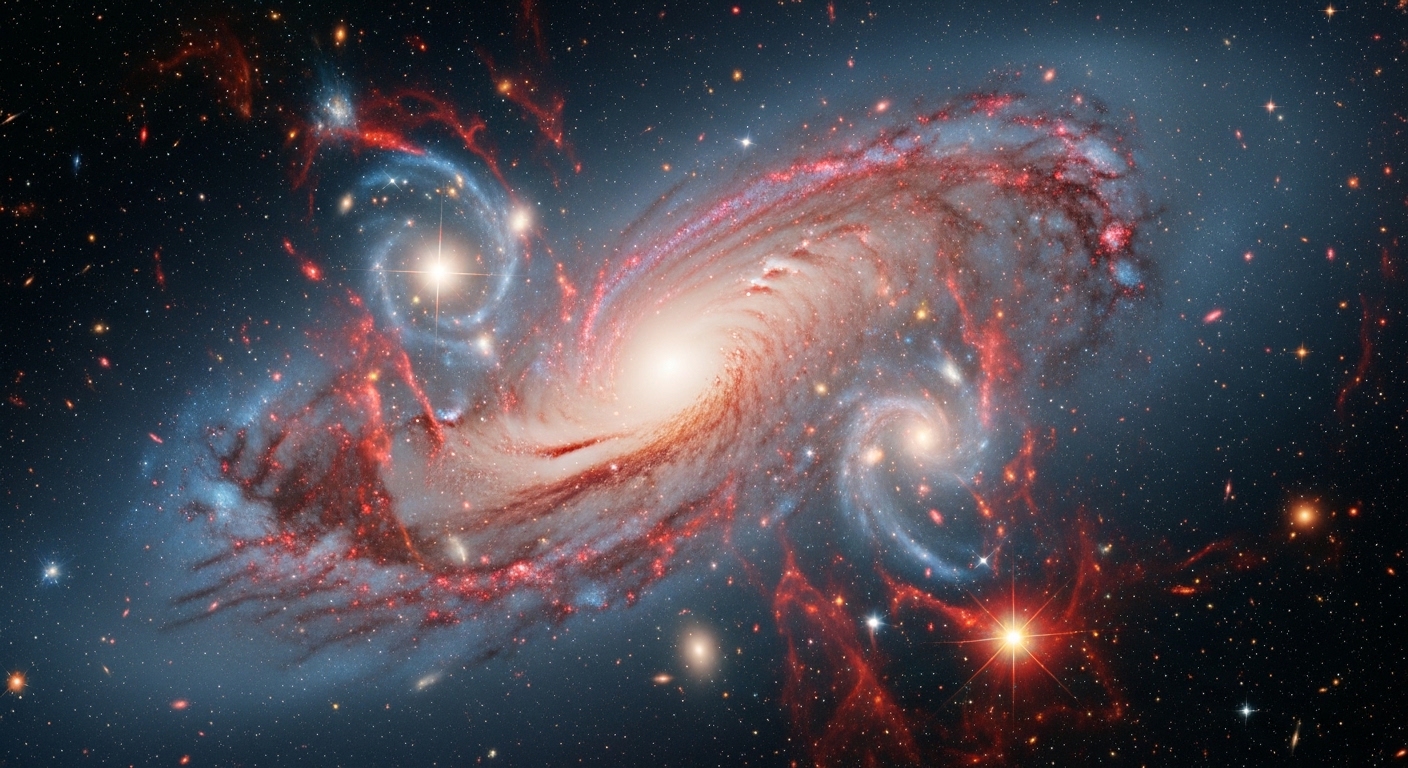
Why Galaxy Collisions Matter to Understanding the Universe
Mergers Built the Galaxies We See Today
Galaxy collisions are not rare catastrophes — they are a fundamental part of how galaxies grow. The current leading model of cosmic structure formation, sometimes called hierarchical assembly, holds that large galaxies built themselves up over time by absorbing smaller ones. The Milky Way itself has consumed dozens of smaller satellite galaxies throughout its history, and faint stellar streams in our galactic halo are the ghostly remnants of those past mergers.
Astronomers have identified what appears to be evidence of a major merger event in the Milky Way's past — sometimes referred to as the 'Gaia-Sausage-Enceladus' event — in which a large dwarf galaxy was absorbed billions of years ago. The name comes from the elongated, sausage-shaped distribution of stellar orbits left behind, detected through data from the Gaia space telescope.
What the Milky Way-Andromeda Merger Will Look Like
When Andromeda and the Milky Way eventually collide, the Sun will almost certainly survive. It will be flung onto a new orbit within the merged system, but the probability of it encountering another star closely enough to cause disruption is vanishingly small. Earth, if it still exists at that point, would have a front-row seat to one of the most spectacular skies imaginable — a night sky filled with the dense, luminous core of a merging galaxy system.
The merged result is expected to be an elliptical galaxy — rounder and less structured than either spiral galaxy is today. Astronomers sometimes call this future object 'Milkomeda' or 'Milkdromeda.' The starburst triggered by the collision will likely exhaust much of the remaining gas, leaving behind a quieter, older stellar population.
(Opinion: There is something quietly humbling about the fact that the most violent-sounding event in astronomy — two galaxies crashing — turns out to be mostly a slow gravitational dance that individual stars barely notice. The universe operates on scales that make our intuitions about collision and destruction almost entirely useless.)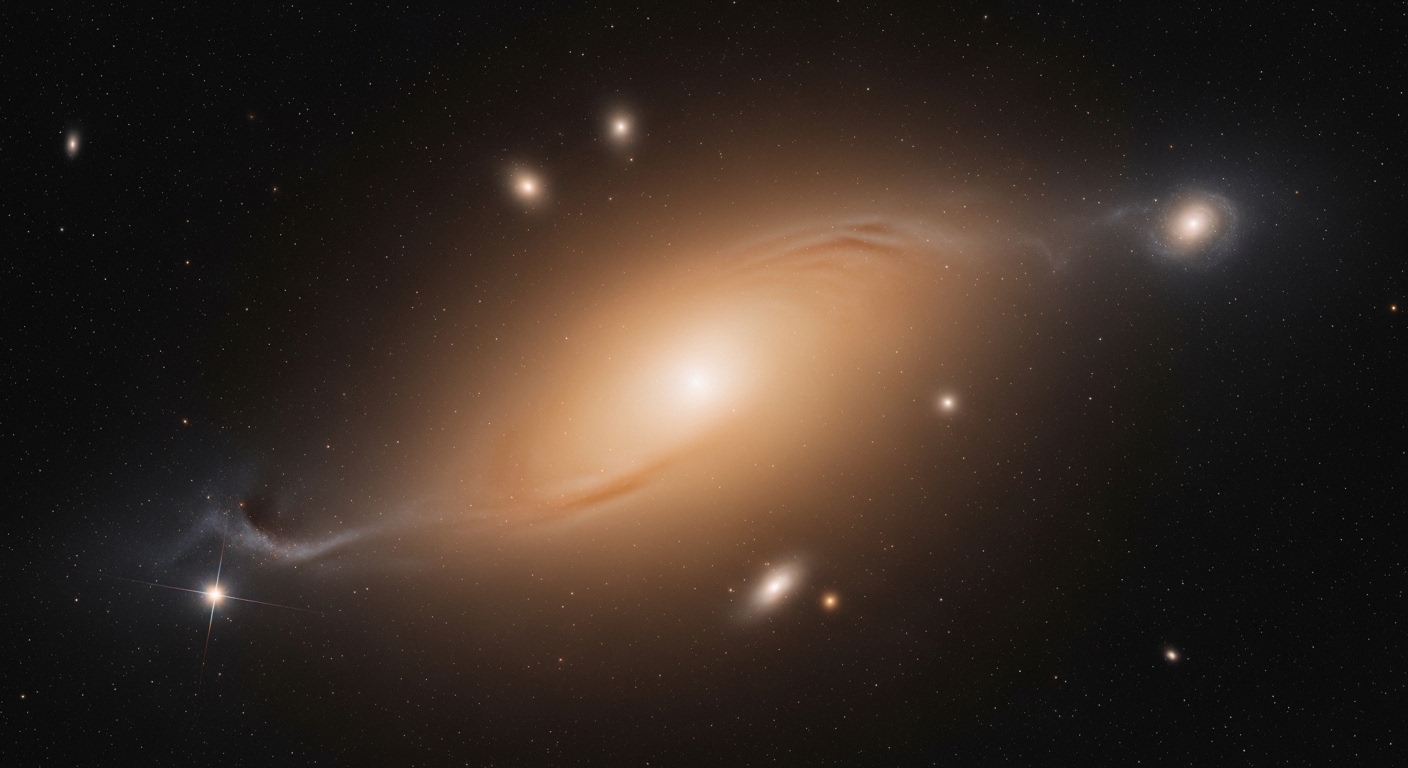
Frequently Asked Questions
Will the Milky Way-Andromeda collision destroy the solar system?
Almost certainly not. The distances between stars are so vast that direct stellar collisions during the merger are extremely unlikely. The Sun will probably be gravitationally redirected onto a new orbit within the merged galaxy, but the solar system itself should remain intact. The bigger long-term threat to Earth is the Sun's own evolution, not the galactic merger.
How do astronomers know two galaxies are colliding if the process takes billions of years?
Because the universe gives us snapshots of mergers at every stage. There are thousands of galaxy pairs and groups at different points in the collision process — some just beginning to interact, some mid-merger with dramatic tidal tails, some nearly finished. By studying these different systems, astronomers can reconstruct the full timeline the way a paleontologist reconstructs an animal's life from fossils at different growth stages.
Can a galaxy survive a collision completely unchanged?
In rare cases, a smaller galaxy can pass through a larger one without being completely disrupted — though it will be significantly altered. A well-documented example is the 'Cartwheel Galaxy,' which appears to have been struck by a smaller companion passing directly through its center, creating a distinctive ring structure from the outward-propagating wave of star formation. The smaller intruder survived but left a permanent mark on both systems.
The Andromeda collision is not a future disaster to dread — it is a process already underway in slow motion, one that has shaped every large galaxy in the observable universe including our own. The Milky Way's halo is already threaded with the dissolved remnants of galaxies that no longer exist as independent structures. In a real sense, we are already living inside the aftermath of ancient collisions, built from the wreckage of things that came before.


Comments
Post a Comment