Beyond Search: How AI is Changing Your Web Browsing Experience
Google processed roughly 8.5 billion searches per day for years — and for most of that time, the experience looked almost identical: type a query, get a list of blue links, click around until you find what you need. That loop is now breaking apart faster than most people realize. AI isn't just sitting inside search boxes anymore; it's reshaping the entire act of moving through the web.

What's Driving the AI Browsing Shift Right Now
The Collapse of the Click-Through Model
For roughly two decades, the web ran on a simple economic engine: users search, publishers rank, advertisers pay for eyeballs. AI-generated answers — the kind that appear directly in a search results page without requiring you to click anywhere — are quietly dismantling that engine. When a search engine summarizes the answer to your question in three sentences at the top of the page, the incentive to visit the original source evaporates.
Publishers have started noticing real traffic drops from informational queries, the kind that used to be reliable audience drivers. Some content categories — medical symptom lookups, recipe steps, quick definitions — are being absorbed almost entirely into AI answer layers. The web underneath hasn't changed, but the interface sitting on top of it has.
Browser-Level AI, Not Just Search-Level AI
The more significant shift is happening at the browser itself, not just in the search bar. Major browser developers have begun integrating AI assistants that can read the page you're currently on, summarize a 40-page PDF you've opened, rewrite a paragraph you've selected, or flag suspicious content before you interact with it. This is a fundamentally different relationship between user and web than anything that existed before.
Think about how you used to research a purchase: open twelve tabs, manually compare specs, try to remember which tab had the price you wanted. Browser-native AI can now collapse that process into a single conversation layer sitting on top of all those tabs simultaneously. Anyone who has spent twenty minutes hunting for a specific detail buried in a long article will immediately understand why this feels like a relief — and also why it changes what publishers need to do to stay relevant.
The browser is becoming less of a window to the web and more of a translator between you and it — and that changes everything downstream.

Key Evidence: Where the Change Is Already Visible
Search Generative Experiences and Zero-Click Results
Search engines from multiple major technology companies have rolled out what are broadly called 'AI Overviews' or 'generative search' features — blocks of synthesized text that appear before any traditional results. Early data from web analytics firms suggests that click-through rates on informational queries have declined noticeably since these features became widespread, though exact figures vary considerably by source and query type.
The counterintuitive finding: for complex, multi-step queries, AI summaries sometimes increase clicks, because users get enough context to know which specific source is actually worth visiting. Simple queries get absorbed; nuanced ones still drive traffic. That distinction matters enormously for anyone building content online.
Agentic Browsing — AI That Acts, Not Just Answers
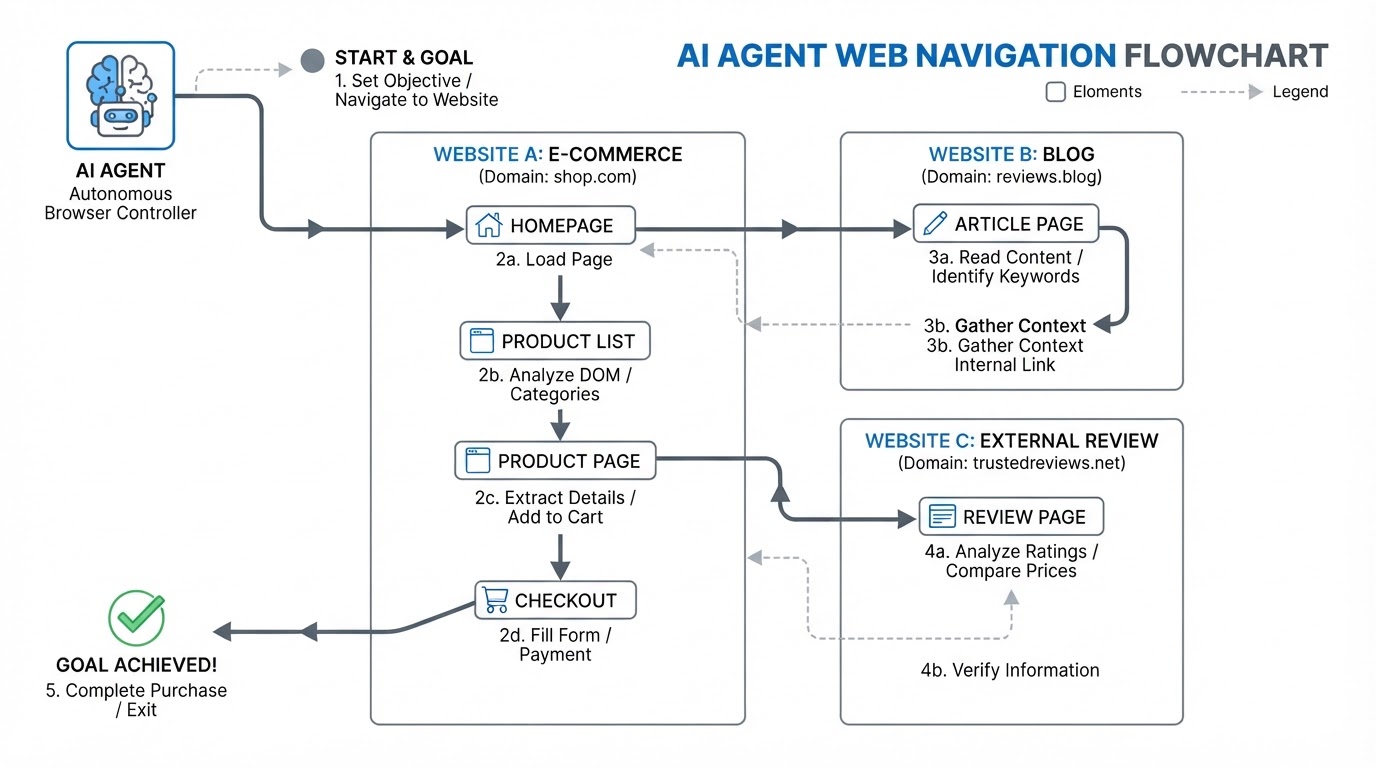
A newer and more disruptive development is what researchers and developers call 'agentic' AI — systems that don't just answer questions but actually navigate the web on your behalf. You describe a task ('find me three plumbers in my area with reviews above four stars and check if they're available this week'), and the AI opens pages, reads them, fills out forms, and returns results. This isn't science fiction; early versions of this capability shipped in several AI assistant products through 2024 and 2025.
The engineering challenge here is significant. Web pages are built for human eyes — inconsistent layouts, dynamic JavaScript rendering, anti-bot protections. Getting an AI agent to reliably navigate real-world sites without breaking, hallucinating, or getting blocked is genuinely hard. Early demos have been impressive; real-world reliability is still uneven.
Who Benefits From AI Browsing — and Who Pays the Price
Users Gain Speed, Lose Discovery
The efficiency gains for everyday users are real. Tasks that used to require opening multiple tabs, reading through irrelevant paragraphs, and manually synthesizing information now take seconds. Research suggests that users with lower baseline digital literacy benefit disproportionately — AI browsing layers reduce the skill gap between a power user and someone who struggles to evaluate search results.
But there's a genuine loss hiding inside that convenience. Browsing used to involve accidental discovery — you went looking for one thing and stumbled onto something unexpected that changed how you thought about a topic. AI-mediated browsing is optimized for efficiency, which means it's optimized against serendipity. The web felt bigger when you had to wander through it.
Efficiency and discovery are in tension. Every second AI saves you is a rabbit hole you never fell into.
Publishers, Advertisers, and the Attention Economy Under Pressure
For publishers, the picture is genuinely complicated. Traffic from AI-generated summaries that cite sources can bring new readers — but only if the AI actually links out, which isn't always guaranteed. Some publishers have begun negotiating licensing deals with AI companies to have their content included in training data or answer generation, a model that's still evolving legally and commercially.
Advertisers face a different problem. The traditional display ad model depends on users loading pages. If AI agents are loading pages on behalf of users — or bypassing them entirely — the impression-based advertising ecosystem loses its foundation. Nobody has fully solved this yet, and the solutions being proposed range from AI-native ad formats to subscription-based web access models.
(Opinion: The advertising problem feels like the one that will actually force a structural reckoning. Search engines and browsers can experiment with AI features indefinitely, but the moment ad revenue collapses for a critical mass of publishers, the content ecosystem those AI systems are trained on starts to degrade. It's a slow feedback loop, but it's real.)
Where AI Browsing Is Heading in the Next 12 to 24 Months
Personalization at the Browser Layer
The next phase most developers are working toward is persistent personalization — AI that knows your reading level, your professional context, your past research, and adjusts how it presents web content accordingly. A medical professional and a curious teenager asking the same question about a drug interaction would receive differently framed answers, sourced from the same underlying web. This is technically feasible now; the friction is privacy architecture and user trust.
Several browser developers have signaled on-device AI processing as their answer to the privacy concern — the model runs locally, your data never leaves your machine. Whether users will actually trust that framing remains an open question. People have been promised 'private by design' features before.
The Regulatory Wildcard
Regulators in the European Union and, to a lesser extent, other jurisdictions have begun scrutinizing whether AI search features constitute anticompetitive behavior — specifically, whether a search engine that answers questions directly is unfairly disadvantaging the publishers it used to send traffic to. The legal frameworks being applied were written for a different era of the web, which makes outcomes genuinely unpredictable.
One specific pressure point: if regulators require AI answer systems to clearly attribute and link to sources in a standardized way, it could partially restore publisher traffic. If they don't, the current trajectory continues. This is one of those policy decisions that will look obvious in hindsight but is genuinely contested right now.

Frequently Asked Questions
Will AI browsing replace traditional search engines entirely?
Probably not in the near term, but the role of traditional search is narrowing. AI-generated answers handle a growing share of informational queries, while traditional ranked results remain useful for navigating to specific sites, finding recent news, or discovering new sources. The two approaches are increasingly layered on top of each other rather than competing head-to-head.
Is AI browsing a privacy risk?
It depends heavily on where the AI processing happens. Cloud-based AI browsing assistants send your page content and queries to external servers, which raises legitimate data exposure concerns. On-device models — where the AI runs entirely on your hardware — avoid that problem but require more processing power. Reading the privacy policy of any browser AI feature is genuinely worth doing, not just a formality.
Can AI agents actually complete tasks on websites without making mistakes?
Current agentic AI tools can handle straightforward, well-structured tasks reasonably well — filling a form on a simple site, extracting a price from a product page. Complex or multi-step tasks on sites with dynamic layouts, login requirements, or anti-bot protections remain unreliable. The technology is improving quickly, but treating it as fully autonomous for anything consequential is premature.
The web was designed as a place you navigate — follow a link, land somewhere, decide where to go next. AI browsing layers are turning that into something closer to a conversation with an intermediary who has already read everything for you. That's genuinely useful. It's also the first time in the web's history that the interface between humans and information has been controlled by something that makes judgment calls about what to show you — and what to quietly leave out.

Related Posts
- 📄 Beyond ChatGPT: How Large Language Models (LLMs) Really Work
- 📄 Beyond Siri: How AI Voice Assistants Actually Understand What You Say
- 📄 AI Agents Explained: How These Smart Programs Work
- 📄 The Secret Behind Your Feed: How Social Media Algorithms Work
- 📄 How Do Private Search Engines Work? A Simple Explainer


Comments
Post a Comment