The Science Behind Nuclear Fusion: How It Could Power Our Future
On December 5, 2022, scientists at the National Ignition Facility in California fired 192 laser beams at a target smaller than a pea and got more energy out than they put in. It was the first time in history that a fusion experiment achieved 'ignition' — the point where the reaction becomes self-sustaining. The physics community had been chasing that milestone for roughly 70 years. The fact that it finally happened in a government lab, not a private startup, surprised almost everyone.
What Is Nuclear Fusion, Really?
The Basic Mechanism
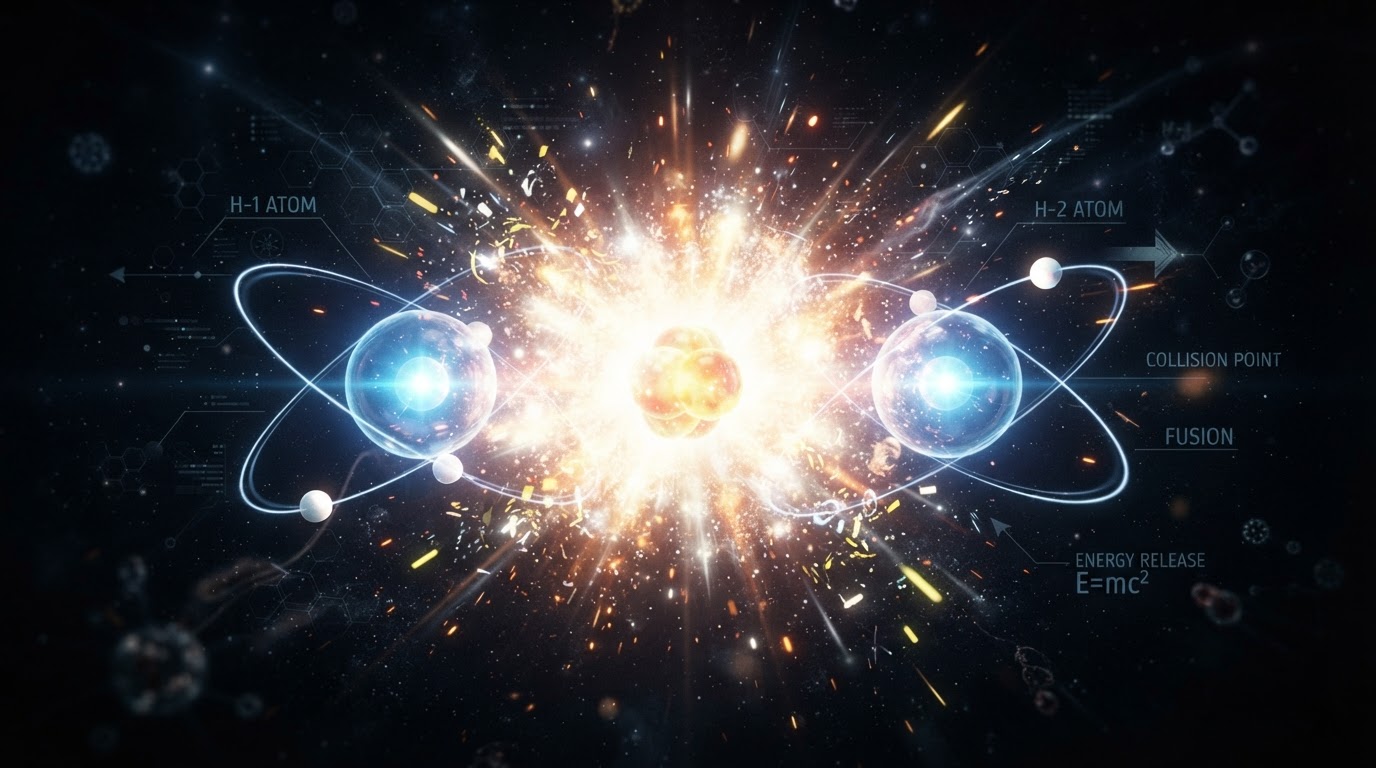
Fusion is the process that powers the sun. Two light atomic nuclei — typically isotopes of hydrogen called deuterium and tritium — are forced together under extreme heat and pressure until they merge into a heavier nucleus, releasing a burst of energy in the process. The key word is 'forced.' Atomic nuclei carry positive charges and naturally repel each other. To overcome that repulsion, you need temperatures exceeding 100 million degrees Celsius — hotter than the core of the sun itself.
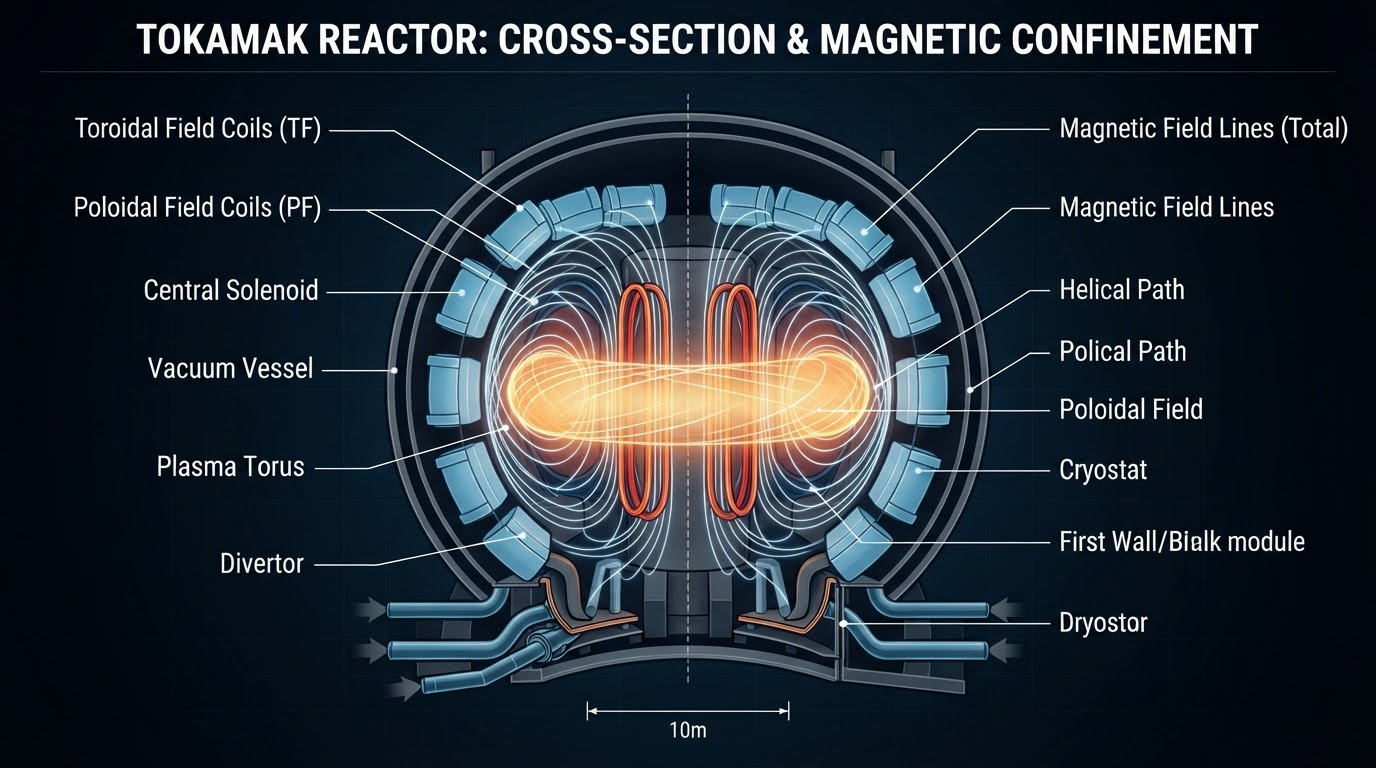
At those temperatures, matter exists as plasma: a superheated soup of electrons and nuclei that behaves unlike any ordinary gas or liquid. Containing plasma is one of the central engineering challenges of fusion. You cannot use a physical container — any known material would vaporize instantly. Instead, researchers use powerful magnetic fields or, in the NIF's case, the sheer inward pressure of laser-driven implosion.
Why Hydrogen Isotopes?
Deuterium and tritium are the preferred fuel because their fusion reaction releases more energy at lower temperatures than other combinations. Deuterium is abundant — it can be extracted from seawater. Tritium is rarer and mildly radioactive, but it can be bred from lithium inside a reactor. The fuel supply problem, unlike with fossil fuels or even uranium, is not really a limiting factor on civilizational timescales.
A single glass of seawater contains enough deuterium to produce the energy equivalent of roughly a barrel of oil — if you could fuse it efficiently.
How Do Fusion Reactors Actually Work?
Magnetic Confinement: The Tokamak Approach
The most developed fusion technology uses a donut-shaped magnetic chamber called a tokamak. Powerful superconducting magnets wrap around the chamber and generate a magnetic field that keeps the plasma suspended away from the walls. The plasma is then heated through a combination of injected neutral beams, radio-frequency waves, and the current induced by the magnetic field itself. Think of it as a very complicated thermos bottle where the thermos is made of invisible magnetic force.
ITER, the international fusion project under construction in southern France, is the largest tokamak ever built. It involves 35 countries and is designed to produce ten times more energy than it consumes — a ratio called Q=10. ITER will not generate electricity directly; it is an experimental machine built to prove the physics works at scale before a follow-on reactor called DEMO is designed to actually feed a power grid.
Inertial Confinement: The Laser Approach
The NIF's method is fundamentally different. Instead of holding plasma in place with magnets, it compresses a tiny fuel pellet so rapidly and violently — using lasers — that fusion occurs before the plasma has time to fly apart. The 2022 ignition result used this approach. The challenge is doing it repeatedly, many times per second, at a scale that produces net electricity after accounting for the energy needed to power the lasers themselves. Current laser systems are far too inefficient for that.
Why Fusion Has Taken So Long — and What Changed
The Engineering Gap Is Enormous
The physics of fusion has been understood since the 1930s. Hans Bethe worked out the equations describing stellar fusion in 1939. The delay has never been about not knowing what to do in principle — it has been about the brutal engineering required to do it in practice. Plasma is inherently unstable. It writhes, kinks, and develops turbulent eddies that bleed energy away from the reaction. Controlling those instabilities across a machine the size of a building, running at 150 million degrees, is a different kind of problem than solving equations on a blackboard.
The old joke in the field — 'fusion is 30 years away and always will be' — was genuinely earned. Timelines slipped repeatedly, budgets ballooned, and several promising approaches were quietly abandoned. Anyone who followed the field through the 1990s and 2000s developed a healthy skepticism.
What Actually Shifted the Trajectory
Two things changed the picture significantly. First, high-temperature superconductors became commercially viable. These materials allow magnets to generate far stronger fields at smaller scales, which means you can build a compact tokamak that achieves the same plasma conditions as a much larger machine. Commonwealth Fusion Systems, a spinout from MIT, is betting its entire approach on this. Their SPARC reactor, if it works as modeled, would be roughly the size of a tennis court rather than a football stadium.
Second, private capital arrived in force. Estimates vary, but billions of dollars have flowed into fusion startups over the past decade. That changed the pace of iteration — private companies can make decisions and run experiments on timescales that intergovernmental projects simply cannot match.
The superconductor breakthrough did not change the physics of fusion. It changed the economics — and that distinction matters more than most coverage acknowledges.

Why Fusion Matters — and What It Cannot Fix
The Case for Fusion Power
A working fusion power plant would produce no carbon emissions during operation. Its fuel — deuterium and lithium — is effectively inexhaustible on human timescales. It produces no long-lived radioactive waste; the reactor structure itself becomes mildly radioactive over decades, but nothing like the spent fuel rods from fission plants that remain dangerous for tens of thousands of years. And unlike fission, a fusion reactor cannot melt down. If you lose control of the plasma, it simply cools and the reaction stops. There is no runaway scenario.
The energy density is staggering. The amount of deuterium in one liter of seawater, fused with tritium bred from lithium, could theoretically yield the energy equivalent of hundreds of liters of gasoline. Scale that up and you have a power source that could, in principle, run industrial civilization indefinitely without the carbon cost.
What Fusion Cannot Do
Fusion will not solve the climate crisis on any timeline that matters for the next two or three decades. Even optimistic projections from credible researchers put commercial fusion power in the 2040s at the earliest — and that assumes no major technical setbacks. The world needs to decarbonize its electricity grid largely using wind, solar, and storage technologies that already exist. Fusion is a long-term insurance policy, not a near-term rescue.
(Opinion: The tendency to frame fusion as a reason to slow down renewable deployment is one of the more frustrating rhetorical moves in energy policy discussions. The two timelines do not compete — they operate in completely different decades.)
Frequently Asked Questions
Is nuclear fusion the same as nuclear fission?
No — they are opposite processes. Fission splits heavy atoms like uranium apart, releasing energy. Fusion combines light atoms like hydrogen together, also releasing energy. Fission is the technology used in all current nuclear power plants and atomic bombs. Fusion is what powers stars. They share the word 'nuclear' because both involve changes to atomic nuclei, but the reactions, fuels, and byproducts are completely different.
Could a fusion reactor explode like a nuclear bomb?
No. A fusion bomb — a thermonuclear weapon — requires a fission bomb to trigger it, creating conditions no reactor is designed to produce. A fusion reactor operates with only a tiny amount of fuel in the chamber at any moment, measured in grams. If containment fails, the plasma simply disperses and cools. There is no mechanism for a runaway explosion. The physics of the two situations are fundamentally incompatible.
Why does fusion produce less radioactive waste than fission?
Fission splits heavy radioactive elements and produces daughter products that remain dangerously radioactive for thousands of years. Fusion's primary reaction produces helium — an inert, non-radioactive gas — and high-energy neutrons. Those neutrons do activate the reactor's structural materials over time, making them mildly radioactive. But the half-lives involved are measured in decades, not millennia, and the materials can be handled and disposed of using existing industrial methods.
The 2022 ignition result was a genuine scientific milestone — but it was achieved in a facility that cost billions of dollars to build and consumed far more energy in its laser systems than the fusion reaction itself released. The gap between 'we proved the physics' and 'we built a power plant' is still vast. What makes the current moment genuinely different from every previous wave of fusion optimism is that multiple independent technical paths are now advancing simultaneously, funded by people who have real money on the line. Whether that pressure produces a working reactor in the 2040s or pushes the timeline out again, the question is no longer whether fusion is physically possible — it is whether we can engineer it cheaply enough to matter.



Comments
Post a Comment