What Is Dark Matter? An Explainer for Curious Minds
Roughly 85% of all matter in the universe is invisible — not invisible in the way a clear glass is invisible, but invisible in the sense that it emits no light, reflects no light, and absorbs no light. We have never directly detected a single particle of it. And yet, without it, galaxies would fly apart, the large-scale structure of the universe would not exist, and you would not be here to wonder about any of this.
What Dark Matter Actually Is — A Plain-Language Definition
The Name Is Misleading
'Dark' does not mean sinister or mysterious in a poetic sense — it is a physicist's way of saying 'does not interact with electromagnetic radiation.' Ordinary matter, the stuff you and every planet and every star are made of, constantly absorbs and emits photons. Dark matter simply does not do that. It passes through electromagnetic fields without a flicker of response.
This is not a fringe idea or a placeholder for ignorance. Dark matter is one of the most rigorously supported inferences in modern physics, backed by multiple independent lines of evidence from completely different measurement techniques. The mystery is not whether it exists — most cosmologists are confident it does — but what it actually is made of at the particle level.
What It Is Not
Dark matter is not antimatter. It is not a black hole (though primordial black holes have been proposed as a partial candidate). It is not simply ordinary matter we have failed to see with our telescopes. Astronomers have done the accounting on dim stars, gas clouds, and compact objects, and they fall dramatically short of explaining the missing mass. Something genuinely new is required.

How Scientists Know Dark Matter Exists — The Evidence That Convinced Everyone
Galaxy Rotation Curves
The most famous evidence comes from rotation curves — graphs showing how fast stars orbit around the center of a galaxy at different distances. If galaxies contained only the visible matter we can see, stars at the outer edges should orbit more slowly, just as outer planets in our solar system orbit the sun more slowly than inner ones. This is basic Newtonian gravity.
But that is not what happens. Astronomer Vera Rubin and her colleagues documented in the 1970s that stars at the outer edges of spiral galaxies orbit at roughly the same speed as stars closer to the center — sometimes even faster. The only explanation that fits is that each galaxy is embedded in a massive, invisible halo of matter extending far beyond its visible disk. The halo provides the extra gravitational pull that keeps those outer stars from flying off into intergalactic space.
Galaxy rotation curves were the moment dark matter stopped being a theoretical curiosity and became a structural requirement of modern cosmology.
Gravitational Lensing
Einstein's general relativity predicts that mass bends spacetime, and light follows those curves. This means a massive object between us and a distant light source will act like a lens, distorting and magnifying the background image. Astronomers use this effect to map where mass is located — and the maps consistently show far more mass than the visible matter can account for.
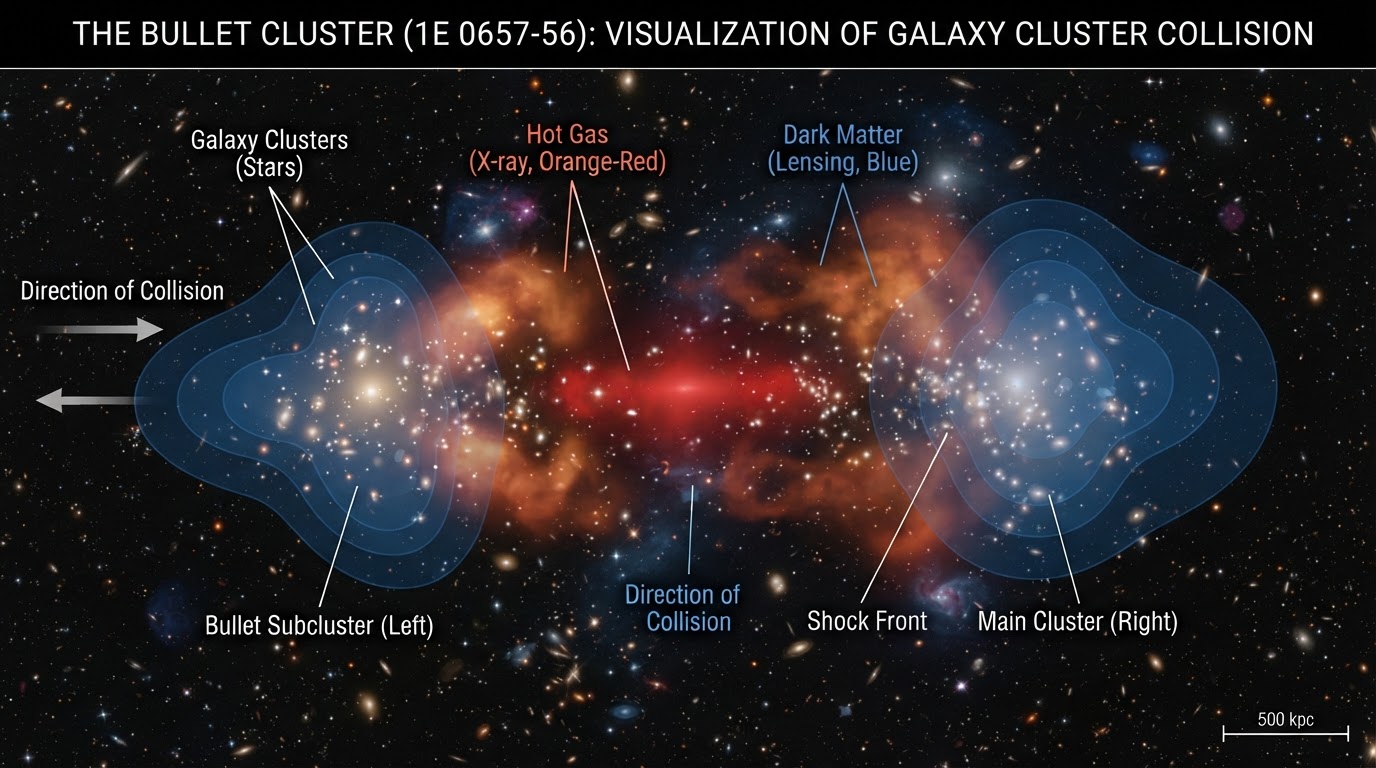
The Bullet Cluster is the clearest real-world demonstration. Two galaxy clusters collided, and the hot gas — which makes up most of the ordinary matter — was slowed by electromagnetic interactions and lagged behind. But the gravitational lensing maps showed the bulk of the mass sailing straight through the collision, unimpeded. That mass had to be something that does not interact electromagnetically. The Bullet Cluster is about as close to a direct observation of dark matter's behavior as physics has produced.
The Cosmic Microwave Background
The faint afterglow of the Big Bang, the cosmic microwave background, carries a detailed imprint of the early universe's density fluctuations. Precise measurements of those fluctuations — particularly from satellite missions designed to map them — match theoretical models only when a specific proportion of dark matter is included. Remove dark matter from the equations and the predictions fall apart completely.
What Could Dark Matter Be Made Of? The Leading Candidates
WIMPs — The Long-Favored Candidate
For decades, the leading candidate has been the WIMP — Weakly Interacting Massive Particle. WIMPs are hypothetical particles that interact via gravity and the weak nuclear force but not electromagnetism. They emerged naturally from supersymmetry theories, which predicted that every known particle should have a heavier 'superpartner.' The fact that WIMPs could explain dark matter without being invented specifically for that purpose made them enormously appealing — physicists call this kind of coincidence the 'WIMP miracle.'
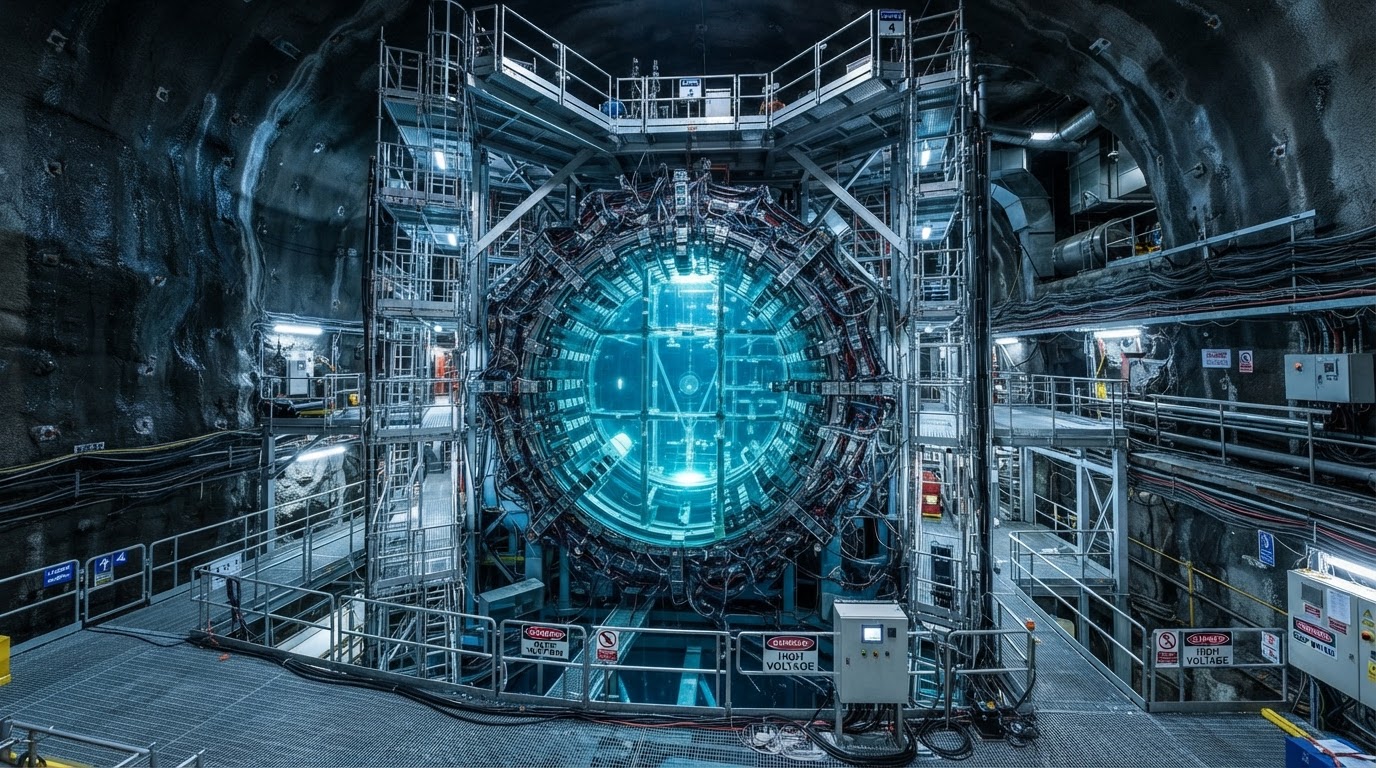
The problem is that decades of increasingly sensitive underground detectors have not found them. Experiments buried deep in mines to shield them from cosmic ray interference have pushed detection sensitivity to extraordinary levels, and the silence has been deafening. WIMPs have not been ruled out entirely, but the most theoretically natural mass ranges have been largely excluded.
Axions and Sterile Neutrinos
Axions are ultralight particles originally proposed to solve a completely unrelated problem in particle physics — a quirk in quantum chromodynamics called the strong CP problem. They turned out to be plausible dark matter candidates almost by accident. Several experiments are currently searching for axions by looking for the tiny signal that would result if an axion converted into a photon inside a strong magnetic field. No confirmed detection yet, but the search is active and well-funded.
Sterile neutrinos are another contender — heavier cousins of the known neutrinos that interact only via gravity. Some researchers believe a faint X-ray signal detected in galaxy clusters could be the decay signature of a sterile neutrino, though the interpretation remains contested.
The uncomfortable truth is that every particle physics experiment built specifically to find dark matter has so far come back empty — which tells us something important about what dark matter is not, even if not yet what it is.
Could It Be Something Else Entirely?
A minority of physicists argue that dark matter does not exist at all — that our theory of gravity is simply wrong at galactic scales. Modified Newtonian Dynamics, or MOND, can explain galaxy rotation curves without invoking invisible matter. But MOND struggles badly with the Bullet Cluster evidence and with the cosmic microwave background data. Most cosmologists treat it as an interesting footnote rather than a serious competitor to dark matter.
Why Dark Matter Matters to You — and to the Universe
It Built the Cosmic Web
Dark matter is not just a gravitational curiosity — it is the scaffolding on which the entire large-scale structure of the universe was built. In the early universe, dark matter clumped first, because it was not slowed down by the pressure of radiation the way ordinary matter was. Those dark matter clumps became gravitational seeds that pulled in ordinary matter, eventually forming the filaments, walls, and voids that make up the cosmic web — the largest structure in existence.
Without dark matter forming those seeds early enough, galaxies as we know them would not have had time to assemble in the roughly 13.8 billion years since the Big Bang. The Milky Way, the solar system, Earth — all of it traces back to dark matter doing its invisible work in the first few hundred million years of cosmic history.
What Solving This Would Mean
Identifying the dark matter particle would be one of the most significant scientific discoveries in human history — on the level of discovering quantum mechanics or the structure of DNA. It would almost certainly require extending the Standard Model of particle physics, which has been the bedrock of the field for half a century. That kind of paradigm shift tends to cascade into technologies and applications that nobody predicted at the time of discovery.
(Opinion: The fact that we have built an entire cosmological model — one that works extraordinarily well at predicting large-scale structure — on the assumption of a substance we cannot identify at the particle level is either the most impressive inference in science or a sign that something deep is being missed. Both possibilities are worth sitting with.)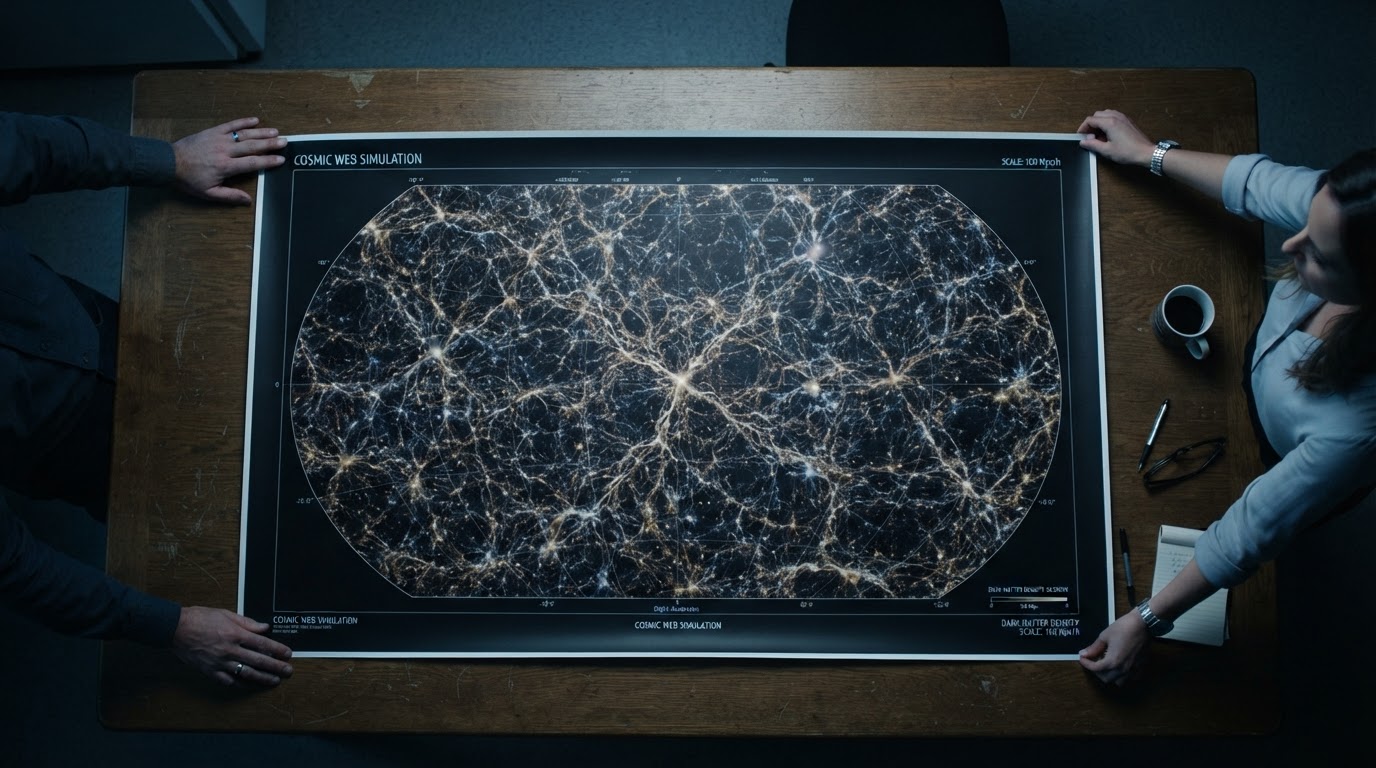
Frequently Asked Questions
Is dark matter the same as dark energy?
No — they are completely separate phenomena that happen to share the word 'dark.' Dark matter is an unknown form of matter that exerts gravitational pull and helped build cosmic structure. Dark energy is a mysterious force causing the expansion of the universe to accelerate. They are measured differently, behave differently, and almost certainly have different origins. Estimates suggest dark energy makes up roughly 68% of the total energy content of the universe, dark matter about 27%, and ordinary matter less than 5%.
Could dark matter ever be dangerous to humans?
Almost certainly not in any practical sense. If dark matter particles exist and pass through ordinary matter without interacting electromagnetically, then enormous numbers of them are passing through your body right now without any effect. The entire point of dark matter is that it does not interact with the stuff you are made of — which is precisely why it has been so hard to detect.
Why haven't we just created dark matter in a particle accelerator?
This is actually one of the active strategies. The Large Hadron Collider at CERN has been searching for evidence of dark matter particles produced in high-energy collisions — specifically by looking for events where momentum appears to go 'missing,' which would indicate a particle that escaped the detector without interacting. So far, no confirmed signal. The absence of results has significantly narrowed the parameter space for WIMP-type candidates, which is itself a scientifically useful outcome.
The deepest strangeness here is not that dark matter is unknown — science is full of open questions. The strangeness is that the universe appears to have built everything we can see and touch and measure using a minority ingredient, while the dominant component remains stubbornly outside our grasp. Every galaxy you have ever seen in a photograph is, in a very real sense, just the luminous tip of something much larger and entirely invisible — and whatever that something is, it has been shaping the cosmos since long before the first star ever lit up.



Comments
Post a Comment