Stay Agile: Essential Exercises to Maintain Mobility as You Age
By your mid-40s, the connective tissue around your joints has already started losing water content — which is why that stiffness you feel getting out of bed in the morning is not just in your head. Mobility doesn't decline because of age alone. It declines because of disuse, and the gap between 'moving well' and 'moving poorly' widens faster than most people expect. The good news is that targeted movement can slow, and in many cases reverse, a significant portion of that decline — at any age.

What You Need Before You Start a Mobility Routine
Understanding Mobility vs. Flexibility
These two words get used interchangeably, but they mean different things. Flexibility is passive — it's how far a muscle can stretch when an external force is applied. Mobility is active — it's how much usable range of motion you can control under your own power. A gymnast might be flexible without being mobile. A martial artist needs both.
For aging well, mobility is the more important target. You want joints that move through their full range when you need them to, not just when someone else pushes them there. That distinction shapes every exercise choice in this guide.
Equipment and Space
You don't need a gym. A yoga mat, a foam roller, and a sturdy chair cover roughly 90% of what's useful here. Some people add a resistance band for hip and shoulder work, which costs very little and travels easily. The chair matters more than people realize — it gives you a stable surface for balance work, which is one of the most underrated components of mobility training.
A Quick Self-Assessment
Before starting, do three simple checks: Can you squat down and hold that position for 30 seconds without your heels lifting? Can you reach both arms overhead without your lower back arching dramatically? Can you stand on one foot for 10 seconds with your eyes closed? If any of these feel impossible, those are your starting points — not a reason to skip the routine.

Step-by-Step Mobility Exercises — The Core Routine
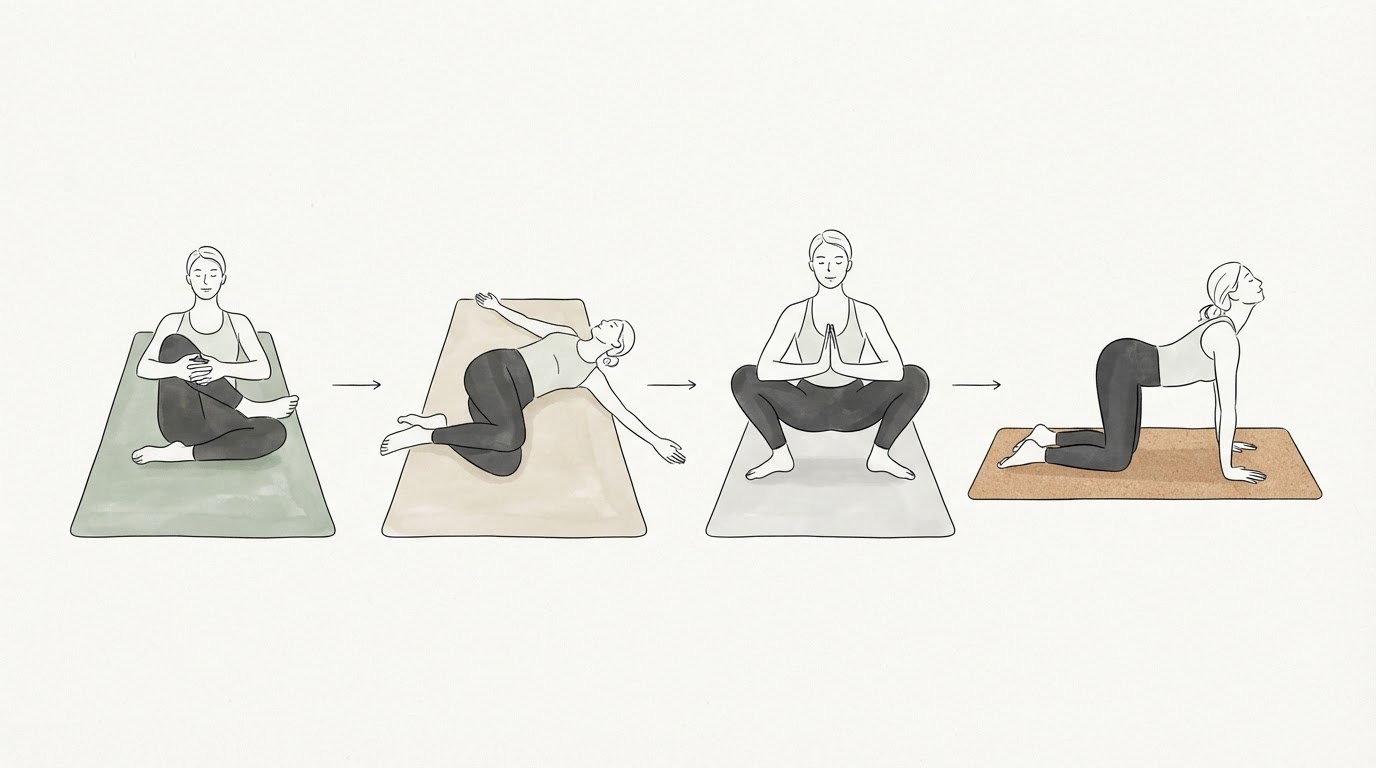
1. Hip 90/90 Stretch (2 minutes per side)
Sit on the floor with both knees bent at roughly 90 degrees — one leg in front, one behind. This position loads both internal and external hip rotation simultaneously, which most people never train. Sit tall, keep your spine neutral, and hold for 60–90 seconds before switching sides. If your hips are very tight, prop yourself up on your hands.
The hip joint loses range of motion faster than almost any other joint in sedentary adults. Desk workers especially tend to develop shortened hip flexors and weak external rotators — a combination that contributes directly to lower back pain. The 90/90 addresses both in one position.
2. Thoracic Spine Rotation (10 reps per side)
Sit cross-legged or in a chair. Place one hand behind your head, elbow pointing out. Rotate your upper back — not your lower back — toward that elbow. The goal is movement through the mid-spine (thoracic vertebrae), which stiffens dramatically with age and contributes to the hunched posture many people associate with getting older. Ten slow, controlled reps per side, breathing out as you rotate.
3. Deep Squat Hold (30–60 seconds)
Stand with feet shoulder-width apart, toes turned out slightly. Lower into a full squat and hold. If your heels lift, place a rolled towel or small weight plate under them. This is one of the most natural human resting positions — many cultures around the world use it daily into old age — but it disappears quickly when you spend years in chairs.
The deep squat is a diagnostic as much as an exercise. If you can't hold it for 30 seconds, your ankles, hips, or thoracic spine are telling you something specific.
4. Cat-Cow Spinal Wave (10 slow reps)
On hands and knees, alternate between arching your spine toward the ceiling (cat) and letting it sag toward the floor (cow). Move slowly and try to feel each vertebral segment moving individually — most people rush this and only move from the extremes. The goal is segmental spinal mobility, not just a stretch at the top and bottom.
5. Shoulder CARs — Controlled Articular Rotations (5 reps per arm)
Stand tall and slowly rotate one arm through the largest circle your shoulder joint can make — forward, up, back, and down — while keeping the rest of your body completely still. This technique, developed within the Functional Range Conditioning system, trains the nervous system to access the full available range of the shoulder. It's harder than it looks, and most people discover their shoulder can only move through about 60% of what they thought it could.
6. Single-Leg Balance Progression (30–60 seconds per side)
Stand on one foot. Start with eyes open, then progress to eyes closed, then try it on a folded towel for an unstable surface. Balance training is often skipped because it feels too simple, but research consistently links poor balance in midlife to significantly higher fall risk in later years. Falls are one of the leading causes of injury-related death in adults over 65 — this exercise is not optional.
Common Pitfalls to Avoid When Building a Mobility Practice
Going Too Hard, Too Fast
Connective tissue — tendons, ligaments, joint capsules — adapts much more slowly than muscle. You can feel 'fine' after an aggressive first session and then spend a week with an irritated hip or shoulder. Start at 50% of what feels possible and add range gradually over weeks, not days. This is the mistake most people make when they finally decide to 'get serious' about stretching.
Confusing Pain with Productive Discomfort
A deep muscular pull or a sensation of 'opening' in a joint is normal. Sharp, pinching, or joint-specific pain is not. If you feel a pinch inside a joint rather than a pull in the surrounding muscle, stop and back off the range. Pinching in a hip squat, for example, often signals impingement — pushing through it makes things worse, not better.
Skipping the Warm-Up
Cold tissue is less pliable and more injury-prone. Five minutes of light walking, marching in place, or gentle arm circles before starting the routine makes a measurable difference in how the joints respond. Anyone who has tried to do a deep stretch first thing in the morning without warming up knows exactly what this feels like.
Mobility work done cold is like trying to bend a cold rubber band — you get less range and take on more risk at the same time.

Pro Tips to Speed Up Your Mobility Progress
Use 'Greasing the Groove' Throughout the Day
Soviet strength coach Pavel Tsatsouline popularized this concept for strength training, but it applies equally to mobility. Instead of one 30-minute session, do 2–3 minutes of hip 90/90 or thoracic rotation every couple of hours. Frequent, low-intensity repetition builds motor patterns faster than infrequent long sessions. Set a phone reminder if you need to — it sounds tedious, but it works remarkably well.
Pair Mobility Work With Something You Already Do
The single biggest predictor of whether someone sticks with a mobility routine is whether it attaches to an existing habit. Do your shoulder CARs while the coffee brews. Run through the hip 90/90 while watching the first ten minutes of a show. The routine doesn't need to be a standalone event to be effective.
Track Your Range, Not Just Your Time
Take a photo or short video of your deep squat or shoulder rotation once a month. Progress in mobility is slow and easy to miss day-to-day, but visible over weeks. Seeing the difference between month one and month three is one of the most motivating things you can do — and it keeps you honest about whether the routine is actually working.
Add Load Gradually
Once you can move through a range passively, the next step is to own it actively — meaning you can control movement through that range under light resistance. A light resistance band around the thighs during a squat, or a small weight held during a shoulder rotation, teaches the nervous system to trust the new range. This is what separates lasting mobility gains from temporary flexibility that disappears when you stop stretching.
(Opinion: Most mainstream fitness culture still treats mobility as a warm-up footnote rather than a training priority in its own right. That's a mistake. For anyone over 40, a well-designed mobility practice probably delivers more quality-of-life return per hour than almost any other form of exercise — and it's one of the few things that gets genuinely more important, not less, as the years go on.)
Frequently Asked Questions
How long before I notice real improvement in my mobility?
Most people notice meaningful changes in 4–6 weeks of consistent practice — typically 4–5 sessions per week. That said, some joints respond faster than others. Thoracic spine and hip flexibility tend to show early wins, while ankle and shoulder mobility can take longer. Consistency matters far more than session length.
Is it safe to do mobility exercises if I already have joint pain or arthritis?
Research suggests that gentle, controlled movement is generally beneficial for most forms of arthritis and chronic joint pain — complete rest often makes stiffness worse, not better. That said, the specific exercises and ranges need to be adjusted for your situation. If you have a diagnosed joint condition, it's worth checking with a physiotherapist before starting, particularly for the hip and shoulder rotations.
Do I need to stretch every single day, or can I take rest days?
You don't need to do the full routine every day. Three to four dedicated sessions per week is enough for most people to make progress. The 'greasing the groove' approach — short movement snacks throughout the day — can fill the gaps on off days without adding recovery stress. The worst outcome is doing nothing for days at a time and then trying to make up for it with one long session.
The exercises in this guide are not complicated, and none of them require special talent or unusual fitness. What they require is regularity — showing up often enough that the nervous system starts to accept new ranges as normal rather than threatening. That shift, from 'this feels impossible' to 'this is just how I move,' is quieter than a strength PR or a weight loss milestone, but it compounds in ways that show up clearly in your 60s, 70s, and beyond.
The uncomfortable truth is that mobility is one of the few physical qualities where neglect is nearly invisible until it suddenly isn't — and by the time a stiff hip or a frozen shoulder becomes a daily problem, you've usually been losing ground for years. The window to act is always earlier than it feels.



Comments
Post a Comment