The Giant Impact: Unraveling the Mystery of How Earth's Moon Formed
The Moon is not a captured asteroid, not a chunk of Earth that spun off, and not a cosmic coincidence. The leading scientific explanation is that roughly 4.5 billion years ago, a Mars-sized object slammed into the early Earth at an oblique angle, and the debris from that catastrophic collision eventually coalesced into the Moon we see tonight. That single event — called the Giant Impact Hypothesis — reshaped our planet, set the length of our day, and may have made complex life possible.
What Is the Giant Impact Hypothesis?
The Basic Idea
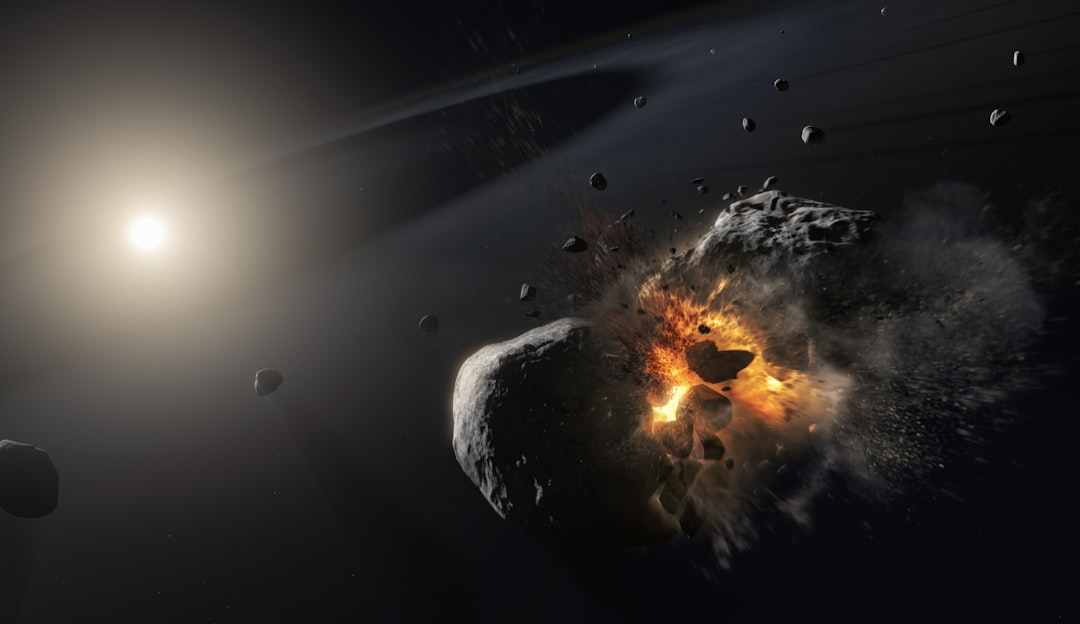
The Giant Impact Hypothesis proposes that a protoplanet roughly the size of Mars — scientists call it Theia — collided with the proto-Earth sometime in the first hundred million years of the solar system. The impact was not a head-on crash but a glancing blow, which is a critical detail. A direct hit would have been far more destructive; the oblique angle allowed a massive spray of vaporized rock to be thrown into orbit rather than simply absorbed or scattered into space.
That orbiting cloud of debris, a mix of molten rock and vapor, gradually clumped together under gravity. Within estimates ranging from a few decades to a few thousand years — geologically instantaneous — the Moon had formed. The timescale is genuinely shocking when you consider that the Moon is over 3,400 kilometers in diameter.
Why Scientists Settled on This Model
Three earlier competing theories were each killed by a specific piece of evidence. The 'fission' model — that the Moon tore away from a rapidly spinning Earth — cannot explain the Moon's current orbital dynamics. The 'capture' model — that the Moon formed elsewhere and was gravitationally snagged — requires an improbably precise set of conditions. The 'co-accretion' model — that Earth and Moon formed side by side from the same cloud — struggles to account for the Moon's relatively small iron core compared to Earth's.
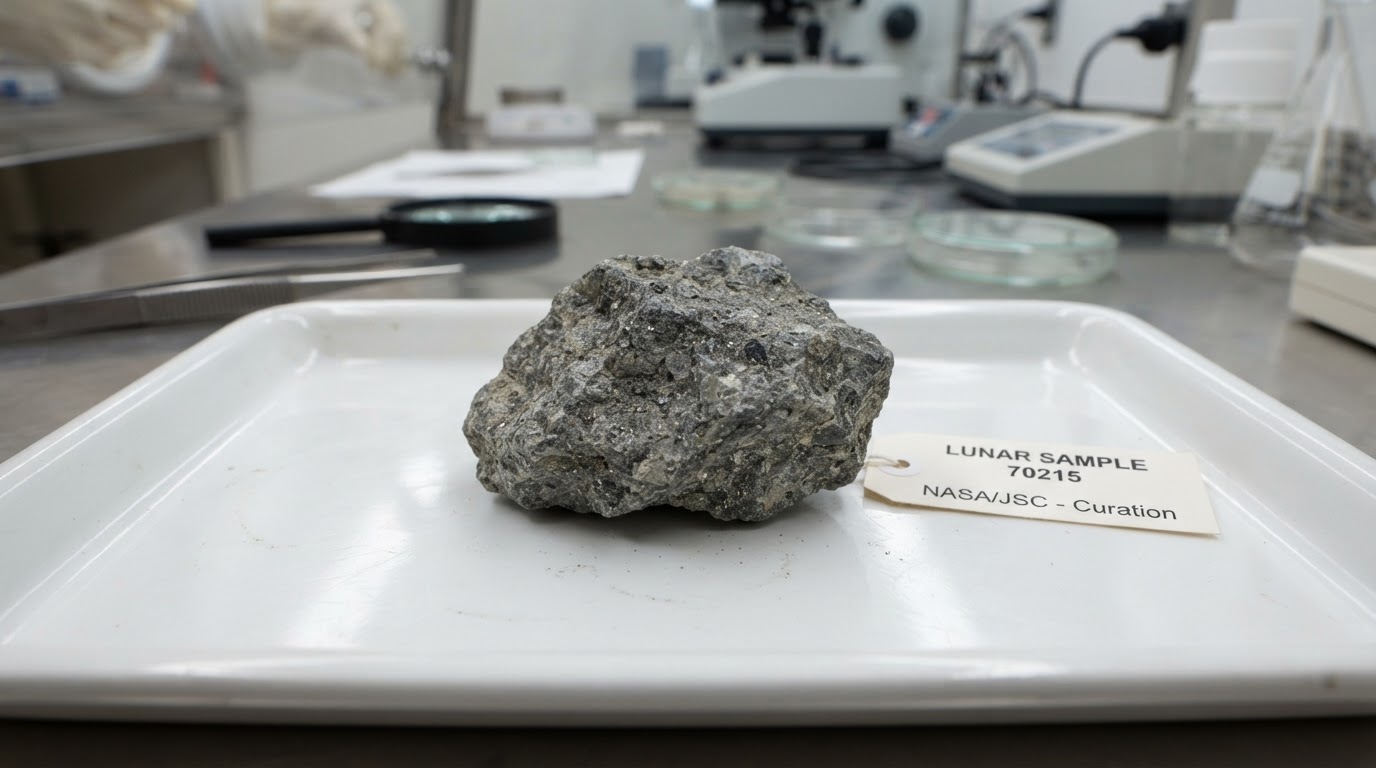
The Giant Impact model survived all three objections. It also got a major boost from the Apollo missions, which returned lunar rocks that turned out to be chemically very similar to Earth's mantle — not what you'd expect from a captured foreign body.
How the Moon Actually Formed — The Mechanics Step by Step
The Collision Itself
Theia is thought to have formed in the same region of the solar system as Earth, possibly sharing a similar orbital path. Over millions of years, gravitational nudges from Jupiter and other planets destabilized its orbit until a collision became inevitable. The impact speed was likely in the range of tens of thousands of kilometers per hour — fast enough to vaporize rock on contact, but not so fast that everything was simply destroyed.
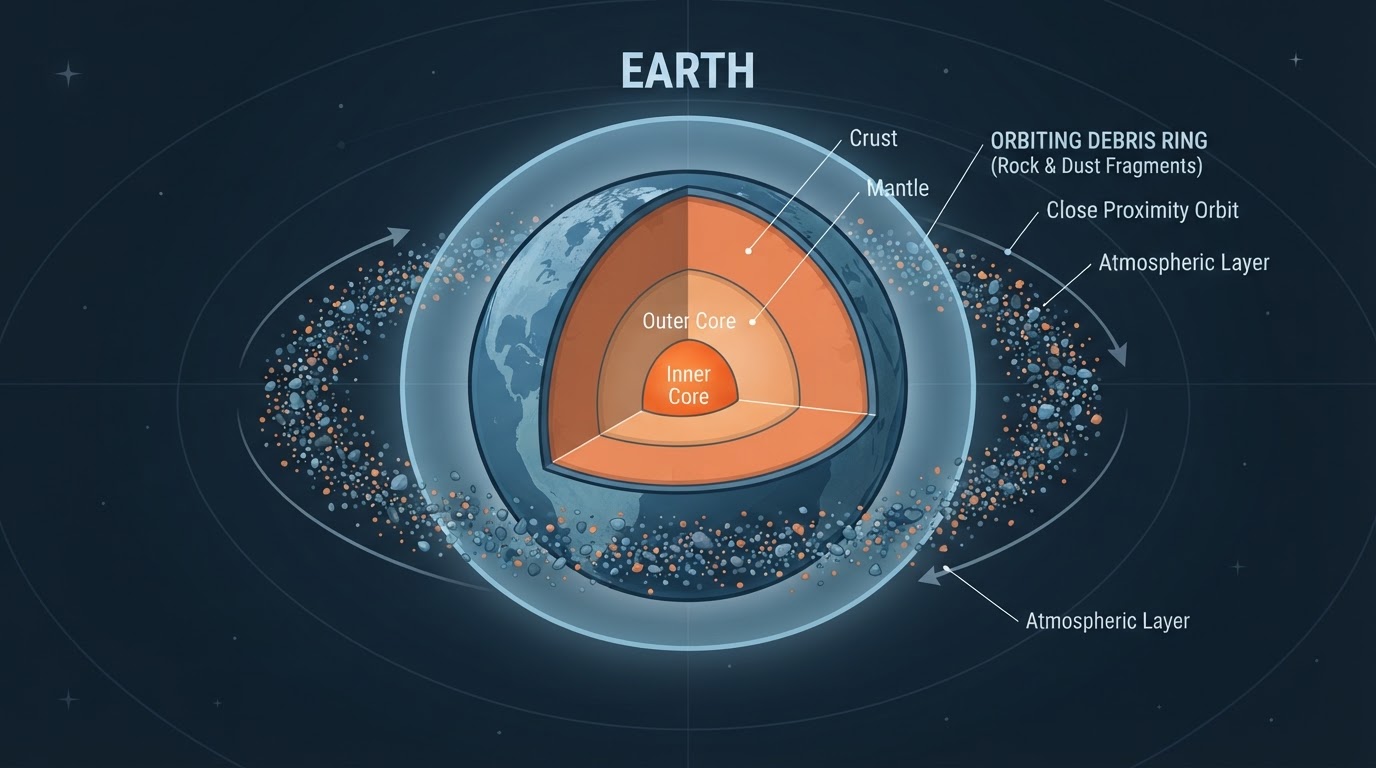
The outer layers of both bodies — mostly silicate rock — were blasted into a superheated disk of vapor and molten droplets surrounding Earth. Theia's iron core, meanwhile, is thought to have sunk into and merged with Earth's own core. That's one reason Earth has an unusually large iron core relative to its size.
The Moon is essentially made from Earth's own mantle material, launched into orbit by a collision that also gave our planet its tilted axis and its relatively fast early rotation.
From Debris Disk to Moon
The debris disk that formed after the impact was not stable. Particles within it collided, stuck together, and grew — a process called accretion. Computer simulations suggest the Moon could have reached roughly its current size within a few thousand years, though the exact timeline is still debated. Early in its existence, the Moon was dramatically closer to Earth, possibly orbiting at a distance of just 20,000 to 30,000 kilometers compared to today's average of about 384,000 kilometers.
That proximity had real consequences. The Moon's gravity raised enormous tides on early Earth — not just ocean tides, but tides in the solid rock of the crust itself. And Earth's gravity was simultaneously pulling the Moon into a tidally locked state, which is why we always see the same face of the Moon today. Anyone who has looked up and wondered why the Moon never rotates from our perspective now has the answer: it does rotate, but at exactly the same rate it orbits Earth, a direct result of tidal locking.
What the Moon Rocks Revealed — and What Still Doesn't Quite Fit
The Isotope Problem
When Apollo astronauts brought back lunar samples between 1969 and 1972, geochemists noticed something striking: the oxygen isotope ratios in Moon rocks are nearly identical to those in Earth rocks. This was initially seen as strong confirmation of the Giant Impact model. If Theia had formed in a completely different part of the solar system, its isotopic fingerprint should be different from Earth's — and it isn't.
Here's where it gets complicated. If Theia was a distinct body with its own isotopic signature, the Moon should show some blend of Earth and Theia chemistry. But it looks almost purely like Earth. Some researchers argue this means Theia formed in the same region of the solar system as Earth and happened to share the same isotopic ratios — a coincidence, but a plausible one. Others have proposed more radical alternatives: that the impact was so energetic it completely mixed the two bodies' materials, erasing any difference.
The High-Energy Impact Variants
A subset of researchers has proposed 'high-energy' or 'high-angular-momentum' impact scenarios, where the collision was more violent than the classic model assumes. In these versions, both Earth and Theia were partially vaporized and thoroughly mixed, which would explain the isotopic similarity. The trade-off is that these models require additional mechanisms to shed the excess angular momentum from the Earth-Moon system afterward — possibly through a resonance interaction with the Sun.
The science here is genuinely unsettled. The Giant Impact Hypothesis is the consensus, but the specific flavor of that impact is still being argued over in peer-reviewed journals.
The Moon's isotopic near-identity with Earth is either a remarkable coincidence, or evidence that the impact was so violent it essentially turned two planets into one mixed system before the Moon re-condensed.
Why the Moon's Formation Matters for Life on Earth
Axial Stability and the Long Game
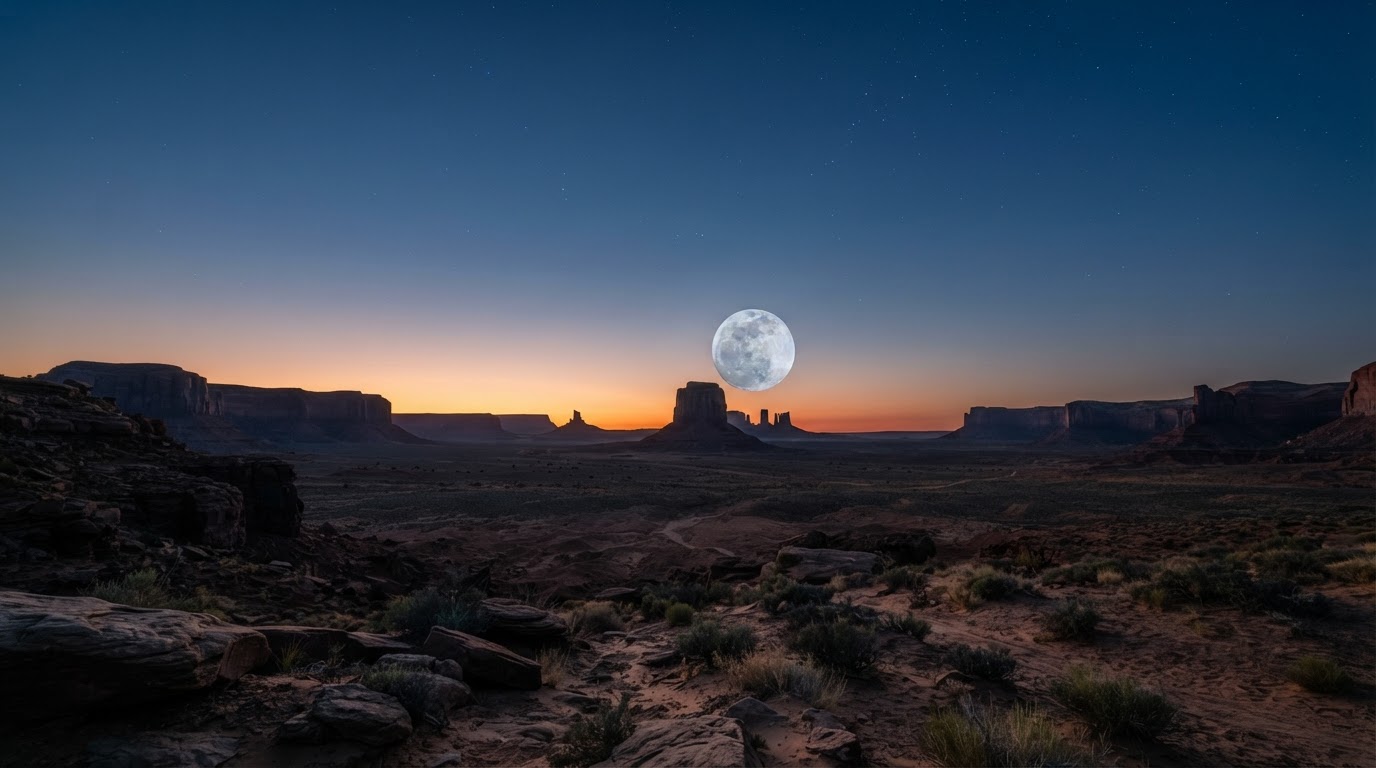
Earth's axial tilt — currently about 23.5 degrees — is what gives us seasons. Without the Moon's gravitational stabilizing influence, research suggests Earth's tilt could vary chaotically over millions of years, swinging between near-zero and extreme angles. That kind of instability would produce wildly unpredictable climate swings, potentially making the sustained, relatively stable conditions that allowed complex life to evolve much harder to achieve.
Mars, which lacks a large moon, does show evidence of significant axial variation over geological time. Whether that instability prevented life from gaining a foothold on Mars is unknown, but it's a question researchers take seriously.
The Tidal Engine
Early Earth's tides — driven by a much closer Moon — were enormous. Some researchers believe those powerful tidal cycles in shallow coastal zones may have played a role in the chemistry that led to the origin of life, by repeatedly concentrating and diluting organic molecules. This is speculative, but it connects the Moon's formation directly to one of the biggest open questions in biology.
The Giant Impact also left Earth with a faster rotation than it would otherwise have had. Longer days in Earth's early history might have meant very different atmospheric circulation patterns, different temperature distributions, different everything. The Moon slowed Earth's rotation over billions of years through tidal friction — Earth's day was once closer to six hours long — but the starting point was set by that ancient collision.
(Opinion: There's something quietly humbling about the fact that the conditions for human existence may trace back to a random collision 4.5 billion years ago. Not design, not inevitability — just a Mars-sized rock arriving at the wrong place at the right time.)
Frequently Asked Questions
Is the Giant Impact Hypothesis proven, or is it still a theory?
It is the scientific consensus — the most well-supported explanation we have — but it has not been 'proven' in the way a mathematical theorem can be. The isotopic evidence from Apollo samples strongly supports it, and computer simulations reproduce many of the Moon's observed properties. However, specific details of the impact, such as the exact angle, speed, and mass of Theia, are still debated. In science, 'theory' means a well-tested explanatory framework, not a guess.
Could there have been a second moon that was later destroyed?
This is a real hypothesis, not just speculation. Some researchers have proposed that the Giant Impact produced two moons, with the smaller one eventually colliding slowly with the larger one. This 'second moon' model has been suggested as a possible explanation for why the Moon's two hemispheres look so different — the far side has a thicker crust than the near side. It remains an active area of research rather than a settled conclusion.
Why does the Moon have almost no iron core if it formed partly from Theia?
This is one of the key pieces of evidence for the Giant Impact model, not a problem with it. The hypothesis holds that Theia's iron core merged with Earth's core during the impact, while the debris that formed the Moon came mostly from the outer, silicate-rich layers of both bodies. That's why the Moon's density is lower than Earth's and why its core is proportionally small. The iron went down, the rock went up.
The strangest part of the Giant Impact story is not the collision itself — it's what came after. A Moon close enough to raise rock tides, slowing a six-hour Earth day down to twenty-four hours over billions of years, stabilizing a tilted axis just enough for seasons to be predictable, possibly stirring the chemical soup that became life. The Moon feels permanent and inevitable from where we stand. It was neither.


Comments
Post a Comment