Cosmic Dance: What Happens When Galaxies Collide?
Two galaxies can pass straight through each other and barely a single star collides. That sounds impossible — until you consider that stars are so small relative to the distances between them that two galaxies merging is, statistically speaking, mostly empty space crashing into empty space. What actually happens is far stranger and more violent than a simple smash-up, and the consequences reshape entire universes of stars over billions of years.
What a Galaxy Collision Actually Is — and What It Isn't
Not a Crash, More Like a Dance
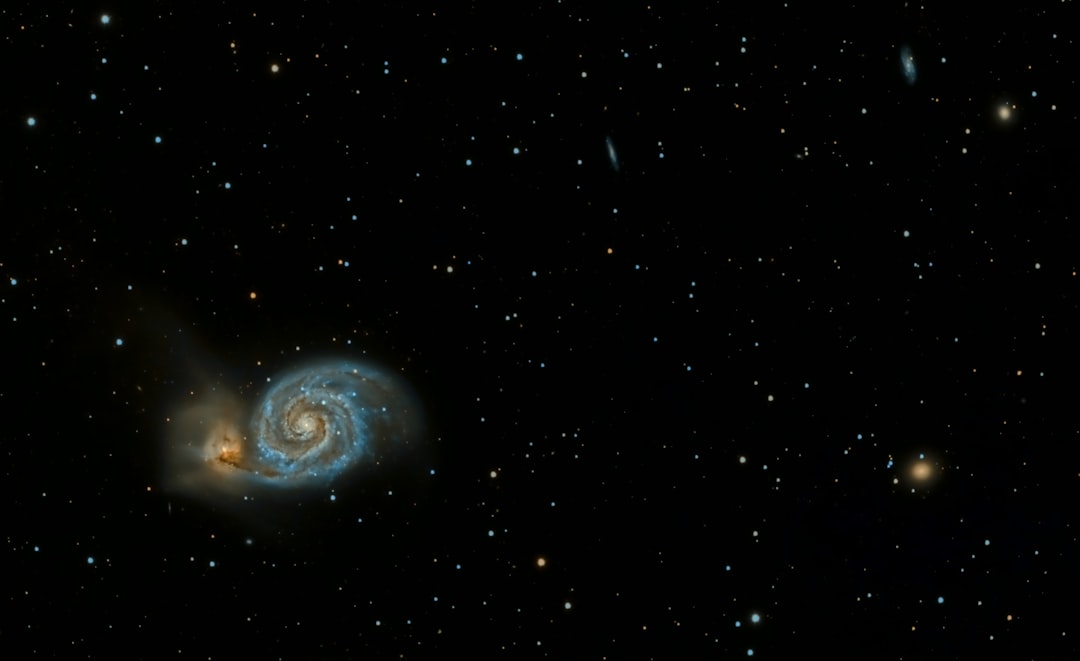
The word 'collision' is technically accurate but wildly misleading. When two galaxies meet, there is no single moment of impact. Instead, they begin a gravitational tango that can last hundreds of millions — sometimes billions — of years. Gravity pulls them together, they swing past each other, separate, then fall back again, repeating the cycle until they finally merge into one larger structure.
The Milky Way and the Andromeda Galaxy are currently on exactly this trajectory. Estimates suggest they will begin their first close pass in roughly 4 to 5 billion years. Astronomers have modeled the encounter in detail, and the result is not annihilation — it is transformation.
Here is the counterintuitive part: even during the closest approach, the probability of any two individual stars colliding is extraordinarily low. The nearest star to our Sun is over 4 light-years away. Scale that to the density of a typical galaxy and you get an enormous amount of nothing between each star. The galaxies interpenetrate like two swarms of bees flying through each other.
What Actually Gets Disrupted
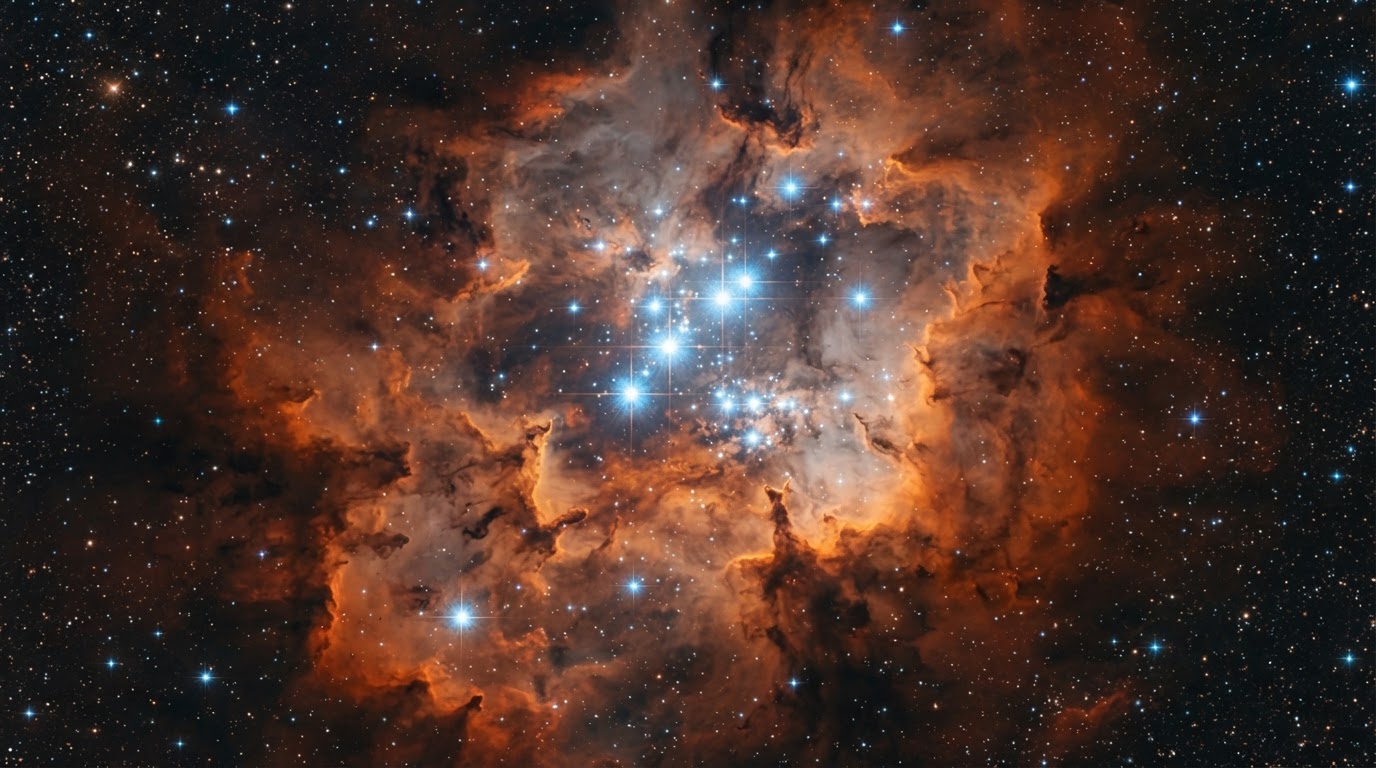
What does get violently disrupted is the gas. Interstellar gas clouds — the raw material for new stars — do collide. They compress, heat up, and trigger massive waves of star formation called starbursts. Some of the most spectacular star-forming regions ever observed exist precisely because two galaxies are in the process of merging.
How Galaxy Mergers Work — The Gravitational Mechanics
Tidal Forces and the Birth of Tidal Tails
The first visible sign that two galaxies are interacting is the appearance of tidal tails — long, sweeping streams of stars and gas flung outward by gravitational tidal forces. The same physics that causes Earth's ocean tides operates here, just at a scale that defies easy imagination. Stars on the near side of a galaxy feel a stronger gravitational pull from the approaching neighbor than stars on the far side, and that difference in force stretches the galaxy like taffy.
The Antennae Galaxies — a pair of colliding galaxies located roughly 45 million light-years from Earth — are one of the best-documented examples of this process. Their two enormous tidal tails give them their name, and Hubble Space Telescope imagery has revealed thousands of new star clusters forming in the collision zone. It is one of those cases where the real thing looks more dramatic than any illustration.
Tidal tails are not debris — they are the galaxy's own stars, flung outward by the gravitational difference between near and far sides during a close pass.
Dark Matter Halos Do Most of the Work
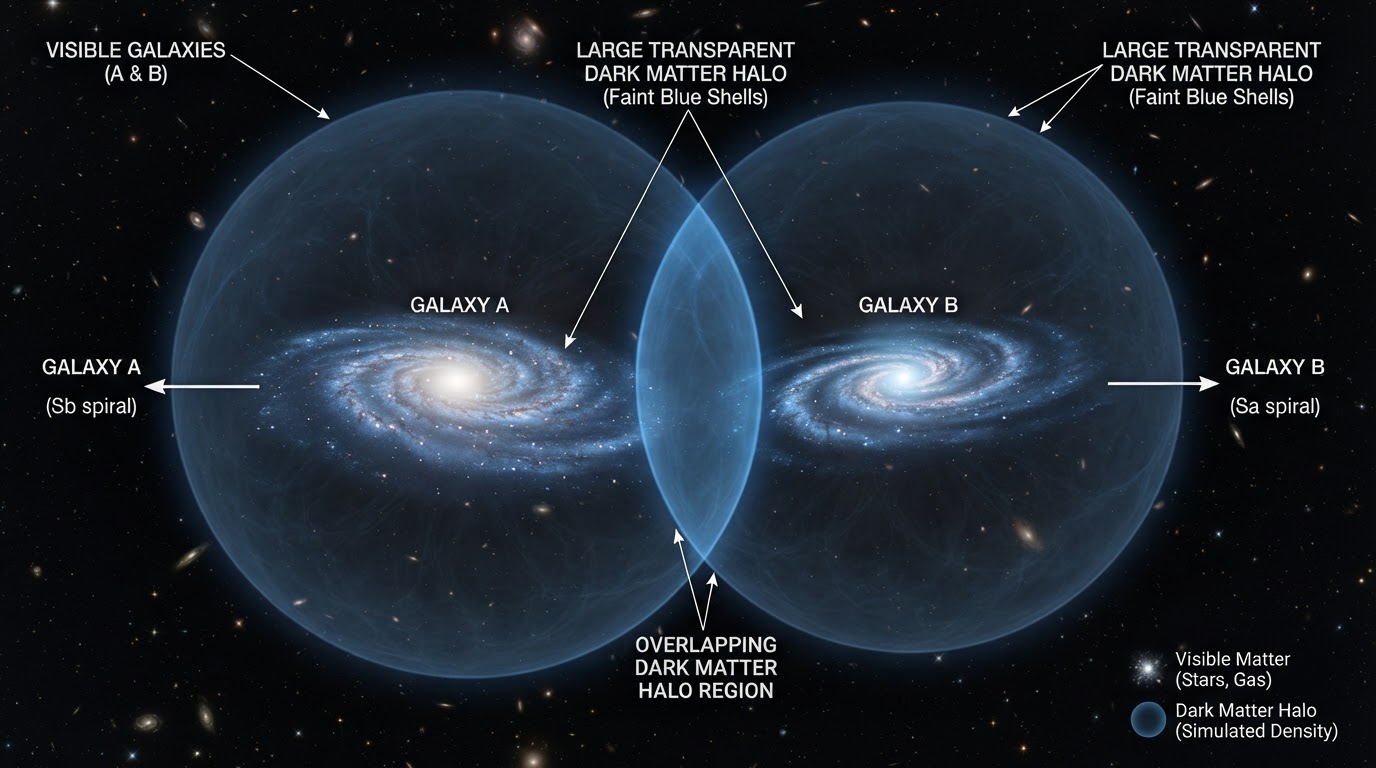
Here is something most casual overviews skip: galaxies are not just the stars and gas you can see. Each one is embedded in a vast halo of dark matter that can extend far beyond the visible disk — sometimes ten times the diameter of the galaxy itself. When two galaxies approach, their dark matter halos begin interacting first, long before the visible parts get anywhere near each other.
This matters because dark matter halos act as gravitational anchors that slow the galaxies down through a process called dynamical friction. The halos drag on each other, sapping orbital energy and causing the galaxies to spiral inward faster than they otherwise would. Without this effect, mergers would take far longer, and the universe would look quite different today.
What Galaxy Collisions Produce — Stars, Black Holes, and New Shapes
Starbursts: A Sudden Explosion of New Stars
When gas clouds from two galaxies collide, they compress rapidly. Compressed gas cools and fragments under its own gravity, and those fragments collapse into new stars. The result is a starburst — a period of star formation happening at a rate that can be tens or even hundreds of times higher than in a normal, undisturbed galaxy. Some starburst galaxies produce new stars so fast that they exhaust their gas supply in a cosmically short time.
The galaxy Arp 220, located about 250 million light-years away, is a well-studied example of a merger-driven starburst. It glows intensely in infrared light — a signature of the enormous amounts of dust-heated energy pouring out of its dense, star-forming core. Infrared observatories have been essential for studying these objects because the dust that fuels the starburst also obscures it in visible light.
Supermassive Black Holes on a Collision Course
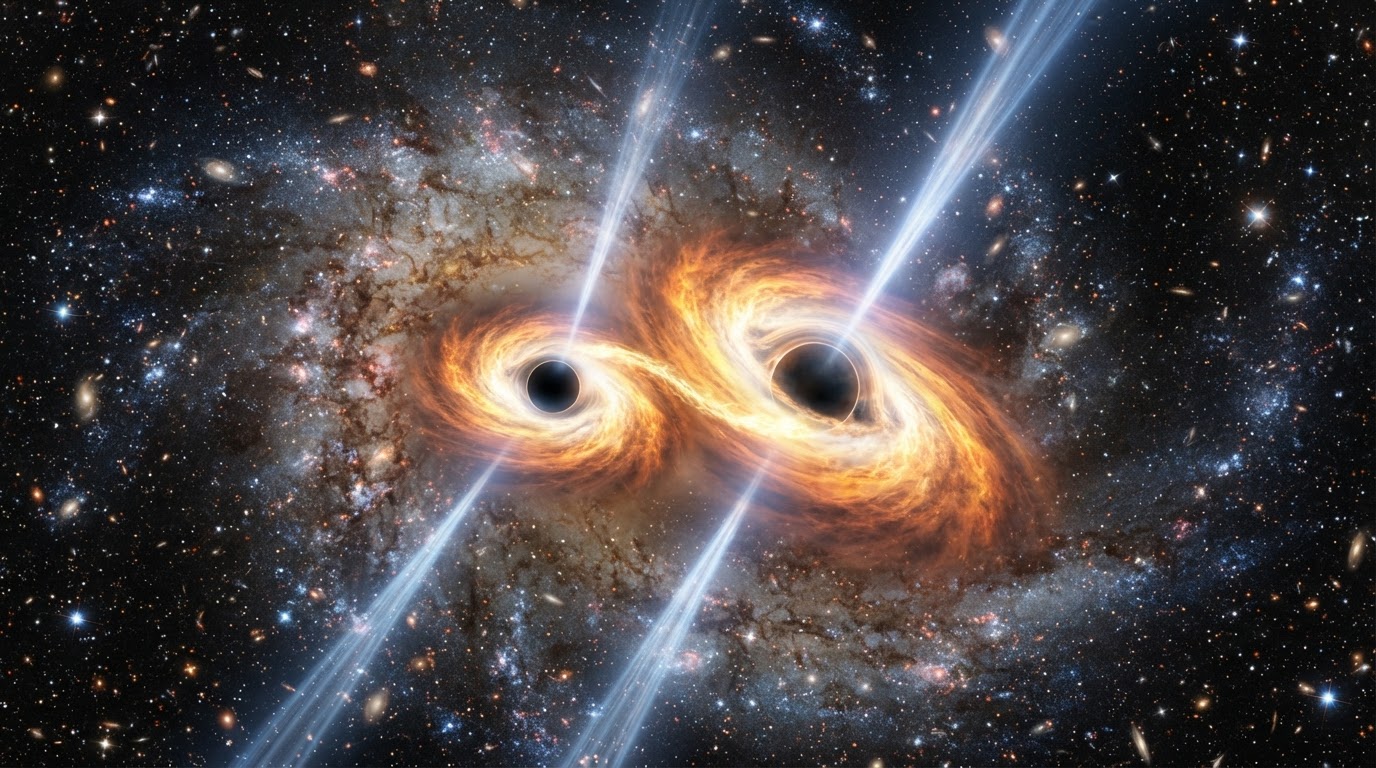
Almost every large galaxy hosts a supermassive black hole at its center. When two galaxies merge, their black holes eventually find themselves orbiting each other in the newly combined galaxy's core. Over time, dynamical friction causes this orbit to shrink — but the final stages of the inspiral are poorly understood. This is sometimes called the 'final parsec problem': getting two black holes from a separation of about one parsec down to the point where gravitational wave emission can carry them the rest of the way.
When they finally merge, the event releases an enormous burst of gravitational waves. Pulsar timing arrays — networks of precisely monitored pulsars spread across the galaxy — have recently detected what appears to be a background hum of gravitational waves, and merging supermassive black holes are the leading candidate source. That hum is, in a very real sense, the echo of ancient galaxy collisions.
Every large galaxy merger eventually puts two supermassive black holes on a collision course — and their final inspiral may be the loudest gravitational wave event in the universe.
Why Galaxy Collisions Matter to Our Own Cosmic Address
The Milky Way Has Already Done This Before
The Milky Way is not a pristine, untouched spiral. It has a history of mergers. The Gaia space telescope's precise stellar motion data has revealed streams of stars with unusual orbits that are almost certainly the remnants of smaller galaxies absorbed by the Milky Way billions of years ago. One such event — sometimes called the Gaia-Enceladus or Gaia-Sausage merger — appears to have been a significant collision that occurred roughly 8 to 11 billion years ago and may have contributed a substantial fraction of the Milky Way's inner halo stars.
The Sagittarius Dwarf Galaxy is currently being absorbed. It has already made multiple passes through the Milky Way's disk, and each pass has stretched it into a long stellar stream that wraps around the galaxy. You cannot see it with the naked eye, but it is there — a ghost of a smaller galaxy being slowly dismantled.
What the Milky Way-Andromeda Merger Will Actually Look Like
When Andromeda arrives, the night sky will change dramatically — but not in the way most people imagine. The two galaxies will not slam together in a single catastrophic event. Over billions of years, the combined system will oscillate, distort, and gradually settle into a new shape. Simulations suggest the end product will likely be a large elliptical galaxy — sometimes nicknamed 'Milkomeda' — with far less organized spiral structure than either galaxy has today.
The Sun will almost certainly survive. Its odds of a direct stellar collision are negligible. But its position within the galaxy could change significantly, as gravitational reshuffling redistributes stars across the merged system. The solar system might end up in a completely different region of the new galaxy than it occupies today.
(Opinion: There is something quietly humbling about the fact that our galaxy's most dramatic future event — a full merger with Andromeda — will unfold so slowly that no individual human moment will witness more than an imperceptible fraction of it. Cosmic violence, it turns out, operates on timescales that make human history look like a camera flash.)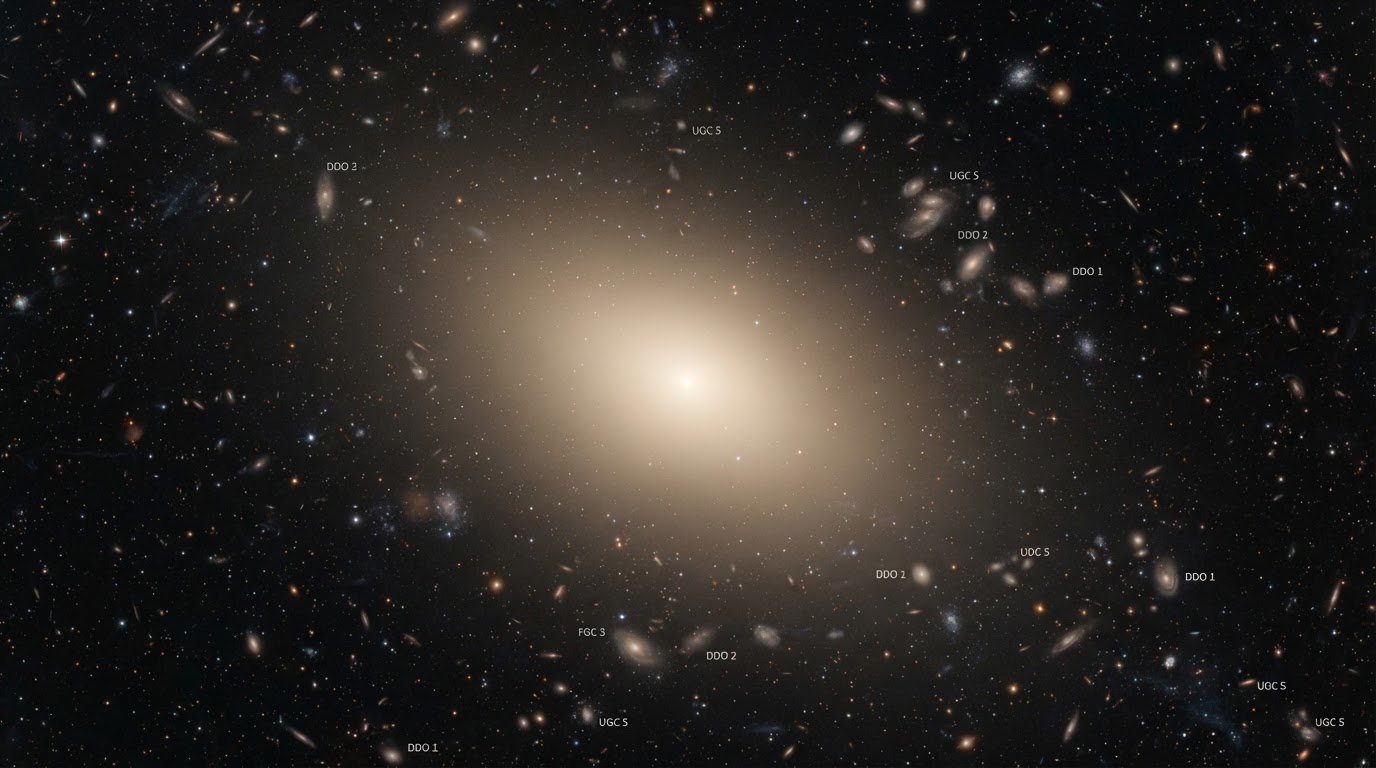
Frequently Asked Questions
Do stars actually collide when galaxies merge?
Almost never. Stars are so small relative to the distances between them that two merging galaxies can interpenetrate almost completely without a single direct stellar collision. The gravitational interactions reshape orbits dramatically, but the stars themselves rarely touch. Gas clouds, however, do collide — and that is what triggers the intense star formation seen in merging systems.
How long does a galaxy merger take?
A full merger typically takes anywhere from hundreds of millions to a few billion years, depending on the masses involved and the geometry of the encounter. The process is not a single event — galaxies often make multiple passes before finally combining. The Milky Way and Andromeda are expected to complete their merger over a period of several billion years after their first close approach.
Can a galaxy survive a collision intact?
In some cases, yes — particularly when a small galaxy passes through a much larger one. The smaller galaxy can emerge on the other side, though it will be significantly disrupted and will likely be pulled back for another pass. When two galaxies of similar mass collide, however, neither typically survives as a distinct structure. They merge into a single, usually elliptical, galaxy over time.
The Milky Way's merger history is written in the orbits of stars that should not be where they are — unusual trajectories that only make sense if they were deposited by a galaxy that no longer exists. Every time a new space telescope maps stellar velocities with greater precision, it finds more of these orphaned stars, each one a fossil record of a collision that happened before the Earth existed. The universe is not building galaxies so much as continuously rearranging them, and what we see tonight as a stable, familiar spiral is just a snapshot of something that has always been in motion.


Comments
Post a Comment