Beyond the Screen: How E-Readers Display Text Without Backlight
A typical smartphone screen blasts light directly into your eyes at anywhere from 400 to 800 nits of brightness. An e-reader, sitting in full sunlight, gets more readable the brighter it gets outside — the exact opposite of every other screen you own. That's not a software trick. It's a fundamentally different technology, one that has more in common with ink on paper than with the LCD panel in your laptop.
What Is E-Ink? The Technology Behind the Page-Like Display
The Basic Idea: Pixels Made of Tiny Capsules
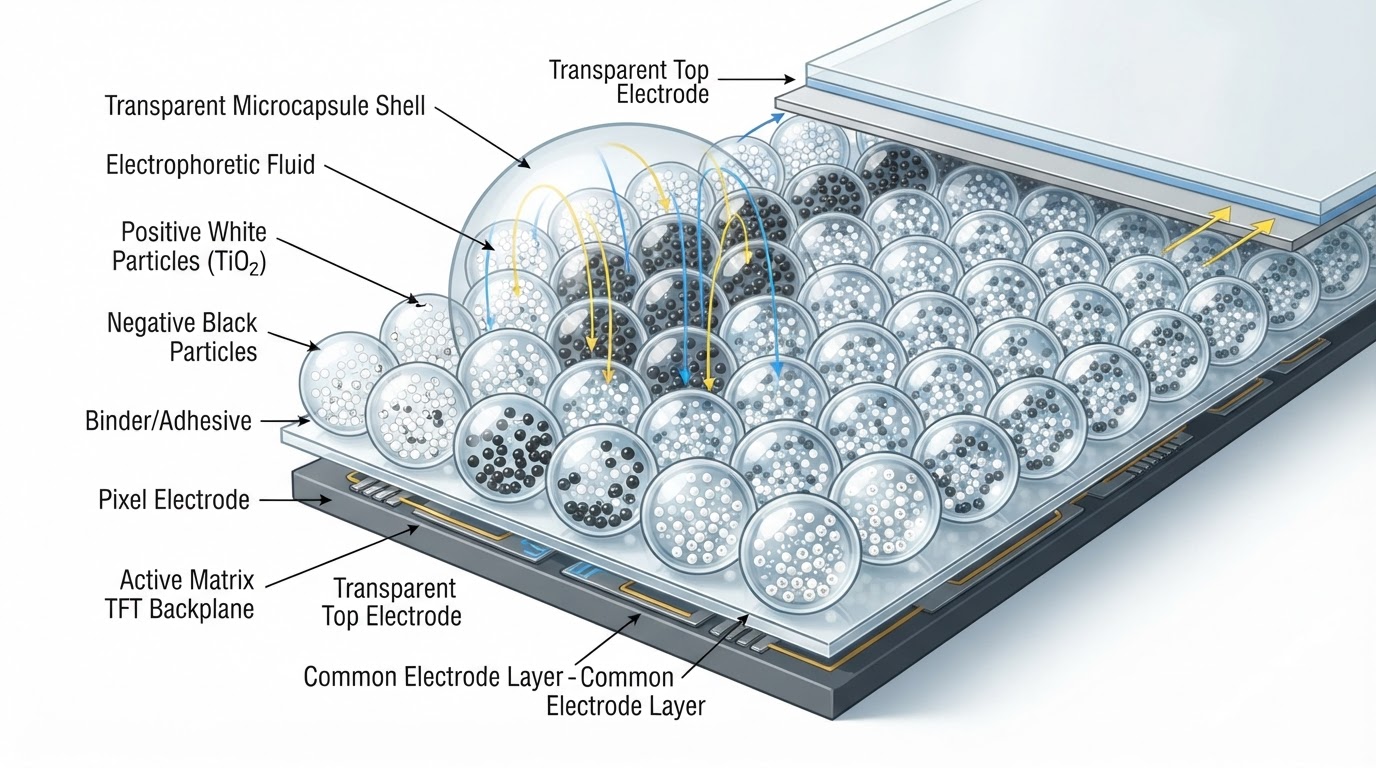
E-ink — short for electronic ink — is a display technology that works by physically moving microscopic particles rather than emitting light. The screen surface is covered in millions of tiny capsules, each roughly the diameter of a human hair. Inside each capsule are two types of charged particles: white ones and black ones, suspended in a clear fluid.
When an electric field is applied, the white particles migrate to the top of the capsule (visible to the reader) and the black ones sink to the bottom — or vice versa. White particles at the top means that spot on the screen looks white. Black particles at the top means it looks dark. Arrange enough of these capsules and you get letters, words, paragraphs.
The crucial detail: once the particles settle, no electricity is needed to hold them in place. The image is mechanically stable. That's why e-readers can display a static page for weeks on a single charge — they only consume power when the page actually changes.
How E-Ink Reflects Light Instead of Generating It
Ambient Light as the Display Engine
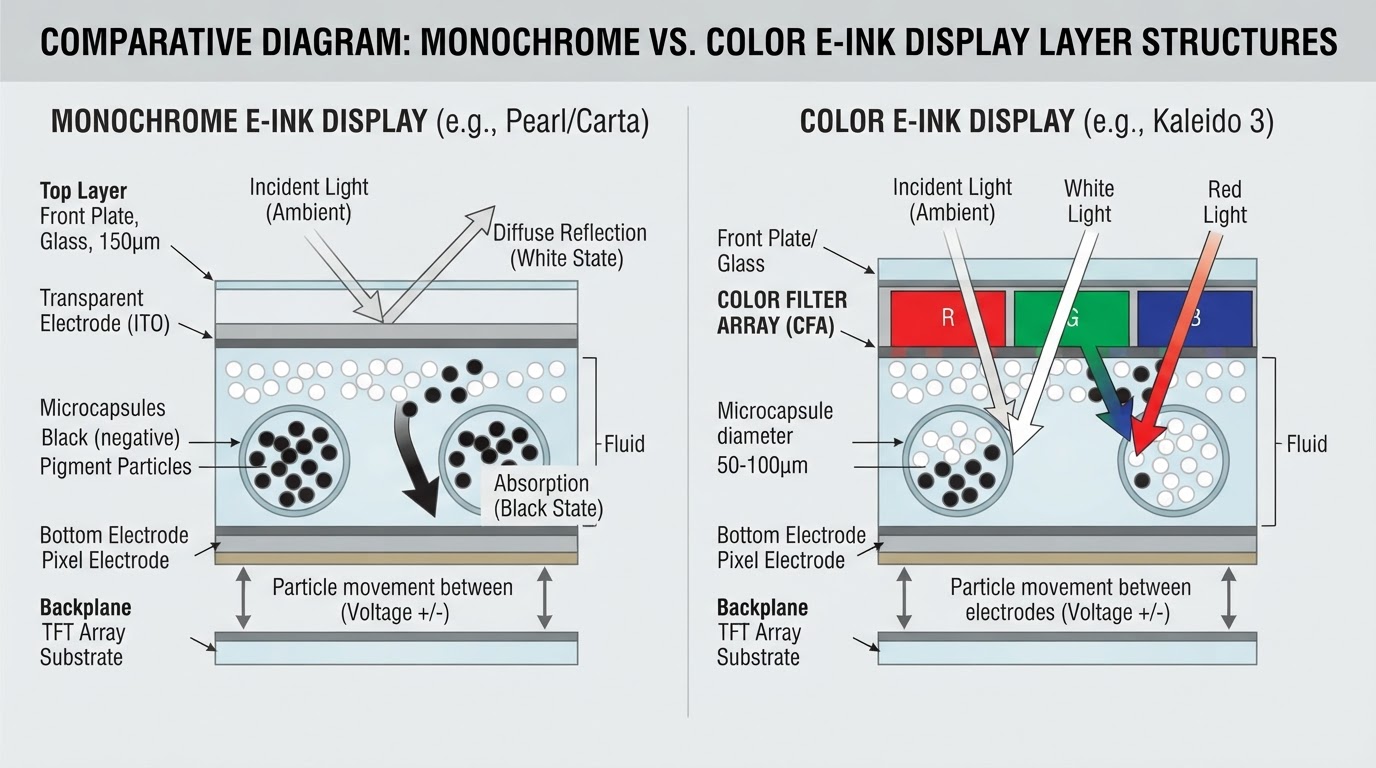
Every LCD or OLED screen you've used works by generating its own light source and then filtering or modulating it. E-ink does neither. The surface of an e-ink display behaves like a printed page — it reflects whatever light is already in the room. In bright sunlight, more light bounces back to your eyes, so the contrast improves. In a dim room, contrast drops, just like reading a physical book would.
E-ink doesn't fight ambient light — it uses it. That single design choice is why reading outdoors on an e-reader feels nothing like squinting at a phone.
This is why early e-readers had no built-in lighting at all. The first Kindle, released in 2007, required an external book light in the dark — the same way you'd need a lamp to read a paperback. The front-lit systems that most modern e-readers now include are a separate layer of LEDs that scatter light across the screen surface rather than shining through it from behind. It's a subtle but important distinction: front-lighting illuminates the reflective surface, while backlighting bypasses it entirely.
Why This Makes Such a Difference for Your Eyes
When you stare at a backlit screen, the light source is aimed directly at your eyes. Your pupils constrict, your ciliary muscles work to focus, and over hours, that sustained effort contributes to the eye strain many people associate with extended screen time. Research suggests this effect is compounded by blue light wavelengths, which backlit displays emit in significant quantities.
Reflected light from an e-ink surface is diffuse and indirect — much closer to the experience of reading under a lamp. The contrast ratio is lower than an OLED screen, but the visual fatigue tends to be lower too. Anyone who has switched from reading on a tablet to an e-reader for long sessions has probably noticed this without being able to explain exactly why.

How Color E-Ink Works — and Why It's Still Catching Up
The Color Problem Is Harder Than It Looks
Black-and-white e-ink is elegant in its simplicity: two types of particles, two outcomes. Color is considerably messier. The dominant approach used in color e-ink displays adds a color filter array — a grid of red, green, and blue filters — layered over the standard black-and-white capsule layer. Each pixel is split into subpixels covered by different filters, and the underlying particles control how much light passes through each one.
The problem is that the color filter absorbs a significant portion of the reflected light. Color e-ink displays tend to look noticeably dimmer and less saturated than their monochrome counterparts — or than any backlit color screen. Manufacturers have been working on alternative approaches, including displays with multiple layers of differently colored particles, but as of now, color e-ink remains a clear step behind monochrome in terms of contrast and sharpness.
Color e-ink's biggest limitation isn't the color itself — it's that adding color filters cuts the brightness of an already-dim reflective display by a substantial fraction.
There's also a refresh rate issue. Moving particles through fluid takes time. Standard e-ink displays refresh in a fraction of a second for a simple page turn, but that's still slow enough to produce a visible flash. Video playback on e-ink is technically possible — some early devices demonstrated it — but the ghosting and lag make it impractical for anything beyond very slow animations. E-ink was designed for static content, and it still excels almost exclusively there.
Why E-Ink Hasn't Taken Over Every Screen
The Refresh Rate Wall
The same physics that makes e-ink power-efficient makes it slow. Moving charged particles through viscous fluid is not a fast process. A typical e-ink display refreshes in roughly 120 to 260 milliseconds for a partial update — fast enough for turning a page, completely inadequate for scrolling a webpage smoothly or watching a video. This isn't a solvable software problem; it's a constraint baked into the physical mechanism.
Some manufacturers have developed 'fast refresh' modes that reduce ghosting and improve responsiveness for basic UI interactions, but these modes typically sacrifice contrast. You end up with a display that's faster but looks washed out — not exactly a winning trade-off for most users.
The Niche That Fits Perfectly
For reading long-form text — books, articles, documents — none of those limitations matter. Page turns happen once every minute or two. Color is largely irrelevant for prose. Battery life measured in weeks rather than hours is genuinely useful when you're traveling or simply don't want to think about charging. E-ink didn't fail to conquer all screens; it found the one use case where its specific set of trade-offs is exactly right.
(Opinion: There's something quietly satisfying about a technology that knows exactly what it is. E-ink made a narrow bet on long-form reading and has held that ground for nearly two decades without needing to become something else. In an industry that tends to chase every possible use case, that kind of restraint is genuinely unusual.)
Frequently Asked Questions
Do e-readers emit any blue light at all?
The base e-ink display itself emits no light — it only reflects ambient light, which contains whatever blue light is naturally present in your environment. However, e-readers with built-in front-lighting do emit some blue light from their LEDs. Many modern devices include a 'warm light' mode that shifts the LED output toward amber wavelengths, reducing blue light emission significantly. The total blue light exposure from a front-lit e-reader is generally much lower than from a backlit tablet or phone at comparable reading brightness.
Why does the screen flash black when turning a page?
That brief black flash — sometimes called a 'full refresh' — is the display cycling all particles to a known state before drawing the new page. It prevents 'ghosting,' where faint traces of previous content remain visible. Some devices let you disable full refreshes for several page turns at a time, which speeds things up but can leave faint shadows of previous text. It's a trade-off between visual cleanliness and refresh speed.
Can e-ink displays wear out over time?
E-ink displays can degrade, but they tend to be quite durable under normal reading use. The microcapsules themselves don't burn out the way backlit pixels can. More common failure modes include delamination of the display layers or damage to the thin-film transistor layer that controls individual capsules. Estimates vary, but e-ink panels are generally rated for hundreds of thousands of page refreshes — far more than most readers would ever reach in a device's practical lifespan.
The deeper implication of e-ink is easy to miss: it's one of the few display technologies that gets better in the conditions where every other screen gets worse. Take it outside on a bright afternoon and it rewards you. That inversion — a screen that thrives on the light it doesn't produce — says something interesting about how often the most elegant engineering solutions run directly against the prevailing logic of an industry.


Comments
Post a Comment