The Wandering Poles: Why Earth's Magnetic Field Changes Over Time
Earth's magnetic north pole is not where most maps say it is — and it hasn't been for decades. As of the mid-2020s, the pole has drifted hundreds of kilometers from its position a century ago, and it's currently sitting closer to Siberia than to Canada. According to data from NOAA's World Magnetic Model, the gap between the geographic North Pole and the magnetic north pole is now roughly 500 kilometers (around 310 miles) — and that distance keeps shifting year by year. This isn't a glitch or a sign of impending catastrophe. It's just what Earth's magnetic field does.

What Is Earth's Magnetic Field, Really?
More Than a Giant Bar Magnet
The simple classroom explanation — Earth is basically a big bar magnet — is wrong in one important way. A solid metal bar magnet works because its atoms are locked in alignment. Earth's core doesn't work like that. The inner core is solid iron-nickel, but the outer core is liquid, and it's constantly churning in slow, massive convection currents driven by heat escaping from deep inside the planet.
Those moving, electrically conductive fluids generate electric currents, and those currents produce a magnetic field. The process is called the geodynamo. Think of it less like a magnet and more like a self-sustaining electromagnetic engine — one that runs on heat and rotation, with no off switch. The Coriolis effect from Earth's spin helps organize the flow, which is why the field has a roughly north-south orientation at all.
The field extends far into space, forming the magnetosphere — the invisible shield that deflects most of the solar wind. Without it, charged particles from the sun would strip away the upper atmosphere over geological timescales. Mars, which lost its geodynamo billions of years ago, is a reasonable preview of what that looks like.

How Does Earth's Magnetic Field Change Over Time?
The Drift That Caught Scientists Off Guard
Magnetic north has been moving for as long as we've been tracking it — but the speed picked up dramatically in the late 20th century. For most of the 1900s, the pole drifted at roughly 10 to 15 kilometers per year. Then, starting around the 1990s, it accelerated to over 50 kilometers per year at its peak. That's fast enough that navigation systems and airport runway designations had to be updated more frequently than planned.
The leading explanation involves competing 'magnetic blobs' deep in the outer core — patches of concentrated magnetic flux beneath Canada and Siberia that essentially tug the pole in different directions. Research published in the past decade suggests the Siberian blob has been winning, pulling the pole northward and eastward. This is the kind of detail that gets left out of general explainers, but it matters: the pole's motion isn't random wandering, it's the surface expression of fluid dynamics happening 3,000 kilometers underground.
The magnetic pole's position is essentially a vote — and right now, the Siberian side of Earth's outer core is winning by a wide margin.
Secular Variation and Field Strength
Pole drift is just one type of change. The overall strength of the field also fluctuates. Over the past few centuries, the field has weakened by estimates of roughly 10 percent or more — a trend that's well-documented in paleomagnetic records. One region, called the South Atlantic Anomaly, already has a notably weaker field, and satellites passing through it experience higher rates of radiation-induced errors. Engineers who work on low-Earth orbit spacecraft know this region well.
These changes happen slowly by human standards, but they're geologically rapid. The field is dynamic in ways that only become obvious when you zoom out to centuries or millennia.
What Are Magnetic Reversals — and Should You Worry?
When North Becomes South
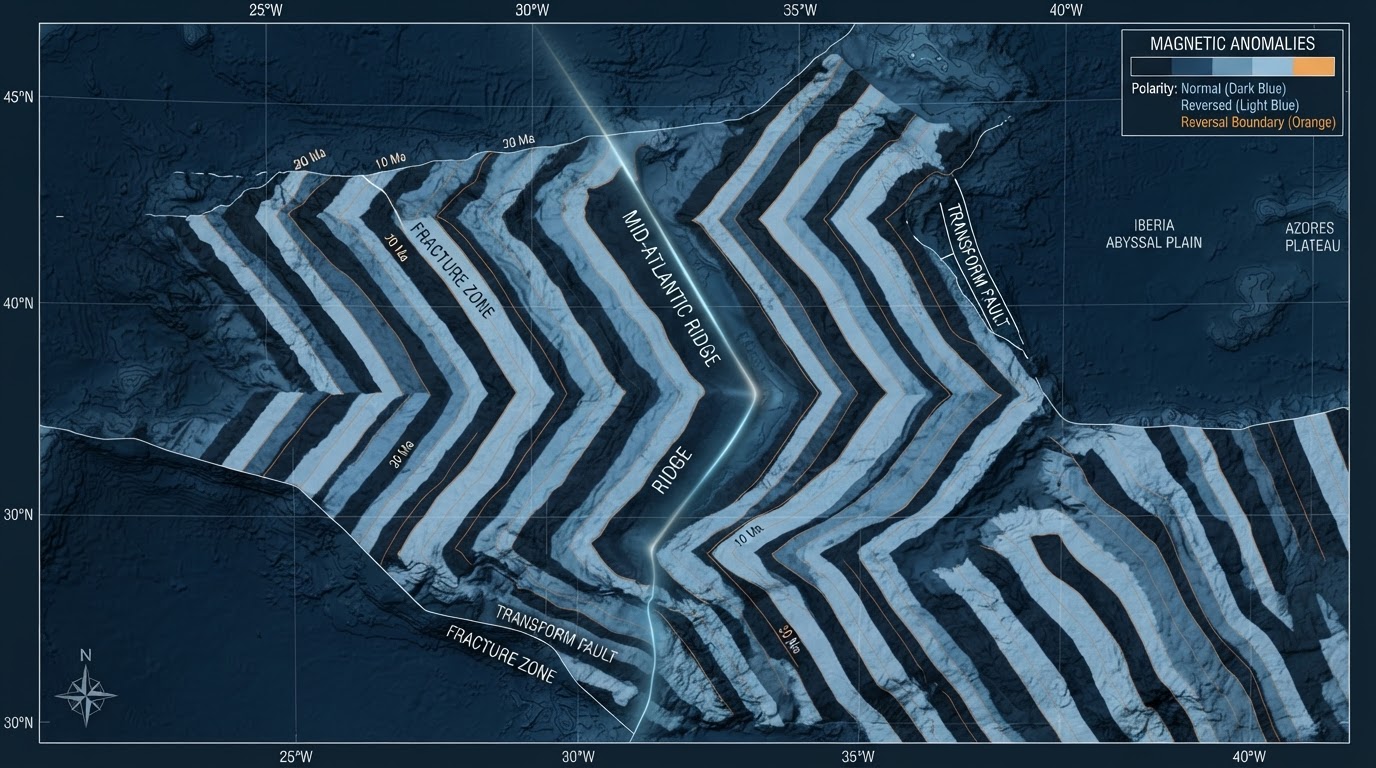
Here's the genuinely strange part: Earth's magnetic field has flipped completely — north becoming south, south becoming north — hundreds of times in the planet's history. We know this because when lava cools and solidifies, iron-bearing minerals freeze in alignment with whatever the field was doing at that moment. The seafloor is essentially a tape recording of millions of years of magnetic reversals, and it's how the theory of plate tectonics got its strongest early confirmation.
The last full reversal, called the Brunhes-Matuyama reversal, happened roughly 780,000 years ago. Before that, reversals occurred on average every few hundred thousand years — though the timing is irregular enough that 'average' is almost meaningless here. Some reversals happened in quick succession; others were separated by millions of years.
During a reversal, the field doesn't simply flip like a switch. It weakens significantly, becomes chaotic and multi-polar for a period that may last thousands of years, then reorganizes with the opposite polarity. The field during that transition would provide less protection from cosmic radiation — but the evidence from past reversals doesn't show mass extinction events tied to them. Life adapted. That said, modern infrastructure — power grids, satellites, GPS — didn't exist during the last reversal, so the practical disruption would be in a different category entirely.
A magnetic reversal isn't a catastrophe in geological terms. In terms of 21st-century infrastructure, it would be a stress test unlike anything we've ever engineered for.
Why Earth's Changing Magnetic Field Matters to You Right Now
Navigation, Aviation, and the World Magnetic Model
NOAA and the British Geological Survey jointly maintain the World Magnetic Model — a mathematical model of the field that gets updated every five years. It's baked into the navigation systems of smartphones, aircraft, ships, and military equipment. When the pole started accelerating in the late 1990s, the model had to be updated ahead of schedule in 2019 because the drift was outpacing the standard update cycle. That's not a dramatic headline, but it's a real operational consequence.
Airport runways are named by their magnetic compass heading, rounded to the nearest ten degrees. As the magnetic pole drifts, those headings shift — and runways occasionally need to be renamed. Tampa International Airport famously had to rename its runways in 2011 for exactly this reason. It's a mundane but concrete example of how a geophysical process shows up in daily infrastructure.
Animal Navigation and Biological Compasses
Many animals — migratory birds, sea turtles, salmon, some sharks — use Earth's magnetic field for navigation. Research suggests they have biological mechanisms sensitive to field intensity and inclination angle, not just direction. As the field shifts, the 'magnetic map' those animals rely on shifts with it. Whether gradual drift causes meaningful disruption to migration patterns is an active area of research, and the honest answer is that scientists don't fully know yet.
(Opinion: The animal navigation angle tends to get buried under the more dramatic reversal storyline, but it's arguably the more immediate and underappreciated consequence of field change. A species that evolved over millions of years to read a magnetic map that's now moving faster than it ever has in recorded history seems like a reasonable thing to pay attention to.)

Frequently Asked Questions
Is the magnetic pole the same as the geographic North Pole?
No — they're two different things. The geographic North Pole is the fixed point where Earth's rotational axis meets the surface. The magnetic north pole is where the field lines point straight down, and it moves continuously based on activity in the outer core. Right now they're several hundred kilometers apart, and that gap changes every year.
Could a magnetic reversal happen in our lifetime?
It's possible but considered unlikely in the near term. Some researchers have pointed to the weakening field and the South Atlantic Anomaly as potential early signs, but the scientific consensus is that we're not in the early stages of an imminent reversal — just normal long-term variation. Reversals typically unfold over thousands of years, not decades.
Does the weakening magnetic field mean we're losing our atmosphere?
Not on any human timescale. Atmospheric loss driven by solar wind is an extremely slow process measured over hundreds of millions of years. Even during past reversals, when the field was significantly weaker, Earth didn't lose its atmosphere. The concern is more about increased radiation exposure for satellites and high-altitude flights than any existential atmospheric threat.
The most unsettling thing about Earth's magnetic field isn't that it might flip — it's that it's already changing faster than our models expected, and the systems we've built that depend on it were designed for a more stable world. A compass needle pointing slightly wrong is a minor inconvenience. A GPS network, a power grid, and a global aviation system all calibrated to a field that's moving faster than anticipated is a different kind of problem — one that engineers are already quietly managing, one update cycle at a time.



Comments
Post a Comment